Australian Journal of Crop Science
Article | https://doi.org/10.21475/ajcs.26.20.09.pne80
Submitted: 19 July 2025 | Revised: 31 October 2025 | Accepted: 30 April 2026
Pages 689-699
Quality of coffea canephora seedlings: influence of genotype, auxin and time of orthotropic branches collection
Hérica Chisté1, Vinicius de Souza Oliveira2,3,*, Jeane Crasque2, Wilgner Fernandes Paradizo3, Johnatan Jair de Paula Marchiori2, Simone Alves Fernandes3,4, Lúcio de Oliveira Arantes3, Edilson Romais Schmildt1, José Altino Machado Filho3, Ana Júlia Câmara Jeveaux-Machado2, Carla da Silva Dias3, Sara Dousseau-Arantes1,2,3,*
1Federal University of Espírito Santo, North University Center of Espírito Santo, São Mateus, ES -Brazil
2Federal University of Espírito Santo- Center for Human and Natural Sciences, Vitória, Espírito Santo, Brazil
3Capixaba Institute of Research, Technical Assistance and Rural Extension, Linhares, ES, Brazil.
4Homeoplant, Pinheiros, ES-Brazil
*Corresponding author: souzaoliveiravini@gmail.com; saradousseau@gmail.com
Abstract: The quality of conilon coffee seedlings produced is influenced by genetic variability among clones, the time of cutting collection, and the low concentration of endogenous auxin. The objective of this study was to evaluate the quality of seedlings of five conilon coffee genotypes produced by vegetative propagation through orthotropic branches (cuttings) with different concentrations of auxin (indole-3-butyric acid - IBA) and different times of cutting collection. The experiment was conducted in a nursery in the municipality of Linhares, Espírito Santo state, Brazil, in a randomized block design. The experiment consisted of five conilon coffee genotypes (A1, LB1, 143, 02, and 748) and concentrations of indole-3-butyric acid (IBA: 0, 500, 1000, 1500, and 2000 mg L⁻¹) and two cutting collection periods, summer (December) and winter (June). The cutting collection period played a crucial role in seedling bud formation, with cuttings collected in winter (June) showing a 72% reduction in bud formation in genotype 748. Genotype 143 exhibited limited bud development, regardless of the collection period. IBA was effective in improving the performance of cuttings collected in summer, especially at a dose of 959 mg L⁻¹. The results demonstrate the importance of the conilon coffee genotype and the cutting collection period in seedling quality. Furthermore, the proper use of IBA can be an advantageous strategy to promote seedling growth, especially for genotypes with lower vigor.
Keywords: Conilon coffee; Indolebutyric acid; Propagation.
Abbreviations: CDM_ cutting dry mass; DMAP_ dry mass of the aerial part; DMAP/RDM_ ratio of the dry mass of the aerial part and root dry mass; DMLC_ dry mass of the leaf of cutting; DQI_ Dickson quality index; IBA_ indole-3-butyric acid; LA_ leaf area; LAC_ leaf area of the cutting; LDM_ leaf dry mass; NL_ number of leaf; NLC_ number of the leaf on cutting; NS_ number of sprouts; RDM_ root dry mass; RL_ root length; SD_ stem diameter; SDM_ stem dry mass; SL_ stem length; SL/SD_ ratio of the stem lenght and stem diameter; SPAD_ Spad index; TDM_ total dry mass.
Introduction
Brazil is the world's largest producer and exporter of coffee (FAO, 2021), with cultivation concentrated mainly in the Southeast region. Conilon coffee (Coffea canephora Pierre ex A. Froehner) is present in 85% of the municipalities of Espírito Santo, with productivity higher than the national average and equivalent to the best in the world, around 50 bags per hectare.
The genetic variability between Conilon coffee clones has been documented in the field, with studies suggesting that a more vigorous root system allows for greater productivity (Silva et al., 2020). The genotype plays a fundamental role in the rooting capacity and quality of Conilon coffee clones (Priyono et al., 2010). However, strategies to optimize the performance of less vigorous clones still need to be developed.
The season and weather conditions in which cuttings are taken also significantly influence rooting and seedling quality, especially when cuttings are not taken from properly managed clonal gardens.
The production period for Conilon coffee seedlings varies from four to five months, and the time for removing the seedlings is defined according to the planting season. Planting in the rainy season (September to December) is preferred by farmers in Espírito Santo, as it allows the harvest to be brought forward by up to 6 months (Fonseca et al., 2017). Therefore, for planting in the rainy season, seedlings must be collected from the clonal garden between April and August.
In Brazil, Conilon coffee is propagated mainly by cuttings, a technique advocated in the mid-1980s by Paulino (Paulino et al.,1985). The technical recommendation is to take cuttings from stock plants grown in clonal gardens, however, many farmers and nurseries use their commercial plantations and shoot pruning practices to obtain propagation material, resulting in physiologically exhausted cuttings. Although farmers and nurseries report reductions of more than 30% in rooting and a high incidence of flowering in cuttings collected during the winter, no studies were found that characterized this effect.
The variability between clones and seasonal difficulties can be attributed to the low concentration and/or sensitivity to auxins, a fundamental hormonal class in the formation of adventitious roots (Rasmussen et al., 2015). In this context, the application of growth regulators such as auxins could improve the development of seedlings during winter, when there is greater demand for seedlings in Espírito Santo.
Indole-3-butyric acid (IBA) is the main growth regulator of the auxin class used to stimulate adventitious rooting in cuttings of different species (Frick and Strader, 2018). However, its effect on Conilon coffee seedlings is not yet well known, especially how the dose interacts with the genotype and the environment. Recent studies carried out in Indonesia (Pujaningrum and Simanjuntak, 2020) indicate that for Conilon coffee the dose of IBA applied to the seedlings should be lower, with ideal values between 100 and 150 ppm, but the Brazilian genotypes have not yet been characterized. The effect of IBA on Conilon coffee genotypes grown in Brazil is still unknown.
In this context, the ideal dose of auxin will depend on the genotype and may lead to better development of seedlings during winter, when there is greater demand for seedlings in Espírito Santo. Therefore, the aim of this study was to evaluate the interaction between different auxin concentrations on the quality of seedlings of five Conilon coffee genotypes collected in summer and winter.
Results and discussion
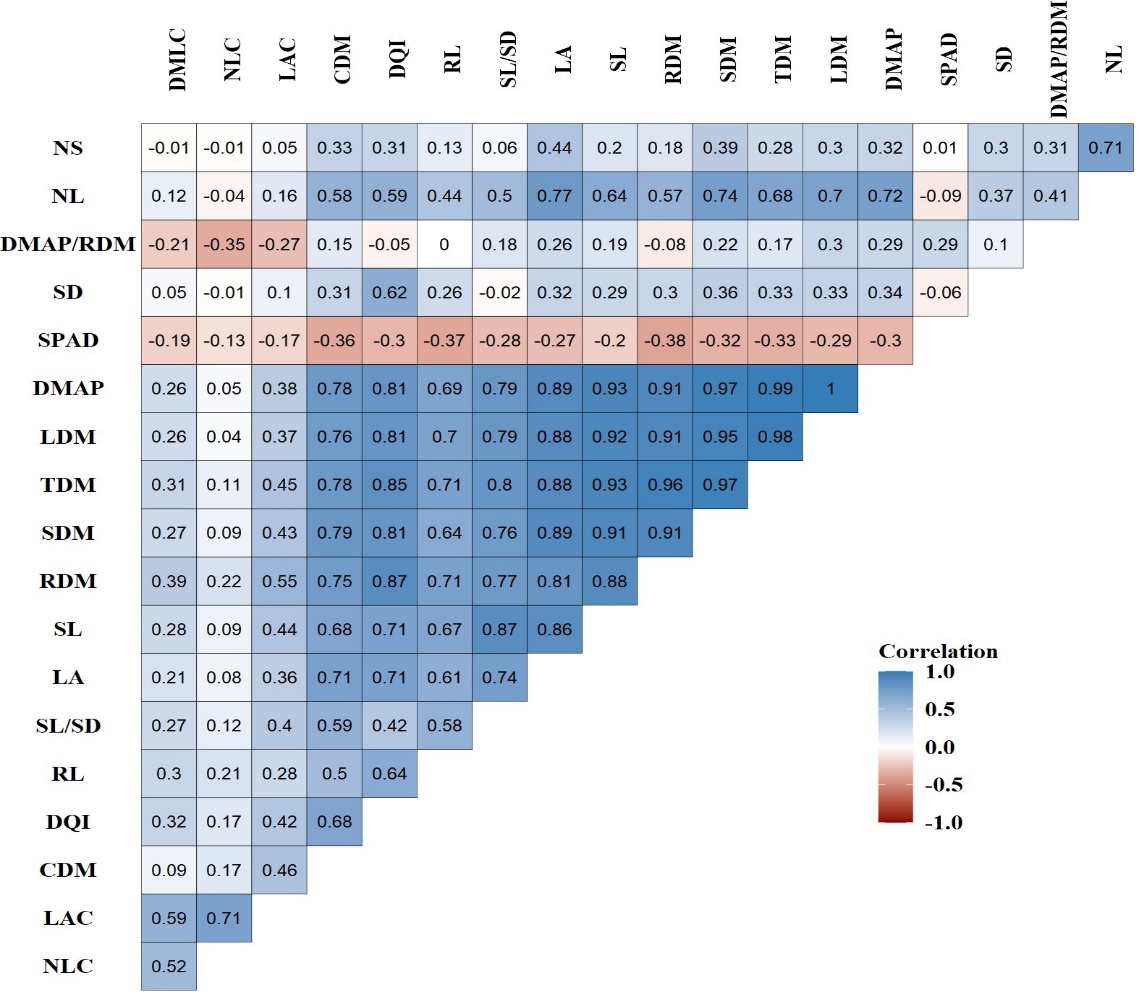
The results of correlation analyses are presented in Figure 1, providing an overview of the degree of relationship among the set of phytotechnical variables of seedlings from the five genotypes of Coffea canephora (143, 02, 748, A1, and LB1) subjected to five concentrations of Indole-3-butyric acid (IBA) (0, 500, 1000, 1500, and 2000 ppm) in two seasons of the year (summer and winter). Positive linear correlation was observed for most characteristics. Stem length showed a high positive correlation with aerial part variables (SL, SDM, NL, LA, LDM, and DMAP) and with the accumulation of dry mass in the seedling (TDM). Among the root variables, RDM showed the highest correlation with DQI, LA, SD, and TDM. DQI presented a high correlation with RDM and a moderate correlation with TDM, while SPAD index correlated positively with almost all root and aerial part development variables, albeit less strongly.
As shown in (Figure 1), stem length best expresses the quality of Conilon coffee clone seedlings produced under the influence of seedling harvest time and IBA doses. It was found that the genotype and the time of collection of the cuttings are the most determining factors in the quality of the seedlings. Paulino et al. (1985) had already observed that there is variability in rooting capacity between Conilon varieties, with values ranging from 51% to 99%. However, only strategies such as preparing cuttings and using more suitable containers and substrates were developed to increase rhizogenesis and improve the quality of seedlings (Verdin Filho et al., 2020; Aquino et al., 2017).
The variability in the development of Conilon coffee genotypes was highlighted in seedlings by Covre et al. (2016) and in adult plants in the field by Silva et al. (2020). According to Rodrigues et al. (2017), the development of the aerial part of C. canephora is a good parameter to characterize the variability of clones, and selection should seek genotypes with slower growth. For Silva et al. (2020), the development of the aerial part of Conilon coffee is more under the control of environmental factors, such as temperature and precipitation, while the root system correlates better with productivity.
Stem length was the aerial biometric variable that showed the strongest correlations with most analyzed variables (Figure 1), and the IBA doses had different effects among genotypes in the seasons of cuttings (Figure 2). In the winter, the increase in IBA had a quadratic effect on the development of the stem in the seedlings of genotype 748, showing a 29.40% increase compared to the 0 mg L-1 dose, reaching its highest efficiency at the dose of 726 mg L-1 of IBA, with a length of 6.70 cm. During this season of cutting the cuttings, genotypes 02, A1, and LB1 showed a linear decrease in stem length with increasing IBA doses. Genotype 143 did not show significant statistical results for the polynomial fit.
In the summer, only genotypes 143 and LB1 showed significant polynomial fits (Figure 2). The stem length of genotype 143 exhibited a quadratic behavior, with a maximum efficiency point at 959 mg L-1 of IBA, resulting in a length of 10.31 cm, corresponding to a 17.85% increase compared to the 0 mg L-1 dose. On the other hand, the linear fitting model found for genotype LB1 indicates inhibition of stem length with the addition of IBA.
The season of cutting influenced the aerial part development of the seedlings, but the effect varied among genotypes and interacted with the IBA dose only for stem length (Table 1). Stem length of genotype 143 was not influenced by the season of cuttings, as well as genotype 02, although only in the absence of auxin. Genotypes 748, A1, and LB1 showed significant reduction in stem length in winter, regardless of the auxin concentration. However, in genotype 748, the reductions in stem length in winter were more intense, approximately 72% compared to the 0 mg L-1 dose, 56% at the dose of 500 mg L-1, 69% at the dose of 1000 mg L-1, 73% at the dose of 1500 mg L-1, and 81% at the dose of 2000 mg L-1, compared to the summer.
In summer, it is possible to differentiate the genotypes into three types of behavior: the first, represented by genotype 143, showed shorter stem length, regardless of the IBA dose, LB1 showed optimized growth, and the other genotypes (02, 748 and A1) presented an intermediate response between the first two. When exposed to concentrations of 500, 1,000 and 2,000 mg L-1 of IBA, genotype 143 showed the worst growth performance, while the others showed similar performance. Finally,
Fig. 1. Correlogram between analyzed variables of seedlings from different genotypes of Conilon Coffee under increasing doses of IBA and conducted in distinct seasons. Legend: LDM - leaf dry mass, SDM - stem dry mass, DMAP - dry mass of the aerial part, RDM - root dry mass, TDM - total dry mass, CDM - cutting dry mass, DMLC - dry mass of the leaf of cutting, NL - number of leaf, SPAD - Spad index, NLC - number of the leaf on cutting, LA - leaf area, LAC - leaf area of the cutting, SL - stem lenght, SD - stem diameter, RL - root lenght, NS - number of sprouts, SL/SD - ratio of the stem lenght and stem diameter, DMAP/RDM - ratio of the dry mass of the aerial part and root dry mass, DQI - Dickson quality index.
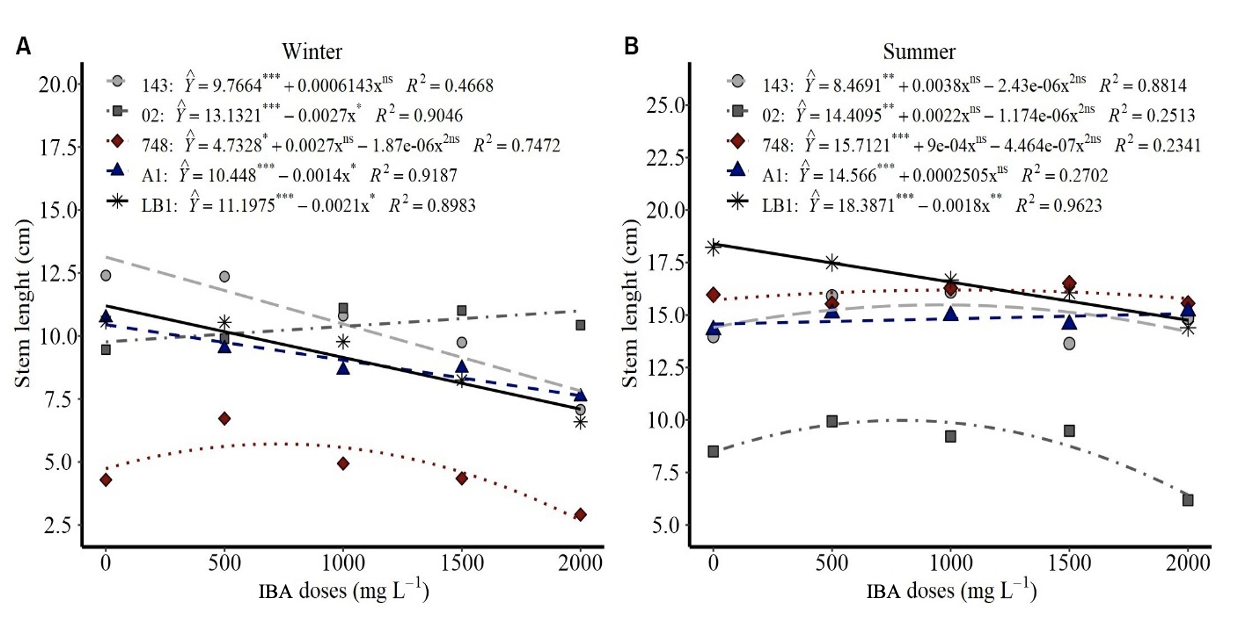
Fig. 2. Effect of increasing doses of IBA on stem length of seedlings from different genotypes of Conilon coffee (143, 02, 748, A1, and LB1) produced in winter (A) and summer (B); (ns: non-significant coefficient at p ≤ 0.05 level of probability).
at a dose of 1,500 mg L-1 of IBA, the genotypes differentiated again, with higher values for genotypes 748 and LB1, followed by A1 and 02 with intermediate values, and 143 with lower values.
Cuttings harvested in winter showed lower shoot formation capacity (lower SL, NL, LA and dry mass) and the intensity of the reduction depends on the genotype (Figure 2). Genotype 748 showed the smallest reduction in stem length in cuttings collected in winter, reaching a reduction of 72% compared to summer, while 143 showed reduced vigor and was indifferent to the season (Table 1). The low temperatures recorded during this period, with minimum temperatures ranging from 24 to 13 °C (Figure 1) probably contributed to the reduction in the development of these seedlings. Studies carried out in the area by Martins et al. (2020) showed that temperatures below 13 °C reduce the growth of orthotropic and plagiotropic branches of Conilon coffee, but the intensity depends on the genotype.
The developmental stage of the coffee mother plant may also have been a factor that contributed to the reduced vigor of seedlings obtained from cuttings in winter. At this time the fruits had already been harvested and the cuttings did not have visible flowers, but the orthotropic branches collected in winter were at the end of the adult vegetative phase, and some even flowered in the nursery, which were discarded. However, flowering-inducing signals were already transmitted in the branches of plants in the field and vegetative vigor decreased.
No studies were found on the rooting of Conilon coffee cuttings with different physiological ages, but evidence supports the effect of chronological age. In the work of Giuriatto Júnior et al. (2020), growth curves of 'Robusta' coffee seedlings were evaluated from cuttings with different chronological ages obtained from 150-day-old orthotropic stems, with the middle part (3rd and 4th nodes) appearing more vigorous. However, in studies by Simanjuntak and Wardani (2021) carried out in Indonesia, cuttings from the second node develop better roots and aerial parts. The divergence of results cannot be explained solely by the chronology of the cutting, whose inhibitory effect on the bases and apical of the cutting is attributed to the degree of lignification and loss of turgidity, respectively. In this case, the genotype and phenological stage of the mother plants are decisive.
The reduction in rooting capacity in cuttings in the reproductive phase is attributed to changes in auxin homeostasis, significantly reducing the pool of indole-3-acetic acid (IAA) at the base of the cutting (Rasmussen et al., 2015). The formation of adventitious roots is a process that involves an integrated network of phytohormones in coordination with the environment, but IAA, the main auxin produced by plants, plays a central role (Lakehal and Bellini, 2019).
The increase in IBA doses promoted a linear decrease in most of the biometric variables that express shoot development (NL, LA, LDM, SDM and DMAP) (Figure 3).
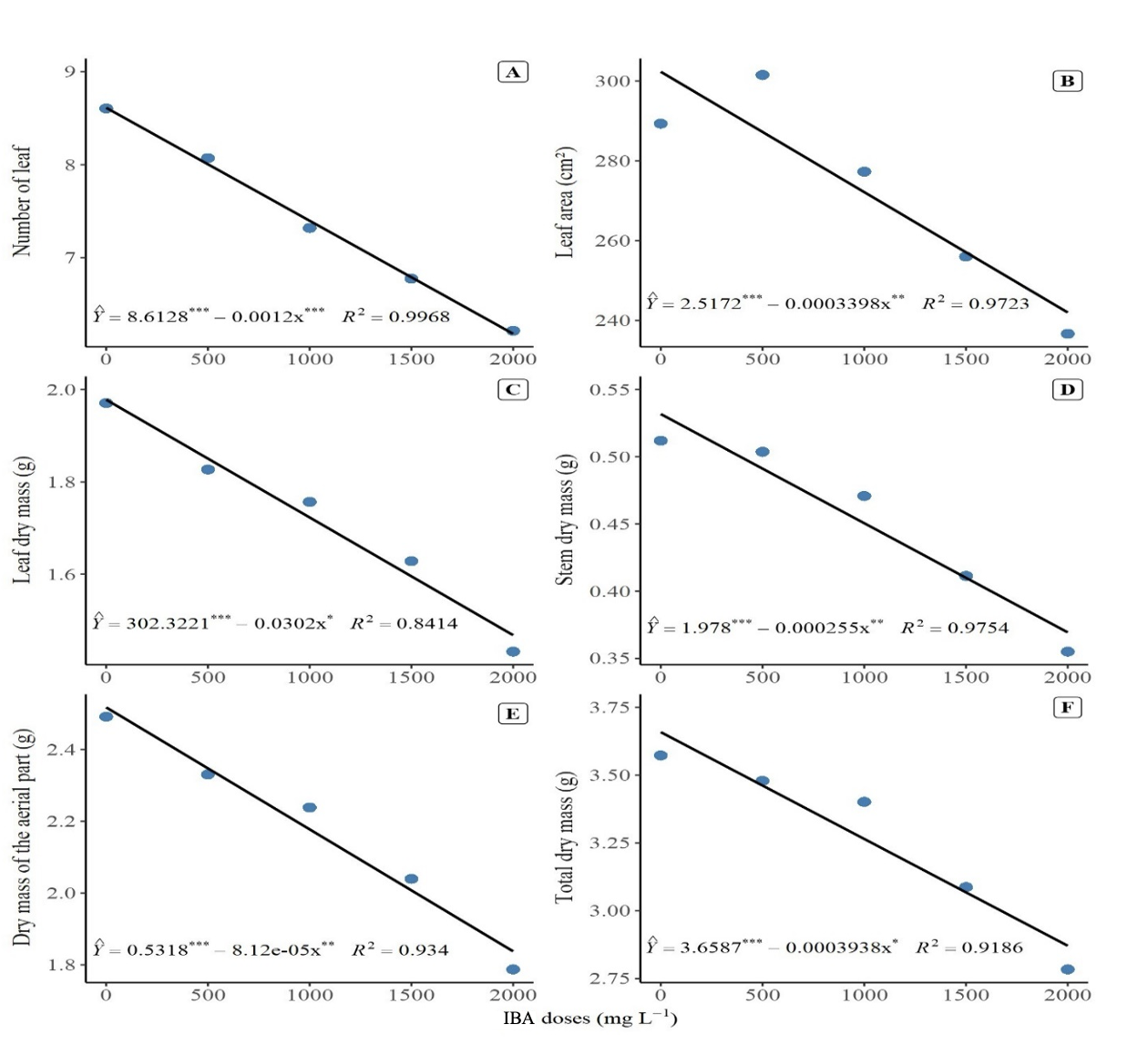
Fig. 3. Isolated effect of IBA doses on biometric variables expressing the development of Conilon coffee seedlings from different genotypes (143, 02, 748, A1, and LB1), produced in winter and summer. A - number of leaves, B - leaf area, C - leaf dry mass, D - stem dry mass, E - shoot dry mass, F - total dry mass (** significant coefficient at p ≤ 0.05 level of probability).
Table 1. Stem length of seedlings from Conilon coffee genotypes (143, 02, 748, A1, and LB1) obtained from cuttings collected in winter and summer and treated with increasing doses of indole-3-butyric acid (IBA).
| Seasons | IBA (mg L-1) |
Genotype of coffee Conilon | ||||
|---|---|---|---|---|---|---|
| 143 | 2 | 748 | A1 | LB1 | ||
| Summer | 0 | 8.5 aC | 13.9 aB | 15.9 aB | 14.3 aB | 18.2 aA |
| 500 | 9.9 aB | 15.9 aA | 15.5 aA | 15.1 aA | 17.5 aA | |
| 1000 | 9.2 aB | 16.1 aA | 16.3 aA | 14.9 aA | 16.7 aA | |
| 1500 | 9.5 aC | 13.6 aB | 16.5 aA | 14.6 aB | 16.1 aA | |
| 2000 | 6.2 aB | 14.8 aA | 15.5 aA | 15.2 aA | 14.4 aA | |
| Winter | 0 | 9.5 aA | 12.4 aA | 4.3 bB | 10.7 bA | 10.6 bA |
| 500 | 9.9 aA | 12.4 bA | 6.7 bB | 9.5 bA | 10.5 bA | |
| 1000 | 11.1 aA | 10.8 bA | 4.9 bB | 8.6 bA | 9.8 bA | |
| 1500 | 11.0 aA | 9.7 bA | 4.3 bB | 8.7 bA | 8.2 bA | |
| 2000 | 10.4 aA | 7.1 bB | 2.9 bC | 7.6 bB | 6.6 bB | |
| CV 1 | 14.05 % | |||||
| CV 2 | 14.14 % | |||||
* Means followed by the same letter do not differ statistically from each other by the Scott-Knott grouping test at 5% probability. Lowercase letters compare the seasons, and uppercase letters compare the genotypes, both within each IBA concentration.
The formation of the aerial part was inhibited and the seedlings had a linear decrease in the number of leaves, leaf area and accumulation of dry mass of the stem and leaves (Figure 3). The effect of IBA on Brazilian genotypes is still unknown; however, studies carried out in Indonesia by Pujaningrum and Simanjuntak (2020) indicated a dose of 100 ppm for shoot development and 150 ppm for the root.
The response to IBA in shoot length depends on each genotype (Figure 2, Table 1), with this differential induction being reflected in the root/shoot ratio (Figure 4). The most vigorous genotypes were inhibited, while those with the worst performance were optimized, suggesting that vegetative vigor is related to sensitivity to IBA. Furthermore, genotypes have different maturation periods, which are related to the genetic development program, thus affecting phenology and response to IBA.
It is evident that there is a strong linear relationship between RDM and biometric variables of the aerial part (LA, SL, DMAP), root (RL), and seedling development, represented by DQI and TDM (Figure 1). Furthermore, the SL/RL ratio was influenced by the triple interaction (Figure 4).
The application of IBA in the cuttings of genotypes 02, A1, and LB1, collected from branches that developed in winter, resulted in a linear decrease in the ratio between the length of the stem and the root. However, in summer, only LB1 maintained inhibition (Figure 4). Genotype 143 did not exhibit behavior that fit the tested polynomial model in the winter season. Nevertheless, in summer, the estimated dose for the maximum point (770 mg L-1) promoted a SL/RL ratio of 0.47, corresponding to a 12.77% increase compared to the dose of 0 mg L-1. Genotype 748 showed a linear increase in the summer season, while in winter, the dose of 540 mg L-1 promoted a SL/RL ratio of 0.76, corresponding to a 59.21% increase compared to the dose of 0 mg L-1.
Genotypes A1 and 02 showed a lower response to IBA doses when the cuttings were collected in the summer, indicating reduced sensitivity to the growth regulator. The fit to the regression model was low; however, genotype 02 appears to show an increase in stem length at a dose of 1123 mg L-1, while for A1 the increase was linear. These genotypes mature early and were registered by the Capixaba Institute for Research, Technical Assistance and Rural Extension.
A interaction between season and genotype was significant for variables expressing the development of the aerial part (SDM, CDM, NL, LA, LDM, NS, DMAP, SPAD index), root (RL, RDM), and the whole seedling (TDM and DQI). The effect of this interaction on the development of the aerial part was similar among the clones (Table 2).
The seedlings obtained from cuttings collected in winter have lower shoot development for all genotypes, except 143, which was indifferent (Table 2). In both summer and winter, the genotypes formed four groups for NL and three for LA and DMAP, but the ranking varied between the cutting seasons. Genotype A1 had the highest NL and LA in both seasons, while 748 only had the lowest values among the genotypes in winter.
In winter, A1 stood out for having the highest number of leaves and leaf area, followed by genotypes 143 and 02, and then LB1 and 748, which are significantly different. The leaf area of all genotypes expanded during the summer season, whereas the opposite occurred during winter, with significant additions mainly in the seedlings of genotype 748, approximately 323%, followed by LB1 with 101%, A1 with 77%, 02 with 41%, and 143 with 4%.
In summer, genotype 748 outperformed the other genetic materials in terms of an increase in NL, with an 84% increase, followed by LB1 with 31%, A1 with 28%, and 02 with 15%, where NL increased in summer and decreased in winter, except for genotype 143, which had a 6% increase in winter and a decrease in summer.
During the winter season, genotype 02 had the highest DMAP accumulation, followed by the intermediate genotypes (143, A1, and LB1), and the lowest accumulation was represented by 748 and the other genotype. In summer, the highest DMAP accumulation was observed in genotypes 748, A1, and LB1, the lowest in 143, and intermediate values in 02.
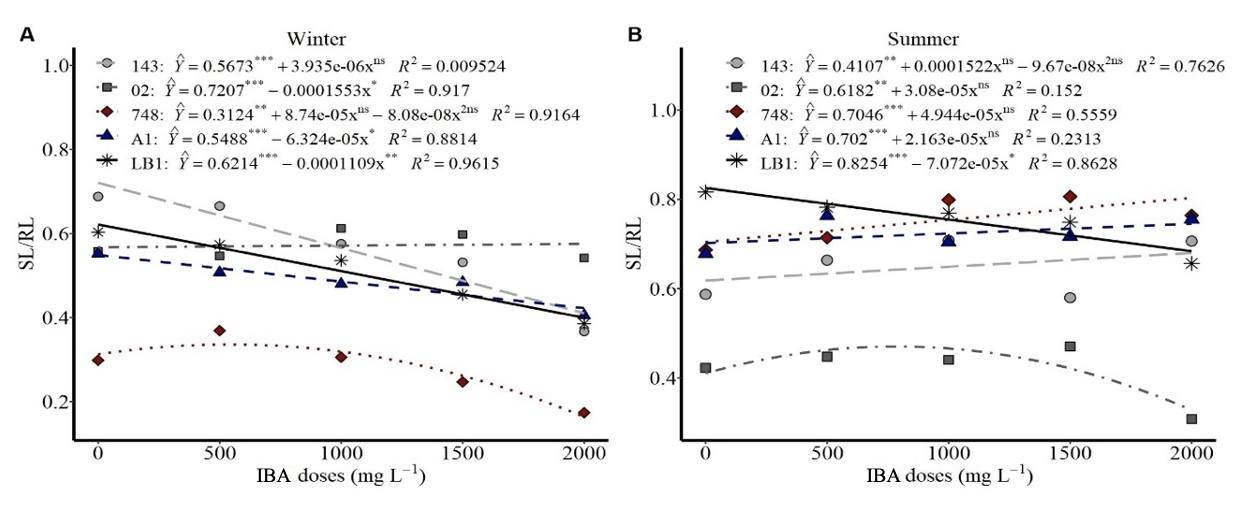
Fig. 4. Effect of increasing doses of IBA on the aerial part to root dry mass ratio of seedlings from different genotypes of Conilon coffee (143, 02, 748, A1, and LB1), produced in winter (A) and summer (B); (ns: non-significant coefficient at p ≤ 0.05 level of probability).
Table 2. Aerial part development of Conilon coffee genotypes (143, 02, 748, A1, and LB1) obtained from cuttings collected in winter and summer and treated with increasing doses of indole-3-butyric acid (IBA), expressed by the number of leaves (NL), leaf area (LA), and shoot dry mass (DMAP).
| Genotype | NL | LA (cm²) | DMAP (g) | |||
|---|---|---|---|---|---|---|
| Winter | Summer | Winter | Summer | Winter | Summer | |
| 143 | 7.06 aB | 6.61 aD | 226.91 aA | 237.35 aC | 1.68 aB | 1.89 aC |
| 02 | 7.07 bB | 8.17 aB | 235.29 bA | 333.39 aB | 1.95 bA | 2.85 aB |
| 748 | 4.53 bD | 8.36 aB | 89.71 bC | 379.50 aB | 0.70 bC | 3.12 aA |
| A1 | 8.39 bA | 10.82 aA | 246.97 bA | 438.98 aA | 1.69 bB | 3.22 aA |
| LB1 | 5.58 bC | 7.34 aC | 177.16 bB | 356.32 aB | 1.43 bB | 3.20 aA |
| CV1 | 13.26 % | 20.56 % | 18.21 % | |||
| CV2 | 13.72 % | 21.53 % | 18.92 % | |||
*Means followed by the same letter do not differ statistically from each other by the Skott-Knott grouping test at 5% probability. Lowercase letters compare the seasons (rows) and uppercase letters compare the genotypes (columns).
The season of the year in which the cuttings are collected influenced the length and accumulation of root dry mass (Table 3). The seedlings produced in summer showed a greater RL in relation to winter for all genotypes. The genotypes showed two types of behavior for root growth during winter, one with the smallest measurements (748) and another with vigorous growth. However, in summer, genotype 02 stood out in terms of root length, followed by LB1, while genotypes A1, 143, and 748 had similar metrics.
Genotype 748 had the greatest increase in root length in summer, about 28%, almost three times the growth of A1, which increased only 10% of its root system. LB1 and 02 had root increases of 22% and 23% respectively, where there was an increase in root length in summer and a decrease in winter, for both genotypes.
The accumulation of root dry mass (RDM) was higher in summer compared to winter for all genotypes, except 143, which did not differ between seasons (Table 3). In winter, genotype 02 had the highest RDM accumulation, followed by the intermediate genotypes (A1, LB1, and 143), and 748 had the lowest value. In summer, the highest RDM accumulation was observed in genotypes A1, LB1, and 748, followed by 02 and 143, with the lowest value.
The accumulation of total dry mass in the seedling (TDM), the SPAD index, and DQI varied according to genotype and the season of cutting collection (Table 4). The genotypes formed three groups in both summer and winter, but in summer, the accumulation of total dry mass in the seedling (TDM) was higher for all genotypes, except 143, which did not differ between seasons. In winter, the highest TDM accumulation was observed in genotype 02, followed by the intermediate genotypes (143, A1, and LB1), and 748 had the lowest accumulation. In summer, the highest DMAP and TDM accumulation was observed in genotypes 748, A1, and LB1, the lowest in 143, and intermediate values in 02.
Among the variables related to seedling quality, the SPAD index was more efficient in discriminating the vigor of the genotypes in winter than the accumulation of TDM and DQI (Table 4). The increase in DMAP in summer and decrease in winter was more pronounced in 748, with a gain of 345%, followed by LB1 with 123%, A1 with 90%, 02 with 46%, and 143 with 12%. The increase in RDM was also more significant in 748, with a gain of 278%, followed by LB1 with 140%, A1 with 92%, 02 with 75%, and 143 with 9%. The increase in TDM was most noticeable in 748, with a gain of 320%, followed by LB1 with 128%, A1 with 92%, 02 with 53%, and 143 with 11.5%.
Table 3. Root development of Conilon coffee genotypes (143, 02, 748, A1, and LB1) obtained from cuttings collected in winter and summer and treated with increasing doses of indole-3-butyric acid (IBA), expressed by root length (RL) and total root dry mass (RDM).
| Genotype | RL (cm) | RDM (g) | ||
|---|---|---|---|---|
| Winter | Summer | Winter | Summer | |
| 143 | 18.15 bA | 20.70 aC | 1.68 aB | 1.89 aC |
| 02 | 18.59 bA | 23.03 aA | 1.95 bA | 2.85 aB |
| 748 | 16.62 bB | 21.30 aC | 0.70 bC | 3.12 aA |
| A1 | 18.68 bA | 20.55 aC | 1.69 bB | 3.22 aA |
| LB1 | 17.88 bA | 21.95 aB | 1.43 bB | 3.20 aA |
| CV1 | 8.30 % | 18.27 % | ||
| CV2 | 7.60 % | 17.79 % | ||
*Means followed by the same letter do not differ statistically from each other by the Skott-Knott grouping test at 5% probability. Lowercase letters compare the seasons, and uppercase letters compare the genotypes.
Table 4. Seedling development of Conilon coffee genotypes (143, 02, 748, A1, and LB1) obtained from cuttings collected in winter and summer and treated with increasing doses of indole-3-butyric acid (IBA), expressed by total dry mass (TDM), SPAD, and Dickson's Quality Index (DQI).
| Genotype | TDM (g) | SPAD | DQI | |||
|---|---|---|---|---|---|---|
| Winter | Summer | Winter | Summer | Winter | Summer | |
| 143 | 2.53 aA | 2.82 aC | 45.12 aB | 35.49 bB | 0.523 bA | 0.636 aB |
| 02 | 2.79 bA | 4.29 aB | 48.25 aA | 36.17 bB | 0.597 bA | 0.771 aA |
| 748 | 1.12 bB | 4.71 aA | 39.21 aC | 36.00 bB | 0.349 bB | 0.805 aA |
| A1 | 2.42 bA | 4.75 aA | 49.50 aA | 36.97 bB | 0.520 bA | 0.906 aA |
| LB1 | 2.19 bA | 5.00 aA | 50.77 aA | 41.17 bA | 0.585 bA | 0.879 aA |
| CV1 | 17.25 % | 9.36 % | 21.14 % | |||
| CV2 | 17.46 % | 8.50 % | 21.26 % | |||
*Lowercase letters compare the seasons, and uppercase letters compare the genotypes. Means followed by the same letter do not differ statistically from each other by the Skott-Knott grouping test at 5% probability.
The results of the present work demonstrated that the application of IBA allows improving the performance of less vigorous genotypes (genotype 143) and/or very sensitive to low temperatures (genotype 748), although sensitivity varies according to the season of the year. The formation of the aerial part of genotype 748 seedlings is inhibited by 72% in cuttings collected in winter, and the dose of 726 mg L-1 of IBA promoted a 29.40% increase in stem length (Figure 2). In summer, genotype 748 is vigorous and its sensitivity to IBA decreased, with poor adjustment to the quadratic equation and an apparent increase in stem length at a dose of 1035 mg L-1. Genotype 748 has not yet been included in the clonal varieties due to difficulties in forming seedlings (Volpi, 2017).
Genotype 143 showed the lowest vegetative development and was indifferent to the cuttings collection time. However, it was identified that the dose of 959 mg L-1 promoted an increase in stem length in summer; conversely, in winter, the increase was gradual and the adjustment to the equation was low, demonstrating less sensitivity in this period. Genotype 143 belongs to the EMCAPA 8131 clonal variety with a late maturation cycle, and fruit maturation is completed in July/August (Bragança et al., 2001).
It was also found that cuttings from early maturing genotypes (02 and A1) and intermediate maturing genotypes (LB1 and 748) are more sensitive to IBA in winter, while the opposite occurs for the late maturing genotype (143).
The lower quality of seedlings from cuttings collected in winter and the difference in the rooting potential of clones belonging to the recommended varieties raise three important questions. The first is the choice of the cultivar most adapted to each region and management, a crucial decision for planning the entire agricultural production system. However, many farmers in Espírito Santo do exactly the opposite, and the choice of cultivar is based more on empirical observations of third-party plantations than on the search for materials registered with the Ministry of Agriculture, Livestock and Supply. Thus, years of research are ignored and many clones without scientific validation are cultivated, increasing the vulnerability of the production system. In this sense, the implementation of actions promoted by the government is essential.
The second observation is that cuttings should not be taken from juvenile adult plants during winter, especially during the flowering or fruiting phases of productive crops. Planting planning must be done in advance so that the plants can be managed to collect seedlings. Choosing some mother plants from the plantation for drastic pruning close to the base to obtain physiologically younger branches is an interesting strategy.
Another strategy is the maintenance of properly managed clonal gardens to obtain seedlings in the vegetative stage when farmers need to plant. Volpi et al. (2017) make an important contribution to obtaining quality seedlings by adapting the super-dense clonal garden technique, recommended for eucalyptus, to Conilon coffee. In this technique, 31,250 plants ha-1 are cultivated, and after 90 days the bending is carried out, followed by disbudding after 45 days, selecting four vigorous branches. After 7 months of planting, 400 thousand seedlings ha-1 are harvested; then, new thinning is carried out and eight shoots are selected, stabilizing after the fifth removal at around 1.5 million seedlings per ha.
The work demonstrated that the use of IBA is an important strategy for reinvigorating low-performing clones. The loss of responsiveness to IBA was evident according to the time of collection of cuttings and the response depended on the genotype and stage of development of the mother plant, highlighting the importance of maintaining clonal gardens. However, the inhibitory effect of the aerial part of Conilon coffee clones needs to be further investigated, as well as evaluating other hormonal manipulation strategies, such as the inhibition of strigolactones, an emerging inhibitor of adventitious rooting. Furthermore, it is necessary to deepen the understanding of how the phenological cycle affects the rooting of Conilon coffee to develop more efficient propagation techniques.
Material and methods
Characterization of mother plants and cutting collection
Five genotypes of C. canephora from the genetic improvement program of the Capixaba Institute for Research, Technical Assistance and Rural Extension (02, A1, LB1, 748, and 143) were selected based on distinct characteristics regarding rooting potential (empirical observations). The cuttings were collected from mother plants at the Conilon Coffee Clonal Garden of Capixaba Institute for Research, Technical Assistance and Rural Extension, located at Fazenda Experimental de Marilândia in the Northwest region of the State of Espírito Santo, in the municipality of Marilândia (latitude 19°24'25, longitude 40°32'40). The mother plants were established in 2010 in Dystrophic Red-Yellow Latosol soil, with a gentle undulating relief, an average annual precipitation of 1164 mm, and an average annual temperature of 24.2 °C. They were spaced at 3.0 m x 1.0 m and were irrigated during periods of high water deficit. Phytosanitary control was carried out following the management recommendations for Conilon clonal gardens in the state of Espírito Santo, as needed and according to current crop recommendations (Ferrão et al., 2018; Prezotti et al., 2007).
Orthotropic branches were used as propagative material, collected from the basal portion of mother plants in two periods: winter (June 2016) and summer (December 2017). Winter cuttings were taken from orthotropic branches developed at the base of the plants in the reproductive stage, collected immediately after the fifth fruit harvest. Immediately after collecting the winter cuttings, the plants underwent scheduled cycle pruning, consisting of cutting back the orthotropic branches, leaving only one branch. The formed orthotropic branches were collected after 6 months and corresponded to the summer cuttings.
After collecting the orthotropic branches, the plagiotropic branches were removed, and the apical and basal nodes were cut, resulting in orthotropic branches with approximately 6 nodes. In both periods, the cuttings were collected and prepared on cloudy/rainy days, from 8:00 a.m. to 4:00 p.m. On these days, the average temperatures were 21.1 and 25.9 °C, with humidity levels of 85.5% and 86.0%, and precipitation of 0.8 and 23.4 mm, for winter and summer, respectively. The orthotropic branches were placed in moistened burlap bags, transported to Linhares Experimental Farm and kept in a nursery with mist irrigation until the following morning when they were sectioned to obtain the cuttings.
Cutting preparation
The orthotropic branch was sectioned, and whole-node cuttings were individually prepared following the method of Fonseca et al. (2017), but with a straight cut at the base, as adapted by Verdin Filho et al. (2014). During preparation, the cuttings were kept in water in 10 L buckets and subsequently immersed in a fungicidal solution (Carbomax® 500 SC) for 5 min. After draining the excess fungicidal solution, the cuttings were treated with the growth regulator indole-3-butyric acid (IBA).
Treatment with indole-3-butyric acid (IBA)
IBA (≥ 99% (T) Sigma-Aldrich) was dissolved in 0.5 M NaOH, and the bases of the cuttings were immersed half a centimeter deep for 3 hours in 10 mL of the IBA solution containing five concentrations (0, 500, 1000, 1500, and 2000 mg L-1), using 50 mL plastic containers that held 10 to 12 cuttings.
Seedling development
After treatment with IBA, the cuttings were taken to the seedling production nursery, located at Linhares Experimental Farm (latitude 19º25'00.1 S, longitude 40º04'35.3 W) in the northern region of the state of Espírito Santo. The climate is classified as Aw humid tropical with a dry winter (Köppen), and the average annual temperature is 23.8 °C. Regarding its natural zone, it is classified as hot, flat land with a transition between rainy and dry seasons (Zone 8), with average maximum and minimum temperatures for the hottest and coldest month, respectively, of 34 °C and 18 °C, with 6 dry months (Alvares et al., 2013).
The seedling production was carried out for 154 days in both periods, covering the winter (June to November 2016) and summer (December 2016 to May 2017) periods. The nursery environment was characterized in Figure 5 based on monthly data of temperature (minimum, maximum, and average) in °C, rainfall (mm), and relative humidity (%) collected by the automatic Meteorological Station of Linhares/ES and provided by the Department of Technical Operations - Meteorology / Climatology of Capixaba Institute for Research, Technical Assistance and Rural Extension (Incaper, 2017).
The experiment was conducted in a randomized block design, in a split-plot scheme, with a factorial arrangement in the main plot, with four replications. The main plots were composed of five genotypes (A1, LB1, 143, 02 and 748) and concentrations of indole-3-butyric acid (0, 500, 1,000, 1,500 and 2,000 ppm), while the subplots were composed of two
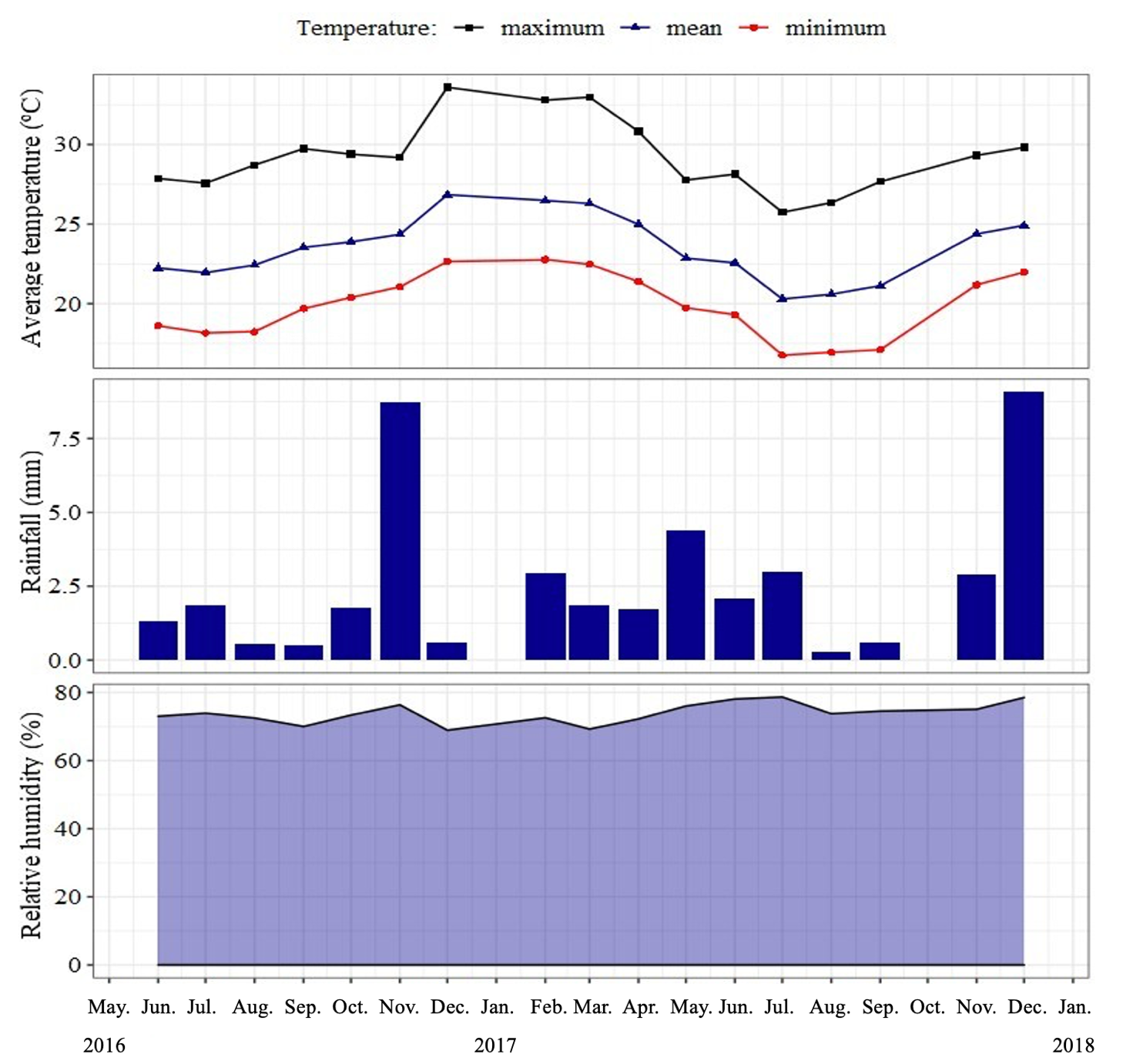
Fig. 5. Rainfall, average values of relative humidity and maximum, mean, and minimum air temperatures recorded at the meteorological station in Linhares-ES, during the period from June 2016 to December 2017. Source: Incaper, 2017.
seasons of collection (summer and winter). Considering the subplots as the smallest experimental units, a total of 200 subplots were used in the experiment, with each subplot containing 14 cuttings.
The cuttings were planted in polypropylene tubes with a top diameter of 5 cm, height of 19 cm, and volume of 280 cm³, containing commercial substrate Bioplant® for seedling production, supplemented with 2 g of Osmocote® and 20% coffee husk straw. The seedlings were kept in a nursery covered with 50% shade netting, with automatic micro sprinkler irrigation during the rooting period (90 days), with 5 seconds of irrigation every 5 minutes. After this period, the irrigation was extended to 5 seconds every 6 minutes.
Biometric analysis
The evaluation of vegetative development was conducted 154 days after the cutting, through biometric measurements and the SPAD index using a chlorophyll meter, Minolta SPAD-502 model. The development of the aerial part was measured by stem length and diameter (SL) and (SD), number of cutting and shoot leaves (NLC) and (NL), leaf area (LA). Stem length was measured using a graduated ruler, from the cutting insertion to the apex, expressed in cm. Stem diameter was measured at the second internode of the orthotropic branch, from bottom to top, using a digital caliper, Zaas 150 mm, expressed in mm. Leaf area was obtained using a LI-COR 3100 meter. Root system development was evaluated by root length (RL), measured using a graduated ruler.
After biometric measurements, the seedlings were divided, placed in paper bags, and dried in a forced-air circulation oven at 65 °C for 15 days. The material was weighed using an analytical balance, QUINTIX3102-10BR model, with a precision of 0.01 g, and the values were expressed in grams of root dry mass (RDM), stem dry mass (SDM), leaf dry mass (LDM), cutting dry mass (CDM), and dry mass the leaf of cutting (DMLC).
With the dry mass results, dry mass of the aerial part (DMAP) was calculated by summing LDM with SDM, and the total dry mass (TDM) was obtained by summing DMAP and RDM. The Dickson Quality Index (DQI) was determined using the growth, development, and dry biomass data in the Dickson equation, where \(DQI = TDM/\lbrack\left( \frac{SL}{SD} \right) + \left( \frac{DMAP}{RDM} \right)\rbrack\) (Dickson et al., 1960). The root-to-shoot ratio \((\frac{RL}{SL})\) and the shoot-to-root ratio \((\frac{DMAP}{RDM})\) were also evaluated.
Statistical analysis
To analyze the linear correlation between the 19 seedling quality variables, the Pearson method was used in the R Core Team software (2022), and the correlation matrix was constructed using the Corrplot package (Wei et al., 2021). The analysis of variance was performed using the statistical program Sisvar version 5.6, Ferreira (2019), and when significant, means were compared using the Scott Knott test at a 5% probability level. Quantitative analyses related to IBA doses by regression were conducted to obtain the polynomial model equations for the growth characteristics of coffee seedlings and determine the effect of IBA in different seasons (winter and summer).
Conclusion
Genotype and the time of cutting collection are the most determining factors for the quality of Conilon coffee seedlings.
Orthotropic branch cuttings collected in winter have a lower capacity for shoot formation. Indole-3-butyric acid (IBA) promotes improvement in the growth of less vigorous genotypes.
Acknowledgments
The authors would like to thank the Espírito Santo State Research Support Foundation (FAPES) for the financial support to carry out this study.
References
Aquino LP, Schmidt R, Dubberstein D, Dias JRM (2017) Seedlings formation of coffee clonal influenced by cuts basal and substrate. Coffee Sci, 12:9-16.
Alvares CA, Stape JL, Sentelhas PC, Moraes JLG, Sparovek G (2013) Köppen's climate classification map for Brazil. Meteorol. Z., 22: 711-728. DOI: 10.1127/0941-2948/2013/0507
Bragança SM, Carvalho CHS, Fonseca AFA, Ferrão RG (2001) Clonal varieties of conilon coffee for the State of Espírito Santo. Pesqui. Agropecu. Bras., 36: 765-770. DOI: 10.1590/S0100-204X2001000500006
Covre AM, Canal L, Partelli FL, Alexandre RS, Ferreira A, Vieira HD (2016) Development of clonal seedlings of promising Conilon coffee (Coffea canephora) genotypes. Aust. J. Crop Sci., 10: 385-392. DOI: 10.21475/ajcs.2016.10.03.p7235
Dickson A, Leaf AL, Hosner JF (1960) Quality appraisal of white spruce and white pine seedling stock in nurseries. For. Chron., 36: 0-13. DOI: 10.5558/tfc36010-1
FAO. The agricultural production. 2019. Disponível em: <http://www.fao.org/faostat/es/#data/QC>. Acessado em: 11/03/2021.
Ferrão RG, Volpi OS, Ferrão MAG, Verdin Filho AC, Fonseca AFA, Ferrão LMV, Ferrão LFV (2018) Melhoramento genético para obtenção da cultivar Marilândia ES 8143, variedade clonal de café Conilon tolerante à seca. Multi-Sci. Res., 1:1. DOI: 10.47621/msr.v1i1.1
Ferreira DF (2019) Sisvar: A computer analysis system to fixed effects split plot type designs: Sisvar. Braz. J. Biome., 37:529–535. DOI: 10.28951/rbb.v37i4.450
Fonseca AFA, Ferrão MAG, Ferrão RG, Verdin Filho AC, Volpi OS, Zucateli F (2004) Conilon Vitória - Incaper 8142’: improved Coffea canephora var. kouillou clone cultivar for the state of Espírito Santo. Crop Breed. Appl. Biotechnol., 4:503-505. DOI: 10.12702/1984-7033.v04n04a20
Frick EM, Strader LC (2018) Roles for IBA-derived auxin in plant development. J. Exp. Bot., 69:169-177. DOI: 10.1093/jxb/erx298
Giuriatto Júnior JJT, Espindula MC, Araújo LFB, Vasconcelos JM, Campanharo M (2020) Growth and physiological quality in clonal seedlings of Robusta coffee. Ver. Ciênc. Agron., 51:4. DOI: 10.5935/1806-6690.20200063
Incaper. Instituto Capixaba de Pesquisa, Assistência Técnica e Extensão Rural. Departamento de Operações Técnicas - Meteorologia / Climatologia do INCAPER. Estação Meteorológica automática de Linhares/ES. 2017.
Lakehal A, Bellini C (2019) Control of adventitious root formation: insights into synergistic and antagonistic hormonal interactions. Physiol. Plant., 165: 90-100. DOI: 10.1111/ppl.12823
Martins MQ, Partelli FL, Golynski A, Pimentel NS, Ferreira A, Rorigues WP, Ramalho JC (2020) Vegetative growth of 28 genotypes of Coffea canephora at 850 meters of altitude. Aust. J. Crop Sci, 14: 1616-1622. DOI: 10.21475/ajcs.20.14.10.p2392
Paulino AJ, Matiello JB, Paulini AE (1985) Produção de mudas de café Conilon por estacas. Rio de Janeiro, RJ: MIC/IBC/GERCA, p.12. (IBC/GERCA. Instruções técnicas sobre a cultura de café no Brasil, 18).
Prezotti LC, Bragança SM, Guarçoni-M A, Lani JÁ (2007) Calagem e adubação. In: FERRÃO, R. G. et al. (Eds). Café Conilon. Vitória, ES: Incaper, 329-343.
Priyono BF, Rigoreau M, Ducos J-P, Sumirat U, Mawardi S, Lambot C, Broun P, Pétiard V, Wahyudi T, Crouzillat D (2010) Somatic embryogenesis and vegetative cutting capacity are under distinct genetic control in Coffea canephora Pierre. Plant Cell Rep., 29: 343–357. DOI: 10.1007/s00299-010-0825-9
Pujaningrum RD, Simanjuntak BH (2020) Pertumbuhan akar dan tunas stek batang kopi robusta (Coffea canephora) sebagai respon dari penggunaan indole-3-butyric acid (IBA). Agriland Jurnal Ilmu Pertanian, 8:120-128.
R Core Team (2022). R: A language and environment for statistical computing. R Foundation for Statistical Computing, Vienna, Austria. Disponível em:<https://www.R-project.org/>. Acesso em: 07/06/2023.
Rasmussen A, Hosseini SA, Hajirezaei M-R, Druege U, Geelen D (2015) Adventitious rooting declines with the vegetative to reproductive switch and involves a changed auxin homeostasis. J. Exp. Bot., 66: 1437-1452. DOI: 10.1093/jxb/eru499
Rodrigues, WN, Colodetti TV, Brinate SVB, Martins LD, Tomaz MA (2017) Genetic variability for sprout growth among genotypes of Coffea canephora led by bending of orthotropic stems. Genet. Mol. Res., 16: 4. DOI: 10.4238/gmr16039813
Silva LOE, Schmidt R, Valani GP, Ferreira A, Ribeiro-Barros AI, Partelli FL (2020) Root Trait Variability in Coffea canephora Genotypes and Its Relation to Plant Height and Crop Yield. Agron. J., 10:1394. DOI: 10.3390/agronomy10091394
Simanjuntak BH, Wardani DK (2021) The effect of stem segment cuttings of robusta coffee (Coffea canephora) on growth of root and leaf sprout. Asian Journal of Agriculture and Rural Development, 11: 28-34.
Verdin Filho AC, Freitas SJ, Comério M, Volpi PS, Colodetti TV, Rodrigues WN, Fonseca AFA, Posse SCP, Fontes AG, Christo BF, Vieira LJD (2020) Implications of the cut type and apex length of stem cuttings used for the production of plantlets of Conilon coffee. Coffee Sci., 15:e151770. DOI: 10.25186/.v15i.1770
Volpi PS, Verdin Filho AC, Ferrão RG, Fonseca AFA, Ferrao MAG, Comério M, Kaulz M, Andrade Júnior S, Tóffano JL, Tragino PH, Viana A (2017) Jardim clonal superadensado de café Conilon: nova técnica para a multiplicação rápida de cultivares clonais melhoradas. Vitória, ES: Incaper. (Incaper. Documentos, 250).
Wei T, Simko V, Levy M, Xie Y, Jin Y, Zemla J, Freidank M, Cai J, Protivinsky T (2021) Package “corrplot”: visualization of a correlation matrix. (Version 0.92).