Australian Journal of Crop Science
Article | https://doi.org/10.21475/ajcs.26.20.09.pne219
Submitted: 14 December 2025 | Revised: 20 April 2026 | Accepted: 04 June 2026
Pages 726-737
Interactive synergistic and antagonistic responses of rice to weed-derived elicitors and ZnO-nanoparticle–enhanced compost fertilization
Nurhidayati Nurhidayati*1,3, Sama’ Iradat Tito2,4, Abdul Basit1,3
1Department of Agrotechnology, Faculty of Agriculture, Universitas Islam Malang, St. MT. Haryono No.193, Malang 65144, East Java, Indonesia
2Department of Biology, Faculty of Mathematic and Natural Sciences, Universitas Islam Malang, St. MT. Haryono No.193, Malang 65144, East Java, Indonesia
3Center for Food Security Studies, Universitas Islam Malang, St. MT. Haryono No.193, Malang 65144, East Java, Indonesia
4Center for Sustainability and Environmental Balance Studies, Universitas Islam Malang, St. MT. Haryono No.193, Malang 65144, East Java, Indonesia
*Corresponding Author: nurhidayati@unisma.ac.id
ORCID ID: https://orcid.org/0000-0002-5538-2187
Abstract: The integration of bioactive elicitors and nanoparticles-enhanced compost represents a promising strategy to improve rice productivity while reducing reliance on chemical fertilizers. However, the dose-dependent trade-offs and interactive responses between these two bio-stimulant systems remain poorly understood. This study evaluated the synergistic and antagonistic effects of three concentrations of weed extract elicitors (0.2, 0.4, 0.6%) in combination with five fertilization schemes: compost powder + 50% NPK, compost powder + 25% NPK, and compost powder enriched with ZnO nanoparticles (100, 200, and 300 mg kg⁻¹ compost) compared to control (0% elicitor and no fertilization). The results showed a significant interaction between elicitor concentration and fertilization type on rice plants' growth and yield. Higher elicitor concentrations suppressed rice growth and yield components, demonstrating a dose-dependent growth–defence trade-off likely associated with excessive activation of defence pathways. In contrast, the combinations of low elicitor concentration (0.2%) with ZnO-nanoparticle-enhanced compost (100-200 mg kg-1) improved plant height, tiller number, nutrient uptake, and grain yield compared with reduced-NPK treatments. These treatments had higher grain yield with an average increase in grain yield of 106% compare to control. These findings demonstrate that weed-extract elicitors can exert synergistic or antagonistic effects depending on dose and fertilization regime. Optimizing elicitor concentration and nanoparticles enhanced compost integration is therefore essential for achieving balanced growth, improved nutrient-use efficiency, and sustainable rice production.
Keywords: weed extract elicitors; ZnO nanoparticles; nano-enhanced compost; rice yield; reduced NPK fertilization
Introduction
Rice (Oryza sativa L.) is a staple food crop worldwide, and enhancing its productivity is crucial amid declining soil fertility and the increasing demand to reduce chemical fertilizer use (Verma et al., 2021; Prikhodko et al., 2023; Pan et al., 2024). Conventional nitrogen–phosphorus–potassium (NPK) fertilization can sustain high yields; however, it is associated with nutrient losses, greenhouse gas emissions, and long-term soil degradation. These environmental concerns highlight the need for more sustainable fertilization strategies. For instance, Alam et al. (2023) report that NPK fertilization increases annual nitrous oxide emissions by 52–73%, contributes to greenhouse gas emissions, and affects soil nutrient stoichiometry, highlighting the need for more balanced and sustainable fertilization strategies. One widely adopted approach is the integration of NPK fertilizers with organic amendments, which has been shown to improve soil fertility, enhance nutrient-use efficiency, increase crop yields, and reduce yield-scaled emissions (Khakwani et al., 2026; Bougma et al., 2025; Pawend-taoré et al., 2025; Reshma et al., 2024).
In recent years, nanotechnology has emerged as a promising innovation in agriculture, particularly in improving nutrient delivery and crop performance. Nanofertilizers, such as nano-nitrogen and nano-zinc, have demonstrated the ability to achieve grain yields more than 10 ton ha-1, comparable to conventional fertilization systems (Elekhtyar & AL-Huqail, 2023). In addition to increasing yield, nanofertilizers can enhance the nutritional quality of rice (Elekhtyar & AL-Huqail, 2023; Yadav & Mandaliya, 2025). Among various nanomaterials, zinc oxide nanoparticles (ZnO-NPs) are especially promising due to their capacity to improve nutrient availability and enhance nitrogen and phosphorus uptake (Mandal, 2023; Guo et al., 2024). ZnO-NPs also stimulate antioxidant activity, contributing to improved plant growth and grain quality through physiological and biochemical processes (Guillén-Enríquez et al., 2023; Paranimuthu et al., 2025).
When incorporated into compost matrices, ZnO-NPs further enhance fertilizer performance by increasing surface reactivity, accelerating mineralization, and enabling slow-release nutrient dynamics. ZnO-based nanocompost has been reported to improve plant growth, biomass accumulation, and grain quality even at low application rates, thereby reducing dependence on synthetic fertilizers (Nurhidayati et al., 2024). Therefore, integrating organic amendments, nanomaterials, and biostimulants represents an innovative and sustainable approach to improving nutrient-use efficiency and rice productivity.
In addition to nutrient management, the use of elicitors has gained increasing attention in modern agriculture. Elicitors are compounds that stimulate plants to produce secondary metabolites such as phenolics, terpenoids, and alkaloids, which play important roles in plant defense against biotic and abiotic stresses (Gaddam et al., 2024; Gowtham et al., 2024; Saha & Pal; 2021; Bibi et al., 2023) . These compounds function through a “priming” mechanism, enhancing the plant’s readiness to respond to stress by activating biochemical pathways such as reactive oxygen species (ROS) metabolism and pathogenesis-related protein synthesis (Paramanya et al., 2021; Mersi et al., 2023; Khan et al., 2025; Siah et al., 2018).
Weed-derived elicitors are particularly rich in secondary metabolites and offer potential as environmentally friendly biostimulants (Ali et al., 2020; Kumar et al., 2020; Yang et al., 2024; Tariq & Ahmed, 2024). Phenolic compounds present in these extracts exhibit strong antimicrobial activity and contribute to enhanced plant resilience (Campos et al., 2016; Karasov et al., 2017; Paul, 2018). However, the application of elicitors must be carefully managed. At high concentrations, elicitors can trigger a trade-off between plant growth and defense due to hormonal interactions involving salicylic acid (SA), jasmonic acid (JA), and gibberellins (Huot et al., 2014; Frackowiak et al., 2022; Zhou et al., 2022). Excessive activation of defense pathways can suppress photosynthesis, nutrient uptake, and ultimately crop yield (Huot et al., 2014; Frackowiak et al., 2022; Zhou et al., 2022)
Previous studies have shown that the use of elicitors in rice cultivation can increase nutrient uptake and grain yield, especially when combined with NPK fertilization. This suggests that elicitors can optimize plant physiological responses, improve resistance to pests and diseases, and promote growth (Nurhidayati et al., 2025). However, interactions between elicitors and nanofertilizers, particularly ZnO-based nanocompost, remain poorly understood.
Theoretically, the combined use of elicitors and nanocompost may result in either synergistic or antagonistic effects. At low doses, elicitors may enhance nutrient-use efficiency through priming without imposing significant metabolic costs, allowing nanocompost to function optimally. Conversely, at high concentrations, elicitors may suppress plant growth despite increased nutrient availability, leading to antagonistic outcomes. Empirical evidence on the interaction between elicitors and nanofertilizers in rice is still limited. Therefore, this study aims to investigate the synergistic and antagonistic responses of rice to different concentrations of weed extract elicitors combined with ZnO-nanoparticle–enhanced compost under reduced NPK input conditions. Key parameters evaluated include plant growth, nutrient uptake, and yield components. Understanding these interactions is essential for developing integrated, low-input fertilization strategies that balance plant growth and defense, optimize nutrient-use efficiency, and support sustainable rice production.
Results and Discussion
Growth responses of rice to weed extract elicitors and fertilization system
Plant height, leaf number, leaf area, and tiller number were significantly affected by elicitor concentration, fertilization system, and their interaction (E × F). Based on the results of the Dunnet test (P<0.05), number of leaves and leaf area of all treatment combinations had significantly higher values than the control (no treatment), while for plant height, several treatment combinations were not significantly different from the control (Table 1). The greatest leaf area and tiller number were produced by a moderate elicitor application (E2 = 0.4%) in conjunction with compost+25% of the recommended NPK dose (F2) (Table 1). This result suggests that elicitor-mediated priming of vegetative growth was achieved under modest nutrient input conditions. Plant height and leaves number were favoured by a low elicitor concentration (E1 = 0.2%) combined with moderate fertilization (F2) or moderate ZnO-nanocompost application (F4). On the other hand, major growth features in all fertilization systems were inhibited by a high elicitor concentration (E3 = 0.6%), indicating an antagonistic impact at an excessive elicitor concentration. These findings show that the optimal fertilization context (nutrient supply and ZnO-NP amendment) influences whether elicitor–fertilizer interactions are antagonistic or synergistic, and that elicitor-derived stimulation is strongly dose-dependent.
The main effect of elicitor concentration showed a clear dose-dependent response (Table 2). The lowest elicitor dose (0.2%) significantly increased plant height, leaf number, leaf area, tiller formation, and panicle initiation compared to higher elicitor doses. Increasing the elicitor concentration to 0.4% and 0.6% reduced overall growth performance, indicating that low elicitor application acts as a growth-promoting priming signal, whereas higher doses imposed physiological stress that suppressed both vegetative and reproductive development. This pattern indicates the onset of a dose-dependent growth–defence trade-off. This trend aligns with the concept that excessive activation of salicylic acid (SA) and jasmonates (JA) signalling suppresses gibberellin-mediated growth pathways (Hou et al., 2013; Karasov et al., 2017; Dong et al., 2021; Jin et al., 2023).
The fertilization system significantly affected leaf number, leaf area, and tiller number (Table 2). Compost combined with moderate ZnO-nanoparticle levels (100–200 mg kg-1) or compost supplemented with reduced NPK rates (25–50%) supported greater vegetative development. This response is consistent with the role of zinc in enzyme activation, chlorophyll biosynthesis, and metabolic coordination (Dimkpa et al., 2017; Dimkpa et al., 2018; Hamada et al., 2024).
Table 1. Interaction effect of elicitor concentration (E) and fertilization system (F) on the plant parameters of plant height (cm), number of leaves, and leaf area compared to control (no treatment).
| Treatments | Plant Height (cm) | Number of leaves | Leaf area (cm2) | Number of Tillers | Number of panicles 14 WAP |
||||||||
|---|---|---|---|---|---|---|---|---|---|---|---|---|---|
| Control | 103.72 | 30.56 | 1833.31* | 13.06 | 7.61 | ||||||||
| E1F1 | 117.77* | abc | 103.00* | abcde | 6956.31* | bcde | 28.56* | ef | 17.83* | e | |||
| E1F2 | 122.63* | c | 110.44* | cde | 7236.97* | bcde | 28.33* | ef | 16.28* | de | |||
| E1F3 | 117.06* | abc | 116.67* | de | 7428.02* | cde | 21.00* | abc | 15.17* | cde | |||
| E1F4 | 122.42* | c | 121.72* | e | 7760.20* | de | 21.61* | bc | 17.00* | de | |||
| E1F5 | 119.00* | bc | 109.11* | cde | 6878.56* | abcde | 21.50* | bc | 16.11* | de | |||
| E2F1 | 116.03* | abc | 109.28* | cde | 7159.53* | bcde | 29.44* | ef | 13.33* | bcd | |||
| E2F2 | 115.26* | abc | 103.94* | abcde | 8248.01* | e | 30.28* | f | 11.67* | abc | |||
| E2F3 | 115.77* | abc | 116.39* | de | 7461.02* | cde | 20.17* | ab | 10.17ns | ab | |||
| E2F4 | 109.07ns | a | 97.78* | abcd | 6941.26* | bcde | 18.67* | ab | 8.72ns | a | |||
| E2F5 | 115.50* | abc | 101.00* | abcd | 6203.98* | abcd | 18.56* | ab | 10.83* | ab | |||
| E3F1 | 109.98ns | ab | 86.89* | ab | 5900.83* | abc | 24.11* | cd | 10.18ns | ab | |||
| E3F2 | 113.09* | ab | 85.33* | a | 5628.42* | ab | 25.89* | de | 10.72ns | ab | |||
| E3F3 | 108.60ns | a | 106.28* | bcde | 6254.72* | abcd | 19.17* | ab | 11.50* | abc | |||
| E3F4 | 117.46* | abc | 99.17* | abcd | 7012.36* | bcde | 19.89* | ab | 12.06* | abc | |||
| E3F5 | 109.03ns | a | 95.44* | abc | 5317.40* | a | 17.17* | a | 10.72ns | ab | |||
| HSD 5% | 9.28 | 19.48 | 1611.60 | 3.90 | 3.98 | ||||||||
| DUNNET 5% | 6.94 | 14.88 | 1200.27 | 3.13 | 3.18 | ||||||||
Note: Means followed by different letters in the same column are significantly different at Tukey-test, p <0.05. *= Significantly different from control and ns = not significantly different from control
Table 2. Effect of elicitor concentration (E) and fertilization system (F) on the plant growth parameters.
| Treatments | Plant Height (cm) | Number of Leaves | Leaf area (cm2) | Number of tiller | Number of panicles | |||||
|---|---|---|---|---|---|---|---|---|---|---|
| E1 | 119.77 | b | 112.19 | c | 7252.01 | b | 24.20 | b | 16.48 | b |
| E2 | 114.33 | a | 105.68 | b | 7202.76 | b | 23.42 | b | 10.94 | a |
| E3 | 111.63 | a | 94.62 | a | 6022.75 | a | 21.24 | a | 11.03 | a |
| HSD 5% | 3.05 | 6.61 | 501.64 | 1.74 | 2.08 | |||||
| F1 | 114.59 | ns | 99.72222 | a | 6672.22 | ab | 27.37 | b | 13.78 | ns |
| F2 | 117.00 | ns | 99.90741 | a | 7037.80 | b | 28.17 | b | 12.89 | ns |
| F3 | 113.81 | ns | 113.1111 | ab | 7047.92 | b | 20.11 | a | 12.28 | ns |
| F4 | 116.31 | ns | 106.2222 | a | 7237.94 | b | 20.06 | a | 12.59 | ns |
| F5 | 114.51 | ns | 101.8519 | a | 6133.31 | a | 19.07 | a | 12.56 | ns |
| HSD 5% | 4.20 | 8.82 | 729.33 | 1.76 | 1.80 | |||||
Note: Means followed by different letters in the same column are significantly different at Tukey-test, p <0.05.
In contrast, the highest ZnO NP level (300 mg kg-1) consistently reduced leaf area and tiller number, suggesting the potential nanoparticle-induced stress. Plant height and early panicle formation were not significantly influenced by the fertilization regime.
The current study demonstrates that rice growth was strongly governed by the dose-dependent interaction between weed-derived elicitor application and fertilization regime. Synergistic responses emerged when low-to-moderate elicitor doses were matched with nutrient regimes supporting balanced macro- and micronutrient availability, whereas antagonistic effects occurred under combinations of high elicitor concentrations and excessive ZnO nanoparticle input. These findings reinforce the concept that plant responses reside along a priming–stress continuum, in which the balance between elicitor intensity and nutrient environment determines whether growth is enhanced or inhibited (Teklić et al., 2021).
Physiological traits of rice to weed extract elicitors and fertilization system
Rice physiological parameters were strongly and significantly influenced by the interaction between elicitor concentration and fertilization system, suggesting that plant responses to elicitation were largely dependent on nutrient availability. The maximum leaf accumulation of N, P, and Zn, as well as the highest chlorophyll content, were observed when low elicitor concentration and moderate ZnO-nanoparticles (E1F3 and E1F4) were coupled (Table 3), indicating a synergistic improvement of nutrient uptake and photosynthetic ability. On the other hand, a number of combinations, including E2F2 and E2F3, showed decreased N, P, and K contents, indicating nutritional antagonism induced by elicitor-driven metabolic competition. Moderate elicitor application rates (E2) showed unstable physiological responses across fertilization systems (Table 4). Similarly, combinations such as E2F2 and E2F3 were associated with decreased N, P, and K contents, further indicating nutritional antagonism brought on by elicitor-induced metabolic competition under suboptimal nutrient supply. In contrast, moderate elicitor rates (E2) continued to display inconsistent physiological responses. At high elicitor concentration (E3), particularly under ZnO-NP treatments (e.g., E3F3), nutrient accumulation and chlorophyll content were frequently suppressed, indicating elicitor-induced oxidative stress outweighed the nutritional advantages provided by ZnO nanoparticles (Table 3). Overall, the E × F interaction demonstrated that elicitor-based priming was effective only when combined with an ideal nutritional environment, whereas plant responses shifted from synergistic to antagonistic when elicitor or ZnO nanoparticle doses became unbalanced.
Table 3. Interaction effect of elicitor concentration (E) and fertilization system (F) on the N, P, K content of leaves
| Treatments | N content of Leaf (%) | P content of Leaf (%) | K content of Leaf (%) | Zn Content of Leaf (ppm) | Chlorophyll Content (SPAD Value) |
||||||
|---|---|---|---|---|---|---|---|---|---|---|---|
| Control | 1.81 | 0.15 | 1.06 | 136.50 | 37.39 | ||||||
| E1F1 | 2.32* | ab | 0.16ns | ab | 2.62* | bcd | 180.33* | d | 46.57* | ef | |
| E1F2 | 2.24* | a | 0.25* | cde | 3.19* | cde | 182.35* | de | 43.45* | cd | |
| E1F3 | 2.83* | bc | 0.28* | e | 1.93* | a | 205.63* | h | 49.18* | f | |
| E1F4 | 4.17* | f | 0.19 ns | bcd | 3.11* | cde | 202.65* | h | 48.53* | f | |
| E1F5 | 4.36* | f | 0.14 ns | ab | 3.57* | e | 197.12* | gh | 45.44* | de | |
| E2F1 | 4.50* | f | 0.24* | cde | 2.56* | bc | 166.17* | c | 43.24* | cd | |
| E2F2 | 3.40* | de | 0.11 ns | a | 1.59* | a | 149.06* | ab | 43.21* | cd | |
| E2F3 | 4.68* | f | 0.18 ns | abc | 1.54* | a | 178.04* | d | 42.72* | bc | |
| E2F4 | 2.97* | cd | 0.25* | cde | 3.56* | e | 156.40* | b | 42.52* | bc | |
| E2F5 | 3.13* | cde | 0.24* | cde | 3.38* | de | 145.69* | a | 44.12* | cde | |
| E3F1 | 3.45* | de | 0.29* | e | 3.58* | e | 166.13* | c | 39.96ns | a | |
| E3F2 | 3.09* | cde | 0.18 ns | abc | 2.75* | cd | 187.09* | def | 43.01* | bcd | |
| E3F3 | 3.27* | cde | 0.26* | de | 2.00* | ab | 192.77* | fg | 39.67ns | a | |
| E3F4 | 3.55* | e | 0.19 ns | bcd | 2.70* | cd | 189.73* | efg | 40.37* | ab | |
| E3F5 | 3.36* | de | 0.19 ns | bcd | 3.42* | e | 191.37* | efg | 42.80* | bc | |
| HSD 5% | 0.52 | 0.07 | 0.65 | 9.65 | 2.64 | ||||||
| DUNNET 5% | 0.39 | 0.06 | 0.47 | 6.88 | 2.74 | ||||||
Note: Means followed by different letters in the same column are significantly different at Tukey-test, p <0.05. *= Significantly different from control and ns = not significantly different from control.
At low elicitor doses, physiological priming enhanced antioxidant activity, improved membrane stability, and promoted nutrient transport efficiency (Mauch-Mani et al., 2017; Conrath et al., 2015). The presence of ZnO nanoparticles further amplified these effects, as Zn acts as a critical cofactor for enzymes involved in nitrogen metabolism, chlorophyll synthesis, and auxin regulation, and nanoparticle formulations increase Zn bioavailability more effectively than conventional zinc sources (Dimkpa et al., 2017; Dimkpa et al., 2018; Faizan et al., 2021). This explains why combinations such as E1F3 and E1F4 produced the highest Zn accumulation and SPAD values (Table 3).
However, when low or moderate nutritional inputs (e.g., F2, F3) were combined with moderate elicitor dosages (E2), the interaction shifted toward antagonism. N, P, and K content decreased in several combinations, including E2F2 and E2F3, indicating that elicitor-induced metabolic activation raised nutrient demand beyond the supply capacity of the fertilization system. Under such imbalanced conditions, elicitors may create competition between nutrient absorption routes or disrupt ion transport and assimilation processes (Qi et al., 2018). This is consistent with previous studies demonstrating that when nutrient availability is limited, elicitor-induced activation of defensive signaling diverts plant resources toward secondary metabolism, thereby decreasing nutrient allocation to growth (Alvarado et al., 2019; Tariq et al., 2023).
At the highest elicitor concentration (E3), nutrient accumulation and chlorophyll content were generally decreased across fertilization treatments, including those receiving high ZnO-NP inputs, suggesting a shift away from priming and toward elicitor-induced stress. According to Narayani and Srivastava (2017), excessive elicitation is known to cause reactive oxygen species (ROS) overproduction, damage chloroplast structure, and lower nutrient uptake efficiency. Although ZnO nanoparticles can improve nutrient utilization efficiency at modest concentrations, they were unable to completely prevent severe oxidative stress brought on by elevated elicitor levels. Due to ROS and membrane damage caused by nanoparticles, high ZnO-NP doses may potentially make stress worse (Dimkpa et al., 2018; Kumar et al., 2021; Mittler et al., 2022). This explains the low SPAD values and decreased accumulation of macronutrients and micronutrients observed in treatments like E3F1 and E3F3.
Overall, the observed interaction patterns support the priming–stress continuum concept (Bagheri & Fathipour, 2022), where low elicitor doses activate metabolic pathways in a beneficial manner if nutrient supply is adequate, while higher doses overwhelm plant physiological capacity and induce antagonistic effects. These results confirm that elicitor-based enhancement of rice physiological performance is strongly dependent on nutrient context and that optimal combinations, particularly low elicitor concentrations combined with moderate ZnO nanoparticles application, can substantially improve nutrient uptake, photosynthetic potential, and physiological vigor. Conversely, mismatched or excessive doses shift plant responses toward stress, metabolic inhibition, and reduced physiological efficiency.
Yield components and grain yield
The results of the 5% Dunnet test showed that the fresh weight and dry weight of straw produced by all treatment combinations had significantly higher results than the control (no treatment). Tukey's test results (P<0.05) showed that the highest panicle number and panicle weight occurred in the combination of low elicitor concentration (E1) with compost plus partial NPK fertilization (F1–F2 and F5). This combination indicates that low elicitor doses stimulated tiller growth and increased the survival rate of productive tillers through the grain filling stage. Conversely, moderate to high elicitor concentrations (E2-E3) decreased panicle number and weight, especially under F4 and F5 treatments, indicating antagonistic interactions between high elicitor intensity and ZnO-NP application (Table 4).
Table 4. Interaction effect of elicitor concentration (E) and fertilization system (F) on the yield component of rice plant.
| Treatments | Fresh weight of straw (g) | Oven-dry weight of straw (g) | Panicle number per hill | Panicles weight per hill (g) | ||||
|---|---|---|---|---|---|---|---|---|
| Control | 63.23 | 17.03 | 9.33 | 28.90 | ||||
| E1F1 | 120.89* | efg | 34.92* | abc | 20.78* | g | 78.95* | h |
| E1F2 | 121.33* | efg | 39.76* | abc | 18.61* | efg | 64.20* | gh |
| E1F3 | 106.50* | bcde | 34.77* | abc | 16.89* | cdefg | 58.86* | efg |
| E1F4 | 109.89* | cdef | 36.60* | abc | 17.72* | defg | 40.17 ns | bcde |
| E1F5 | 94.17* | abcd | 32.46* | ab | 18.83* | fg | 61.70* | fgh |
| E2F1 | 135.11* | g | 48.14* | cd | 15.44* | bcdef | 46.58* | defg |
| E2F2 | 126.33* | fg | 56.00* | d | 14.56* | abcdef | 36.05 ns | abcd |
| E2F3 | 113.11* | def | 45.20* | bcd | 12.22ns | ab | 37.46 ns | abcd |
| E2F4 | 90.67* | ab | 36.23* | abc | 10.17 ns | a | 22.22 ns | ab |
| E2F5 | 92.72* | abc | 38.83* | abc | 10.44 ns | a | 19.00 ns | a |
| E3F1 | 79.44* | a | 28.76* | a | 12.67 ns | abc | 25.71 ns | abc |
| E3F2 | 95.33* | abcd | 35.16* | abc | 14.39* | abcdef | 39.75 ns | bcde |
| E3F3 | 103.78* | bcde | 36.94* | abc | 14.06* | abcde | 39.27 ns | bcde |
| E3F4 | 106.17* | bcde | 37.18* | abc | 13.78* | abcd | 43.68 * | cdef |
| E3F5 | 89.28* | ab | 31.75* | ab | 13.50* | abcd | 38.23 ns | abcd |
| HSD 5% | 19.09 | 14.09 | 4.63 | 19.24 | ||||
| DUNNET 5% | 14.62 | 11.54 | 3.51 | 14.54 | ||||
Note: Means followed by different letters in the same column are significantly different at Tukey-test, p <0.05. *= Significantly different from control and ns = not significantly different from control
The highest number of filled grains was observed in E1F2 and E1F3, confirming that low elicitor concentration combined with balanced fertilization supported spikelet fertility. Conversely, the number of empty grains increased sharply in E2F3, E2F4, and E2F5, indicating that moderate elicitor levels under high Zn nutrient conditions induced reproductive stress and reduced grain filling efficiency. The highest spikelet numbers occurred in E1F3 and E1F4, reinforcing the finding that low elicitor concentrations combined with moderate micronutrient (Zn) availability increased panicle potential. The lowest spikelet numbers were recorded in E2F5 and E3F1, reflecting that stress induced from moderate-to-high elicitor levels limited spikelet initiation (Table 5). The highest grain weights per panicle and per hill were achieved in E1F1 and E1F4, indicating that low elicitor concentrations promoted efficient assimilate partitioning toward the panicle, thereby increasing grain size and weight. The lowest grain weights observed in E2F4, E2F5, and E3F5 (Table 5). It indicated that the combination of moderate elicitor intensity and high ZnO input inhibited grain filling due to the strong stress effects imposed by excessive elicitation, even when Zn was available. This aligns with previous reports in rice and wheat showing that plant
Table 5. Interaction effect of elicitor concentration (E) and fertilization system (F) on the grain yield.
| Treatments | Grain weight per panicle (g) | Grain weight per hill (g) | Filled grain number per panicle | Unfilled grain number per panicle | Total grain number per panicle | |||||||
|---|---|---|---|---|---|---|---|---|---|---|---|---|
| Control | 1.86 | 24.51 | 64.24 | 19.04 | 83.28 | |||||||
| E1F1 | 3.21* | f | 66.79* | g | 93.34* | de | 28.88* | cd | 122.22* | d | ||
| E1F2 | 2.73* | def | 50.75* | efg | 93.97* | de | 31.90* | cd | 125.88* | de | ||
| E1F3 | 2.83* | def | 47.78* | def | 100.28* | e | 35.81* | de | 136.09* | e | ||
| E1F4 | 2.95* | ef | 52.27* | fg | 94.91* | de | 31.29* | cd | 126.20* | de | ||
| E1F5 | 2.47* | cde | 46.89* | def | 86.51* | d | 21.94 ns | ab | 108.46* | c | ||
| E2F1 | 2.42* | bcde | 37.46* | cdef | 50.83ns | a | 44.71* | f | 95.54* | abc | ||
| E2F2 | 1.99* | abc | 28.96ns | abc | 50.69ns | a | 45.62* | f | 96.30* | abc | ||
| E2F3 | 2.50* | cde | 30.47ns | abcd | 58.43ns | ab | 48.43* | f | 106.86* | bc | ||
| E2F4 | 1.74* | ab | 17.72ns | ab | 51.83ns | a | 47.02* | f | 98.85* | abc | ||
| E2F5 | 1.38* | a | 14.40ns | a | 50.26ns | a | 41.96* | ef | 92.22 ns | a | ||
| E3F1 | 1.57* | a | 18.27ns | abc | 68.92ns | bc | 27.25* | bcd | 96.17* | abc | ||
| E3F2 | 2.27* | bcde | 32.62* | bcd | 74.42ns | d | 20.44 ns | a | 94.86* | ab | ||
| E3F3 | 2.46* | cde | 34.35* | bde | 69.26 ns | bc | 31.30* | cd | 100.55* | abc | ||
| E3F4 | 2.53* | cdef | 34.94* | bdef | 72.00 ns | c | 33.10* | d | 105.10* | abc | ||
| E3F5 | 2.31* | bcde | 31.13ns | abcd | 59.59 ns | ab | 37.80* | de | 97.39* | abc | ||
| HSD 5% | 0.68 | 17.49 | 10.90 | 6.80 | 13.24 | |||||||
| DUNNET 5% | 0.51 | 7.62 | 10.56 | 6.25 | 10.89 | |||||||
Note: Means followed by different letters in the same column are significantly different at Tukey-test, p <0.05. *= Significantly different from control and ns = not significantly different from control
activators such as chitosan, BTH, or methyl jasmonate enhance yield only at optimal concentration doses but reduce yield at excessive concentrations (Campos et al., 2014; Jiang et al., 2017; AL-Jubouri, 2024).
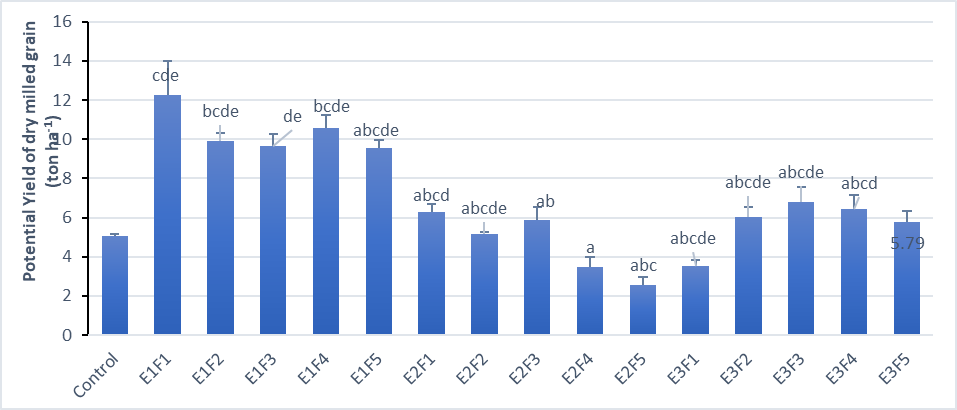
The histogram clearly demonstrates that the high grain yield was achieved when low elicitor concentration (E1) was combined with balanced nutrient supply or moderate to high ZnO-nanocompost (F1–F5) (Figure 1). This treatments combination resulted in an average increase in grain yield potential of 106% compared to the control. The other treatments, however, did not significantly differ from the control, and some even showed lower results.
Figure 1. The potential yield of dry milled grain depends on the interaction between elicitor concentration and fertilization system
Low concentration of elicitor commonly induces beneficial priming, enhancing photosynthesis, nutrient uptake efficiency, and metabolic resilience (Conrath et al., 2015; Johnson & Puthur, 2021; Sorrentino et al., 2021). This explains the yield advantages observed under E1 treatments. In contrast, moderate to high elicitor doses (E2–E3) significantly reduced grain yield, as reflected by the lower values in the graph. Higher elicitor concentrations often trigger excessive ROS production, disrupt hormonal signalling, and divert metabolic resources from growth and grain filling toward stress response pathways (Zhang et al., 2024). These mechanisms align with the yield reduction observed in treatments such as E2F4, E2F5, and all E3 combinations. The role of ZnO nanoparticles is also evident: moderate ZnO nanoparticle levels enhanced yield when paired with low elicitor intensity, whereas higher ZnO nanoparticle application rates resulted in unfavourable interactions with moderate and high elicitor concentrations (E2 and E3). Although ZnO nanoparticles can improve nitrogen metabolism, chlorophyll synthesis, and reproductive development (Dimkpa et al., 2018; Kumar et al., 2021; Mittler et al., 2022), excessive ZnO under elicitor-induced stress conditions may intensify oxidative burden and impair grain formation. Overall, the graph reflects the priming stress continuum (Alvarado et al., 2019; Teklić et al., 2021), where low elicitor levels promote productivity, but excessive elicitation leads to metabolic overload and reduced yield, especially when combined with high ZnO nanoparticle input.
Materials and Methods
Experimental site and plant materials
The experiment was conducted in a controlled greenhouse environment in Sidomulyo Village, Jabung, Malang Regency, Indonesia, located at 7o95'68" South Latitude and 112o75'49" East Longitude. The site was characterized by average temperatures of 25-30 °C, relative humidity of 75-82%, and natural light conditions. Rice (Oryza sativa L. cv. Inpari-32) was used as the test crop. Composting was carried out in a field laboratory at the same location, while soil and plant analyses were carried out at the Integrated Laboratory at the Universitas Islam Malang. Rice seeds were surface sterilized and pre-germinated before transplanting into pots containing 10 kg of air-dried soil classified as Entisol. The physicochemical characteristics of the soil used as the planting medium are presented in Table 6.
Table 6. The results of the analysis of Entisol soil used as a planting medium in this study.
| Parameter | Result | Criteria |
|---|---|---|
| pH H2O | 6.7 | Moderate |
| pH KCl | 6.3 | Moderate |
| C-organic (%) | 1.38 | Low |
| N total (%) | 0.10 | Low |
| C/N ratio | 13.27 | Moderate |
| P2O5 (Olsen) (ppm) | 15.74 | Moderate |
| K-exchangeable (cmol kg-1) | 0.49 | Moderate |
| Mg- exchangeable (cmol kg-1) | 1.18 | Moderate |
| Ca-exchangeable (cmol kg-1) | 6.35 | Moderate |
| S-SO4 (ppm) | 11 | Moderate |
| Zn (ppm) | 2.1 | Moderate |
Preparation of weed extract elicitors
Fresh weed biomass consisting of Mikania micrantha Kunth, Asystasia gangetica L., Mitracarpus hirtus L., Ageratum conyzoides L., and Euphorbia Hirata was collected from agricultural fields. A cumulative mass of 300 grams of botanical material was manually kneaded in 5 L of purified water under continuous agitation to attain homogeneity. The kneading procedure was executed gradually over a duration of 20 minutes. The resultant solution was subsequently assessed for its Total Dissolved Solids (TDS), and the elicitor solution was considered ready for application once the TDS value reached 300-500 parts per million (ppm). The chemical composition of the natural elicitor solution contained flavonoid 9.017 ppm, phenolic compound 28.29 ppm, total phenolic compound 0.90 mg GAE/g, and antioxidant activity of 7.655%. The extract was filtered and diluted to produce three elicitor concentrations: E1 (0.2%), E2 (0.4%), and E3 (0.6%). The elicitor solutions were applied as foliar spray from 10 to 60 days after transplanting (DAT) with an interval of 10 days. Applications were carried out uniformly until the leaf surfaces were fully wetted.
Preparation of ZnO-nanoparticle–enhanced compost
The composting process utilized organic waste materials, consisting of bovine excrement, goat excrement, spent mushroom substrate, cocopeat, rice husk biochar, dry Tithonia diversifolia leaves, and rice bran, in a proportional ratio of 9:9:9:9:3:1:1. All materials were ground, mixed thoroughly, and placed into a composting bin with the addition of 1% lime. Composting was facilitated using activated decomposers and allowed to proceed for one month. Following compost maturation, the resultant compost was desiccated to a moisture level of ~10% subsequently milled into a fine powder utilizing a grinder-mill. The powdered compost was further sieved through a 50-mesh sieve. The chemical composition of compost powder is presented in Table 7. Commercial ZnO nanoparticles with a particle size of 100–150 nm were incorporated into the compost powder at three concentrations: 100 mg ZnO-NP per kg compost, 200 mg ZnO-NP per kg compost, and 300 mg ZnO-NP per kg compost. The compost–nanoparticle mixtures were homogenized using a mechanical mixer to ensure uniform distribution of ZnO nanoparticles into compost powder.
Table 7. Chemical composition of compost powder.
| Parameter | Results | Methods |
|---|---|---|
| pH | 7.1 | Electrometry |
| C-Organic (%) | 11.01 | Walkley and Black |
| Organic matter (%) | 18.94 | |
| N-Total (%) | 1.28 | Kjeldahl |
| C/N ratio | 8.65 | - |
| P-Total (%) | 1.04 | Wet Oxidation with HNO3 and HClO4 |
| K-Total (%) | 0.85 | |
| Ca-Total (%) | 6,32 | |
| Mg-Total (%) | 1.74 | |
| S-SO4 (%) | 0.74 | |
| Fe-Total (ppm) | 13515.70 | |
| Zn-Total (ppm) | 87.30 | |
| Cu-Total (ppm) | 39.20 |
Fertilization treatments
Five fertilization regimes were tested: F1: Compost powder + 50% recommended NPK; F2: Compost powder +25% recommended NPK; F3: Compost+ZnO NP (100 mg kg⁻¹)+2; F4: Compost + ZnO NP (200 mg kg⁻¹); and F5: Compost + ZnO NP (300 mg kg⁻¹). The recommended NPK fertilization rates for rice were based on regional agronomic standards and consisted of urea at 300 kg ha⁻¹, ZA fertilizer at 100 kg ha⁻¹, triple superphosphate (TSP) at 100 kg ha⁻¹, and KCl at 100 kg ha⁻¹. Urea was applied in three split doses at 7, 28, and 56 days after planting (DAP). TSP was applied at 7 and 56 DAP, while KCl was applied at 7 DAP.
Experimental design
The experiment employed a two-factor factorial split-plot design (SPD) with three replications. The main-plot (E) factor consisted of elicitor concentration (E1: 0.2%, E2: 0.4%, and E3: 0.6%), while the sub-plot (F) factor comprised fertilizer systems (F1–F5). A total of 15 treatment combinations were established, with three replications. In addition to these treatment combinations, there was a control (no treatment) as a comparison. resulting in 46 experimental units. Each experimental unit consisted of one planting pot containing six rice plants.
3.6 Agronomic Management System
One hundred kilograms of air-dried soil were flooded and homogenized to form a muddy substrate within planting boxes. Powder compost and ZnO-NP–enhanced compost were incorporated into the soil 24 hours before transplanting. Rice seeds were sown on 12 April 2025, and seedlings were maintained in the nursery for 21 days. Subsequently, seedlings were transplanted into the muddy soil blocks at a spacing of 20 cm × 20 cm, with six hills per box, and two seedlings per hill. During plant growth, the water level in the box was maintained at 1 cm until the seed filling phase. After that, irrigation was applied every three days. Weed control was performed manually as required.
Growth and yield measurements
Measurements of rice growth parameters were taken periodically from 2 to 12 weeks after planting (WAP). Plant height (cm) was recorded from the soil surface to the tip of the longest leaf using a graduated ruler. The number of leaves and tillers per hill was counted manually. Leaf area was calculated using a portable leaf area meter with the standard formula (leaf length × leaf width × 0.75). Chlorophyll content was assessed non-destructively with a SPAD meter (SPAD-502 Plus, Konica Minolta), with three readings per plant averaged to obtain a representative SPAD value.
Yield-related parameters were assessed at maturity and included the number of panicles per hill, panicle length (cm), number of filled and unfilled grains per panicle, total grain yield per hill, the proportion of filled and unfilled grains per hill, and estimated grain yield per hectare. Panicles were harvested manually, and grain yield was determined at harvest and after oven-drying at 70°C to constant weight. Potential grain yield per hectare was extrapolated based on plant density and grain yield per hill.
Leaves nutrient content analysis
Nutrient uptake of N, P, K, and Zn was determined from leaf samples. Plant tissues were oven-dried at 70 °C to constant weight, finely ground, and subjected to wet digestion. Total N was analyzed using the Kjeldahl method, P was quantified calorimetrically using a UV–Vis spectrophotometer, potassium concentration was measured by flame photometry, and Zn concentration was determined using atomic absorption spectrophotometry (AAS) (Okalebo et al., 2002; Kalra, 1997).
Statistical analysis
Data were subjected to two-way analysis of variance (ANOVA) at a 5% significance level using Minitab software (version 22.3.0). When significant differences were detected, the Tukey honestly significant difference (HSD) test (p< 0.05) was applied at the same significance level to determine the differences among treatment means. Interaction effects between elicitor concentration and fertilization system (E × F) were further examined using interaction plots and simple effect analysis. The comparison between the tested treatment and the control (no treatment) was tested using the Dunnet test (p<0.05).
Conclusions
This study demonstrated that the combined application of weed extract elicitors and ZnO-nanoparticle-enhanced compost produces both antagonistic and synergistic responses in rice, depending strongly on elicitor dose and fertilization regime. Plant growth, nutrient uptake, and grain yield were considerably enhanced under reduced NPK fertilization when low elicitor concentrations (0.2%) were combined with ZnO-NPs, especially at application rates of 200–300 mg ZnO-NP per kg compost. These synergistic effects suggest that mild elicitation functioned as a physiological priming mechanism, enabling improved nutrient availability from nano-enriched compost to support plant metabolic and physiological processes. On the other hand, regardless of the fertilization method, high elicitor concentrations (0.6%) consistently reduced plant height, tiller number, chlorophyll content, nutrient uptake, and yield components. These results corroborate the dose-dependent growth–defence trade-off, in which excessive activation of secondary metabolite signalling pathways suppresses gibberellin-driven growth and limits carbon allocation towards grain production. Overall, the findings emphasize the critical importance of optimizing elicitor dosage when incorporating nano-enabled fertilizers and bio-stimulants into sustainable rice production systems. When appropriately combined, weed-derived elicitors and compost enhanced with ZnO-NPs can improve nutrient-use efficiency and sustain rice yield while reducing chemical fertilizer inputs. Future research should include physiological indicators of elicitor priming, long-term field validation, and the effects of repeated applications of nanoparticles and organic fertilizers on the environment.
Acknowledgments
The authors express their sincere gratitude to the Directorate General of Research and Development, Ministry of Higher Education, Science and Technology of the Republic of Indonesia for financial support through the Regular Fundamental Research scheme with contract agreements: No. 128/C3/DT.05.00/PL/2025; 020/LL7/DT.05.00/PL/2025; 412/G164/U.LPPM/K/B.07/VI/2025
Contribution of Authors
Conceptual idea: Nurhidayati, N.; Tito, S.I.; Methodology design: Nurhidayati, N; Basit A. Data collection: Basit, A.; Tito, S.I. Data analysis and interpretation: Nurhidayati, N.; Tito, S.I.; and Writing and editing: Nurhidayati, N; Tito, S.I.; Basit, A.
Conflict of Interest
The authors declare no conflict of interest. The funder had no role in the design of the study; in the collection, analyses, or interpretation of data; in the writing of the manuscript; or in the decision to publish the results.
References
Alam MA, Huang J, Khan MN, Daba NA, Zhang L, Shen Z, Li J, Liu L, Han T, Hayatu NG, Rahaman MA (2023) Effects of long-term organic and inorganic fertilization on greenhouse gas emissions and soil nutrient stoichiometry in a rice–rice–fallow cropping system. Agriculture, Ecosystems & Environment, 357:108695. https://doi.org/10.1016/j.agee.2023.108695
Ali Q, Shehzad F, Waseem M, Shahid S, Hussain AI, Haider MZ, Habib N, Hussain SM, Javed MT, Perveen R (2020) Plant-Based Biostimulants and Plant Stress Responses (pp. 625–661). Springer, Singapore. https://doi.org/10.1007/978-981-15-2156-0_22
AL-Jubouri WMS (2024) Effect of methyl jasmonate spraying on growth and yield of Vicia faba L. Plant. Academia Open, 9(2). https://doi.org/10.21070/acopen.9.2024.10403
Alvarado AM, Aguirre-Becerra H, Vázquez-Hernández MC, Magaña-Lopez E, Parola-Contreras I, Caicedo-Lopez LH, ... & Feregrino-Perez AA (2019) Influence of elicitors and eustressors on the production of plant secondary metabolites. In Natural Bio-active Compounds: Volume 1: Production and Applications (pp. 333-388). Singapore: Springer Singapore. https://doi.org/10.1007/978-981-13-7154-7_11
Bagheri A, & Fathipour Y (2022) Induced resistance and defense primings. In Molecular approaches for sustainable insect pest management (pp. 73-139). Singapore: Springer Singapore. https://doi.org/10.1007/978-981-16-3591-5_3
Bibi Y, Nisa S, Zahara K, Qayyum A (2023) Nano Elicitors and Bioactive Plant Metabolites (pp. 279–310). BENTHAM SCIENCE PUBLISHERS. https://doi.org/10.2174/9789815136838123010019
Bougma PTC, Bondé L, Yaro VSO, Dicko I, Zongo AFR, Gebremichael AW, Mohamed M, Malz C, Matschullat J, Linstädter A, Ouédraogo O (2025) Greenhouse Gas Emissions from Fertilization Practices in Maize Cropping in Sub-Saharan Africa: Toward Climate-Smart Agriculture. Environments, 12(7), 211. https://doi.org/10.3390/environments12070211
Campos ML, Yoshida Y, Major IT, de Oliveira Ferreira D, Weraduwage SM, Froehlich JE, Johnson BF, Kramer DM, Jander G, Sharkey TD, Howe GA (2016) Rewiring of jasmonate and phytochrome B signalling uncouples plant growth-defense tradeoffs. Nature communications, 7(1), p.12570. https://doi.org/10.1038/ncomms12570
Conrath U, Beckers GJ, Langenbach CJ, Jaskiewicz MR (2015) Priming for enhanced defense. Annual review of phytopathology, 53(1), 97-119. https://doi.org/10.1146/annurev-phyto-080614-120132
Dimkpa CO, Singh U, Bindraban PS, Elmer W H, Gardea-Torresdey JL, White JC (2018) Exposure to weathered and fresh nanoparticle and ionic Zn in soil promotes grain yield and modulates nutrient acquisition in wheat (Triticum aestivum L.). Journal of Agricultural and Food Chemistry 66(37), 9645-9656. https://doi.org/10.1021/acs.jafc.8b03840
Dimkpa CO, White JC, Elmer WH, Gardea-Torresdey J (2017) Nanoparticle and ionic Zn promote nutrient loading of sorghum grain under low NPK fertilization. Journal of agricultural and food chemistry 65(39), 8552-8559. https://doi.org/10.1021/acs.jafc.7b02961
Dong S, Dong S, Tarkowská D, Sedaghatmehr M, Molochko M, Molochko M, Gupta S, Gupta S, Mueller-Roeber B, Mueller-Roeber B, Balazadeh S, & Balazadeh S (2021) An HB40 - JUNGBRUNNEN1 - GA 2-OXIDASE regulatory module for gibberellin homeostasis in Arabidopsis. bioRxiv. https://doi.org/10.1101/2021.02.17.431590
Elekhtyar NM, Al-Huqail AA (2023) Effect of foliar application of phosphorus, zinc, and silicon nanoparticles along with mineral NPK fertilization on yield and chemical compositions of rice (Oryza sativa L.). Agriculture, 13(5), 1061. https://doi.org/10.3390/agriculture13051061
Faizan M, Yu F, Chen C, Faraz A, Hayat, S (2021) Zinc oxide nanoparticles help to enhance plant growth and alleviate abiotic stress: A review. Current Protein and Peptide Science, 22(5), 362-375. https://doi.org/10.2174/1389203721666201016144848
Frąckowiak P, Wrzesińska B, Wieczorek P, Sánchez-Bel P, Kunz L, Dittmann A, Obrępalska-Stęplowska, A (2022) Deciphering of benzothiadiazole (BTH)-induced response of tomato (Solanum lycopersicum L.) and its effect on early response to virus infection through the multi-omics approach. Plant and Soil, 481(1–2), 511–534. https://doi.org/10.1007/s11104-022-05651-7
Gaddam N.R, Devi TM, Rupali JS, Reddy GR (2024) Exploiting induced plant resistance for sustainable pest management: mechanisms, elicitors, and applications: a review. Journal of Experimental Agriculture International, 46(9), 586-599. https://doi.org/10.9734/jeai/2024/v46i92857
Gowtham HG, Murali M, Shilpa N, Amruthesh KN, Gafur A, Antonius S, Sayyed RZ (2024) Harnessing abiotic elicitors to bolster plant's resistance against bacterial pathogens. Plant Stress, 11, 100371. https://doi.org/10.1016/j.stress.2024.100371
Guillén-Enríquez RR, Sánchez-Chávez E, Fortis-Hernández M, Márquez-Guerrero SY, Espinosa-Palomeque B,Preciado-Rangel, P (2023) ZnO nanoparticles improve bioactive compounds, enzymatic activity and zinc concentration in grapevine. Notulae Botanicae Horti Agrobotanici Cluj-Napoca. https://doi.org/10.15835/nbha51413377
Guo S, Hu X, Wang Z, Yu F, Hou X, Xing B (2024) Zinc oxide nanoparticles cooperate with the phyllosphere to promote grain yield and nutritional quality of rice under heatwave stress. Proceedings of the National Academy of Sciences of the United States of America, 121(46), e241482212.https://doi.org/10.1073/pnas.2414822121
Hamada AM, Radi AA, Al Kahtany FA, Farghaly, FA (2024) A review: zinc oxide nanoparticles: advantages and disadvantages. Journal of Plant Nutrition, 47(4), 656-679. https://doi.org/10.1080/01904167.2023.2280127
Hou X, Ding L, Yu H (2013) Crosstalk between GA and JA signaling mediates plant growth and defense. Plant Cell Reports, 32(7), 1067–1074. https://doi.org/10.1007/S00299-013-1423-4
Huot B, Yao J, Montgomery BL, He SY (2014) Growth–defense tradeoffs in plants: a balancing act to optimize fitness. Molecular plant, 7(8), 1267-1287. https://www.cell.com/molecular-plant/fulltext/S1674-2052(14)60932-1
Jiang Y, Ye J, Li S, Niinemets Ü, Niinemets Ü (2017) Methyl jasmonate-induced emission of biogenic volatiles is biphasic in cucumber: a high-resolution analysis of dose dependence. Journal of Experimental Botany, 68(16), 4679–4694. https://doi.org/10.1093/JXB/ERX244
Jin G, Qi J, Zu H, Liu S, Gershenzon J, Lou Y, Baldwin IT, Li, R (2023) Jasmonate-mediated gibberellin catabolism constrains growth during herbivore attack in rice. The Plant Cell. 35(10), 3828-3844 .https://doi.org/10.1093/plcell/koad191
Johnson R, Puthur JT (2021) Biostimulant priming in Oryza sativa: a novel approach to reprogram the functional biology under nutrient-deficient soil. Cereal Research Communications, 1–8. https://doi.org/10.1007/S42976-021-00150-4
Kalra Y (1997) Handbook of reference methods or plant analysis (1st ed). CRC Press, Taylor and Francis Group
Karasov TL, Chae E, Herman JJ, Bergelson J (2017) Mechanisms to mitigate the trade-off between growth and defense. The Plant Cell, 29(4), 666-680. https://doi.org/10.1105/tpc.16.00931
Khakwani AA, Saddozai UK, Awan IU, Baloch MS, Khan Q, Munir M, Saddozai G, Bakhsh I (2016). Effect of organic and inorganic inputs on soil parameters and productivity of coarse rice (Oryza sativa l. CV. IR-9). J. Agric. Res, 54(2), 195-205. http://www.jar.com.pk
Khan A, Kanwal F, Fahad M, Tariq L, Riaz A, Tanveer M, Zhang G (2025) Plant secondary metabolites—central regulators against abiotic and biotic stresses. Metabolites, 15(4), 276. https://doi.org/10.20944/preprints202502.0739.v1
Kumar A, Singh IK, Mishra R, Singh A, Ramawat N, Singh A (2021) The role of zinc oxide nanoparticles in plants: A critical appraisal. In Nanomaterial biointeractions at the cellular, organismal and system levels (pp. 249-267). Cham: Springer International Publishing. https://doi.org/10.1007/978-3-030-65792-5_10
Kumar S, Abedin MM, Singh AK, Das S (2020) Role of phenolic compounds in plant-defensive mechanisms. In Plant phenolics in sustainable agriculture: volume 1 (pp. 517-532). Singapore: Springer Singapore. https://doi.org/10.1007/978-981-15-4890-1_22
Mandal TK (2023) ZnO Nanoparticles: Sustainable Plant Production (pp. 259–281). Springer International Publishing. https://doi.org/10.1007/978-3-031-41329-2_10
Mauch-Mani B, Baccelli I, Luna E, Flors V (2017) Defense priming: an adaptive part of induced resistance. Annual review of plant biology, 68, 485-512. https://doi.org/10.1146/annurev-arplant-042916-041132
Mersi M, Sinthary V, Rijai L (2023) Profil kromatografi lapis tipis antioksidan tumbuhan gulma: Axonopus compressus (Sw.) P. Beauv and Digitaria ciliaris (Retz.) Koeler. Proceeding of Mulawarman Pharmaceuticals Conferences, 18, 87–91. https://doi.org/10.25026/mpc.v18i1.709
Mittler R, Zandalinas SI, Fichman Y, Van Breusegem F (2022) Reactive oxygen species signalling in plant stress responses. Nature reviews Molecular cell biology, 23(10), 663-679. https://doi.org/10.1038/s41580-022-00499-2
Narayani M, Srivastava S (2017) Elicitation: a stimulation of stress in in vitro plant cell/tissue cultures for enhancement of secondary metabolite production. Phytochemistry reviews, 16(6), 1227-1252. https://doi.org/10.1007/s11101-017-9534-0
Nurhidayati, N., Basit, A., & Qur’ania, A. (2024). Effect of ZnO Nanoparticles enhanced compost with different application methods on nutrient uptake and Grain Yield of Rice (Oryza sativa) Var. Inpari 32. In BIO Web of Conferences (Vol. 143, p. 01002). EDP Sciences. https://doi.org/10.1051/bioconf/202414301002
Nurhidayati N, Basit A, Tito SI, Qur'ania A (2025) Boosting Rice Nutrient Uptake and Grain Yield Through Co-Application of Natural Elicitor, Powder Compost, and NPK Under Greenhouse Conditions. In BIO Web of Conferences (Vol. 201, p. 02002). EDP Sciences. https://doi.org/10.1051/bioconf/202520102002
Okalebo JR, Gathua KW, Woomer PL (2002) Laboratory Methods of Soil and Plant Analysis: A Working Manual Second Edition, 21, (pp.25-26). Sacred Africa, Nairobi, file:///E:/Download/SoilAnalysesmanual%20(1).pdf.
Pan J, Wang J, Zhuang S (2024) Soil biological fertility evolution in a chronosequence under long‐term rice cultivation after land reclamation in China. European Journal of Soil Science, 75(4), e13539. https://doi.org/10.1111/ejss.13539
Paramanya A, Prairna, Şekeroğlu N, Ali A (2021) Secondary Metabolites for Sustainable Plant Growth and Production Under Adverse Environment Conditions (pp. 437–456). Springer, Cham. https://doi.org/10.1007/978-3-030-65912-7_18
Paranimuthu S, Pandey R, Yadav A, Gowda VT, Krishnan P, Sharma DK, Shankar SV, Madhuri V, Rupali JS, Ranjan R, Bana RS, Kumar A (2025) Optimizing Zinc biofortification in basmati rice through soil application of size-varied Zinc Oxide Nanoparticles (ZnO-NPs). https://doi.org/10.21203/rs.3.rs-6661167/v1
Paul RS (2018) Inducers and elicitors of defense response in plants–an overview. Journal of Emerging Technologies and Innovative Research (JETIR), 5 (12), 481-489. www.jetir.org.
Pawend-taoré CB, Loyapin B, Valaire SOY, Idrissa D, Amara Z, Amanuel WG, Mohamed M, Claudia M, Jörg M, Anja L, Oumarou O. (2025). Greenhouse Gas Emissions from Fertilization Practices in Maize Cropping in Sub-Saharan Africa: Toward Climate-Smart Agriculture. Environments, 12(7), 211. https://doi.org/10.3390/environments12070211
Prikhodko IA, Sergeev AE, Komsyukova YA (2023) Development of new approaches to the preservation of soil fertility in rice agricultural landscapes. Аgrarnyy nauchnyy zhurnal = The Agrarian Scientifi c. 2023 (11): 122-129. https://doi.org/10.28983/asj.y2023i11pp122-129
Qi J, Song CP, Wang B, Zhou J, Kangasjärvi J, Zhu JK, Gong Z (2018) Reactive oxygen species signaling and stomatal movement in plant responses to drought stress and pathogen attack. Journal of integrative plant biology, 60(9), 805-826. https://doi.org/10.1111/jipb.12654
Reshma MS, Jawahar S, Kalaiyarasan C, Suseendran K (2024) Evaluating the effect of organic NPK granules on yield, nutrient uptake, post-harvest soil fertility and soil microbial population in rice (Oryza sativa L.). Crop Research Hisar, 59(5 and 6), 190-195. https://doi.org/10.31830/2454-1761.2024.cr-984
Saha S, Pal, D (2021) Elicitor Signal Transduction Leading to the Production of Plant Secondary Metabolites (pp. 1–39). Springer, Cham. https://doi.org/10.1007/978-3-030-54027-2_1
Santhosh B, Bharti P, Singh SK, Kumari S (2023) Elicitors: Role in Secondary Metabolite Production in Medicinal Plants (pp. 147–178). https://doi.org/10.1007/978-981-99-4939-7_7
Siah A, Magnin-Robert M, Randoux B, Choma C, Rivière C, Halama P, Reignault P. (2018) Natural Agents Inducing Plant Resistance Against Pests and Diseases (pp. 121–159). Springer, Cham. https://doi.org/10.1007/978-3-319-67045-4_6
Sorrentino M, De Diego N, Ugena L, Spíchal L, Lucini L, Miras-Moreno B, Zhang L, Rouphael, Y, Colla G, Panzarová K (2021) Seed priming with protein hydrolysates improves arabidopsis growth and stress tolerance to abiotic stresses. Frontiers in Plant Science, 12, 626301. https://doi.org/10.3389/FPLS.2021.626301
Tariq A, Ahmed A (2024) Plant phenolics production: a strategy for biotic stress management. In Plant Phenolics in Biotic Stress Management (pp. 441-454). Singapore: Springer Nature Singapore.
Tariq A, Zeng F, Graciano C, Ullah A, Sadia S, Ahmed Z, Murtaza G, Ismoilov K, Zhang Z (2023) Regulation of metabolites by nutrients in plants. Plant ionomics: sensing, signaling, and regulation, 1-18. https://doi.org/10.1002/9781119803041.ch1
Teklić T, Parađiković N, Špoljarević M, Zeljković S, Lončarić Z, Lisjak M (2021) Linking abiotic stress, plant metabolites, biostimulants and functional food. Annals of Applied Biology, 178(2), 169-191. https://doi.org/10.1111/aab.12651
Verma V, Vishal B, Kohli A, Kumar PP (2021) Systems-based rice improvement approaches for sustainable food and nutritional security. Plant Cell Rep., 40, 2021–2036. https://doi.org/10.1007/s00299-021-02790-6
Yang W, Zhang L, Yang Y, Xiang H, Yang P (2024) Plant secondary metabolites-mediated plant defense against bacteria and fungi pathogens. Plant Physiology and Biochemistry, 217, 109224. https://doi.org/10.1016/j.plaphy.2024.109224.
Yadav KSR, Mandaliya VB (2025) Nano-fertilizer for Climate-Smart Agriculture: A Comprehensive Patent Analysis for Sustainable Soil Management Practices. In Contemporary Suitability of Nanobionics in Agriculture: Nanotechnology in Horticultural Crops (pp. 195-213). Cham: Springer Nature Switzerland. https://doi.org/10.1007/978-3-031-82779-2_10
Zhang Y, Hou S, Athanassiou CG, Guo L, Zhao S, Hu Q, Ding C, Liu Q (2024) Regulatory role and mechanisms of reactive oxygen species in grains during post-harvest storage: the vanguard sentinel of quality deterioration. Food Reviews International 1–31. https://doi.org/10.1080/87559129.2024.2430652
Zhou H, Hua J, Zhang J, Luo S (2022) Negative interactions balance growth and defense in plants confronted with herbivores or pathogens. Journal of Agricultural and Food Chemistry, 70(40), 12723-12732. https://doi.org/10.1021/acs.jafc.2c04218