Australian Journal of Crop Science
Article | https://doi.org/10.21475/ajcs.26.20.10.pne180
Submitted: 13 November 2025 | Revised: 02 April 2026 | Accepted: 16 April 2026
Pages 789–796
Copper toxicity in Schizolobium amazonicum Herb. plants
Karla Samylle de Queiroz Costa1, Cassio Freitas de Oliveira1, Madson Pereira Melo1, Arthur Vinicius Pires1, Dayse Gonzaga Braga1, Hedilberto do Carmo Lima1, Hellen Patrícia Lemos Cordovil1, Fabricia Kelly Cabral Moraes1, Luma Castro de Souza2, Nilvan Carvalho Melo1, Raphael Leone da Cruz Ferreira1, Flávio José Rodrigues Cruz*3
1Instituto Federal de Ciência e Tecnologia do Amapá, Campus Porto Grande - Amapá, BR 210, Km 103, Retiro dos Pinhais, 68997-000, Porto Grande - Amapá, Brasil
2Universidade Federal do Maranhão, Campus Chapadinha - Maranhão, BR-222, 65500-000, Chapadinha - Maranhão, Brasil
3Universidade Federal do Oeste do Pará, Campus Juruti - Pará, Rua Vereador José de Sousa Andrade, 68170-000, Juruti - Pará, Brasil
*Corresponding author: fjrcpp@outlok.com
Abstract: Copper is a micronutrient essential for plant growth and development. However, in excess, it is toxic to plants and may cause various physiological and morphological changes. Therefore, the study of the growth of plants exposed to excess Cu is important for the development of phytoremediation programs and for understanding the mechanisms involved in the tolerance of this metal. The objective of this research was to evaluate the effect of excess copper on growth and tolerance level responses of Schizolobium amazonicum Herb. Schizolobium amazonicum is a tree species suitable for planting in consortia within agroforestry systems in the Amazon region. It grows rapidly and its wood is suitable for the plywood industry. The study was conducted in a greenhouse using a completely randomized design described by five copper concentrations and five replicates. Biometric measurements, Cu content in tissues and indices (translocation factor, tolerance index, bioconcentration factor and bioaccumulation factor) were assessed. Schizolobium amazonicum does not tolerate Cu toxicity because it has considerable reduction in aerial part and root growth at lower concentration. Moreover, the indices translocation factor, tolerance index, bioconcentration factor and bioaccumulation factor presented values lower than 1, suggesting that Schizolobium amazonicum does not phytoremediate Cu, let alone be sensitive to this metal.
Keywords: Paricá, Toxicity, Heavy metal, Translocation, Growth.
Abbreviations: Copper_Cu; Dickson Quality Index_DQI; Total dry matter of the plant_TDM); Shoot dry matter_SDM; Dry matter of the root_RDM; Translocation fator_TF; Tolerance index_TI; Bioconcentration fator_BCF; Bioaccumulation fator_BF; COPT_Copper transporter;
Soil contamination by copper (Cu) is an environmental issue of concern. Its addition to soils primarily occurs through human activities, represented by industrial, mining, and agricultural practices (Cruz et al., 2022). The intensive use of fertilizers, agrochemicals containing Cu, and organic fertilization based on pig manure are major sources of Cu input in agricultural soils (Van-Zwieten et al., 2004; Gräber et al., 2005).
Cu is an essential element for all living organisms. In plants, Cu acts as a cofactor within cells in various physiological processes, including electron transfer during photosynthesis, mitochondrial respiration, superoxide radical elimination, the lignification process of cell walls, and ethylene signaling (Epstein and Bloom, 2005; Marschner, 2012).
However, despite the various functions of Cu in plants, toxic levels of Cu trigger physiological disorders because Cu directly participates in the generation of free radicals in cells, in the Haber-Bosch and Fenton reactions, and in the substitution of sulfur (S) by Cu in iron-sulfur proteins (Cruz et al., 2022). This set of biochemical events promotes oxidative stress and, consequently, reduces plant growth (Maksymiec, 1997; Yruela, 2005; Chen et al., 2022).
Soil contamination by heavy metals (HMs) is a significant problem for the environment and human health, as their decontamination requires time and can be costly. However, a variety of soil remediation approaches have been developed to recover soils contaminated by HMs. These measures are based on mechanical or physicochemical techniques, such as soil incineration, excavation and landfilling, soil washing, solidification, and the application of electric fields (Sheoran et al., 2011; Wuana and Okieimen, 2011; DalCorso et al., 2019).
However, phytoremediation of soils contaminated by HMs is a simple and cost-effective strategy that involves the use of plants to extract and remove HMs or reduce their bioavailability in the soil through root absorption and translocation of HMs to the aboveground parts of the plants (Ghosh and Singh, 2005; Yan et al., 2020). In this context, tree species are potential candidates for phytoremediation due to their high biomass production, deep root growth, larger leaf area for transpiration, and ability to remove HMs from contaminated soils (Pulford and Watson, 2003; Fan et al., 2011).
Regarding Cu, some Amazonian species are identified as potential phytoremediators, such as Khaya ivorensis and Cedrela fissilis. However, the pioneering tree species paricá (Schizolobium amazonicum Herb.) meets the botanical requirements for phytoremediation due to its rapid growth and good biomass production (Zeidler et al., 2021; Niu et al, 2022), there is a lack of data regarding its tolerance to phytoremediation in Cu-contaminated soils. This indicates the need for studies to evaluate the potential of this species to accumulate Cu in its tissues through the extraction of these HMs from contaminated soils.
To the best of our knowledge, there are no studies investigating the tolerance of paricá plants to toxic levels of copper. This study was based on the hypothesis that the paricá species has potential and tolerance for copper phytoextraction due to its rapid growth and high biomass production. The aim of this study was to evaluate the potential and tolerance level of paricá plants to toxic levels of copper in soil conditions.
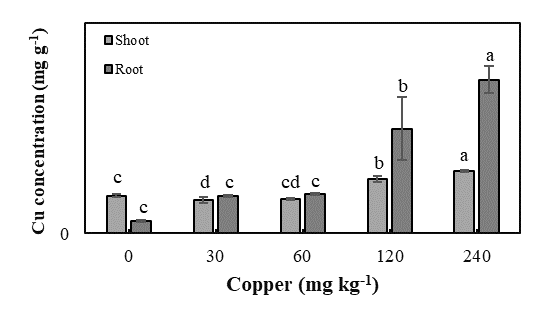
The Cu concentrations in the leaves and roots of paricá plants were significantly increased by the Cu doses applied to the soil. The doses of 120 and 240 mg kg⁻¹ of Cu promoted the highest Cu levels in both leaves and roots. The 240 mg kg⁻¹ dose increased the foliar and root Cu levels by 62.5% and 95.5%, respectively, compared to the control treatment. However, Cu levels were higher in the roots compared to the shoot parts (Figure 1). At doses of 120 and 240 mg kg⁻¹, the root Cu levels were 79% and 72% higher than the foliar levels, respectively.
Figure 1. Copper content in young paricá plants grown in soil contaminated with Cu. Bars represent standard error of the mean. n = 5. Means followed by the same letter on the column do not differ by Tukey test (p<.05).
Plant growth responded significantly to the Cu doses applied to the soil (Table 1). The 240 mg kg-1 Cu dose had the greatest impact on plant growth, reducing shoot dry mass (SDM), root dry matter (RDM), total dry matter (TDM), and the Dickson Quality Index (DQI) by 28%, 76.5%, 47%, 74.7%, and 41%, respectively, compared to the control treatment. Even at the lowest Cu dose (30 mg kg-1), there was a significant reduction in Paricá plant growth, but to a lesser extent than at the 240 mg kg-1 dose and the dose corresponding to the prevention value for copper (60 mg kg-1).
Table 1. Stem diameter (SD), shoot dry matter (SDM), roots dry matter (RDM), total dry matter (TDM) and Dickson quality index (DQI) of Schizolobium amazonicum exposed to different Cu levels.
| Cu levels | SD | SDM | RDM | TDM | DQI |
|---|---|---|---|---|---|
| mg kg-1 | cm | g plant-1 | |||
| 0 | 5.82 ± 1.0 a | 5.21 ± 0.91 a | 1.88 ± 0.25 a | 7.09 ± 1.15 a | 4.24 ± 0.52 a |
| 30 | 5.18 ± 0.68 ab | 3.09 ± 0.63 b | 1.14 ± 0.19 b | 4.23 ± 0.63 b | 3.65 ± 0.85 ab |
| 60 | 5.04 ± 0.41 ab | 2.58 ± 0.51 b | 1.12 ± 0.03 b | 3.71 ± 0.5 b | 3.08 ± 0.59 abc |
| 120 | 4.08 ± 0.74 b | 1.17 ± 0.26 c | 0.63 ± 0.12 c | 1.81 ± 0.26 c | 2.24 ± 0.69 c |
| 240 | 4.19 ± 0.9 b | 1.22 ± 0.41 c | 0.53 ± 0.05 c | 1.79 ± 0.4 c | 2.5 ± 0.84 bc |
Means followed by the same letter on the column do not differ by Tukey test (p<.05). Mean and standard error of the mean were used to represent the data. n = 5.
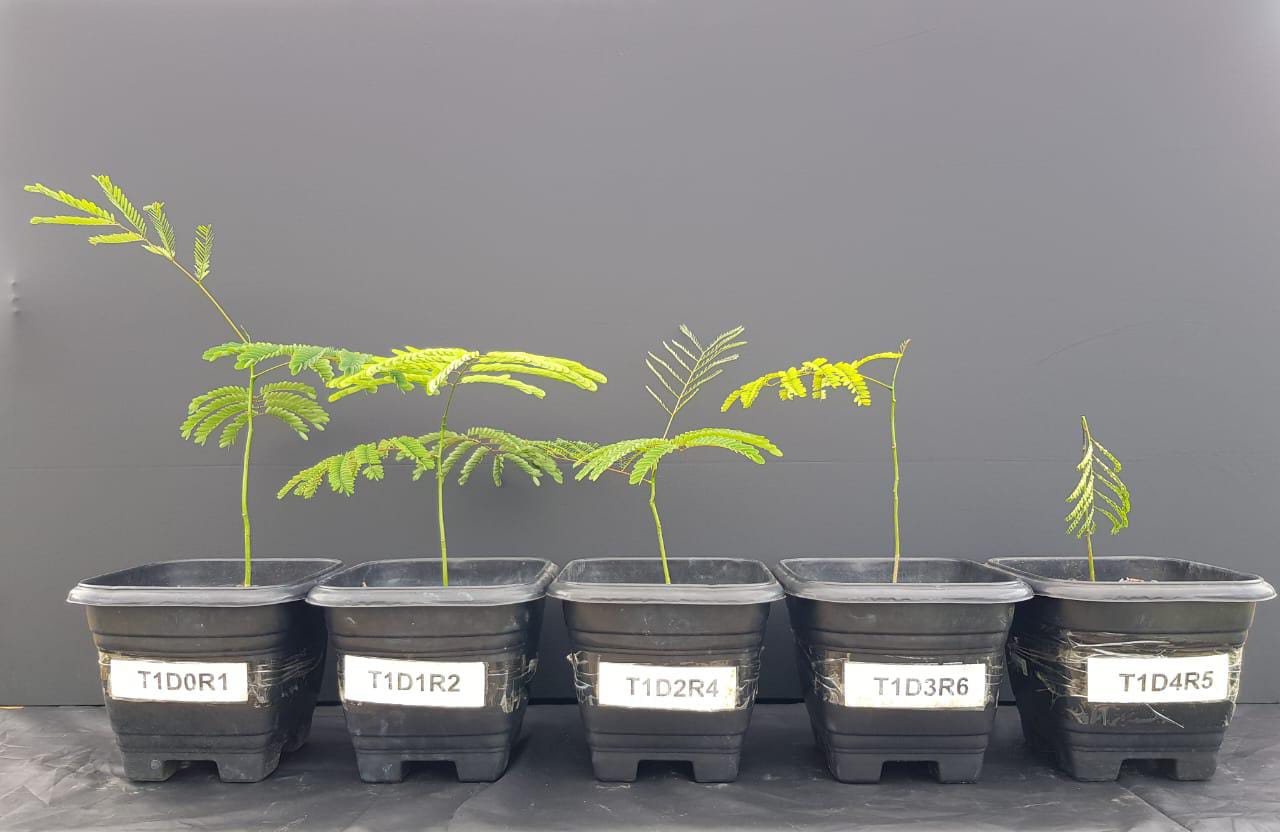
Toxicity due to high Cu levels manifested in the root system, which exhibited loss of vigor with prolonged exposure to Cu, resulting in dark coloration, thickening, and reduced growth. In the shoot parts of the plants, morphological symptoms of Cu toxicity were evident through leaf chlorosis and a marked reduction in growth (leaves, stem, and roots). In later stages, the leaf edges became necrotic, leading to leaf drop. These symptoms were more pronounced at doses of 60, 120, and 240 mg kg⁻¹ (Figure 2).
Control 30 mg kg-1 60 mg kg-1 120 mg kg-1 240 mg kg-1
Figure 2. Paricá plants (Schizolobium amazonicum) treated with doses of copper.
All phytoremediation efficiency indices were significantly affected by increasing Cu doses applied to the soil (Table 2). The 240 mg kg-1 Cu dose reduced the translocation index (TI), translocation factor (TF), bioconcentration factor (BCF), and bioaccumulation factor (BF) by 51%, 54.5%, 50%, and 66.6%, respectively, compared to the 30 mg kg-1 Cu dose (Table 2).
Table 2. Tolerance index (TI), translocation factor (TF), bioconcentration factor (BCF), and bioaccumulationfactor (BF) of Schizolobium amazonicum exposed to different Cu levels.
Cu levels (mg kg-1) |
TI | TF | BCF | BF |
|---|---|---|---|---|
| 30 | 51.69 ± 8.97 a | 0.88 ± 0.07 a | 0.0036 ± 0.0001 a | 0.006 ± 0.0002 a |
| 60 | 52.29 ± 7.14 a | 0.87 ± 0.03 a | 0.0038 ± 0.0003 a | 0.007 ± 0.0002 a |
| 120 | 25.5 ± 3.76 b | 0.60 ± 0.04 b | 0.0022 ± 0.0002 b | 0.003 ± 0.0001 b |
| 240 | 25.3 ± 5.72 b | 0.40 ± 0.03 c | 0.0018 ± 0.0001 b | 0.002 ± 0.0001 c |
Means followed by the same letter on the column do not differ by Tukey test (p<.05). Mean and standard error of the mean were used to represent the data. n = 5.
In this study, the Cu concentrations in the leaves and roots were proportional to the Cu doses applied to the soil. However, the roots exhibited higher Cu levels (Figure 1). Cu absorption in the root system occurs through specific and non-specific transporters located in the plasma membrane of root cells. These transporters are identified as P-type ATPase copper transporters, COPT (Copper Transporters), ZIP family transporters, and NRAMP family transporters. P-type metal transporters (P-type ATPase copper transports) are responsible for the transmembrane transport of toxic metals, such as divalent cations (Cu²⁺, Zn²⁺, Cd²⁺, and Pb²⁺). These transporters utilize ATP to pump molecules across the cell membrane (Williams et al., 2000; Kumar et al., 2021). The family of proteins responsible for transporting Cu in its reduced form includes copper transporter (COPT - COPT1, COPT2, COPT3, COPT4, and COPT5). Zinc-regulated proteins are involved in the absorption of Cu ions. Depending on the Cu concentration in the plant growth medium, Zrt-/Irt-related Proteins (ZIP2 or ZIP4) may act as transporters. The Natural Resistance-Associated Macrophage Protein (NRAMP) is responsible for the relocation of ions such as Fe, Ni, Mn, Zn, and Cu from the roots to the shoot parts through cellular and vacuolar membranes (Krämer et al., 2007; Deng et al., 2013; Kavitha et al., 2015). This set of transporters facilitates greater Cu absorption by plants. However, the higher accumulation of Cu in the roots of paricá plants compared to the shootparts (Figure 1) is due to Cu's affinity for enzyme groups and proteins present in the apoplast and cell wall of root cells, leading to greater retention of Cu in the root system (Girotto et al., 2016). Furthermore, the production and release of exudates, chelation, sequestration, and compartmentalization of metal ions in the vacuoles of root cells (Kumar et al., 2021) are plant defense mechanisms to restrict Cu in the root system and prevent its accumulation in the shoot organs, thereby avoiding damage to the photosynthetic machinery (Marques et al., 2008).
Although the biochemical mechanisms for restricting Cu in the root system described above are strategies to mitigate the toxic effects of Cu in both the shoot and root parts, these mechanisms were not effective in the present study. This is evidenced by the reduction in growth of the shoot part, root, stem diameter, and the decrease in the Dickson Quality Index (DQI) (Table 1). The dry matte of the shoot, root, and total mass were significantly reduced at a dose of 30 mg kg⁻¹ of Cu, which is below the intervention value described by CONAMA (2009), which is 60 mg kg⁻¹, indicating the sensitivity of paricá plants to Cu. Additionally, the 30 mg kg⁻¹ dose considerably affected the DQI, is a tool for evaluating the quality of tree seedlings based on total dry matter, plant height, stem diameter, shoot dry matter, and root dry matter. The DQI is considered a promising integrated measure of morphological characteristics (Johnson and Cline, 1991). It is regarded as a good indicator of seedling quality because it reflects the robustness and distribution of biomass while considering several important parameters (Fonseca et al., 2002). Silva et al. (2015) observed a reduction in DQI in a study with young plants of Anadenanthera macrocarpa, Mimosa scabrella, and Apuleia leiocarpa subjected to Cu doses. However, these authors used more toxic doses than those applied in the present study, which explains the much lower DQI values found in their research.
Under toxic Cu doses, plants exhibit reduced growth due to oxidative stress, which causes damage to the photosynthetic machinery (Maksymiec, 1997; Yruela et al., 2008), nitrogen metabolism enzymes (Lindon and Henriques, 1992; Xiong et al., 2006), and cell membranes through lipid peroxidation (Karimi et al., 2012; Yusuf et al., 2021). The reduction in plant growth, as evidenced in the present study, has been recorded in Senna multijuga and Erythrina crista-galli (De Marco et al., 2016), Hymenaea courbaril (Marques et al., 2018), and Hevea brasiliensis (Castro et al., 2024) cultivated under toxic Cu levels. The decrease in plant growth induced by toxic levels of Cu may also result from ultrastructural damage in root cells, such as disturbances in the plasma membranes and mitochondrial membranes, and in the endoplasmic reticulum, affecting the proliferation of apical meristem cells in the roots (Doncheva, 1998), thereby compromising the absorption of water and essential mineral nutrients for plant growth (Barceló and Poschenrieder, 2008; Rucinska-Sobkowiak, 2016).
The reduction in the tolerance index due to Cu toxicity highlights the sensitivity of paricá plants to excess Cu, as the toxic Cu levels significantly affected plant growth. Since Cu affects the proliferation of apical meristem cells in the roots, the physiological functions of the roots related to the absorption of water and essential mineral salts for plant growth are compromised by Cu toxicity. Therefore, the translocation factor, bioconcentration factor, and bioaccumulation factor were strongly affected by the increase in Cu dose, indicating that paricá plants have a low phytoextraction capacity for Cu at doses greater than 60 mg kg⁻¹ of Cu (Table 2). The bioconcentration factor (BCF) is an excellent indicator of the capacity to accumulate heavy metals (HMs), as it considers the plants' ability to extract HMs from the soil (McGrath and Zhao, 2003; Odjegba and Fasidi, 2007). The bioaccumulation factor (BF) is another parameter commonly used to evaluate the rate of HMs in the shoot parts of plants compared to the soil (Yoon et al., 2006). The translocation factor (TF) indicates the proportion of HMs in the shoot part of the plant relative to the root (Cui et al., 2007; Li et al., 2007). For phytoextraction purposes, plants should exhibit TF, BF, and BCF values > 1, assuming that they are good phytoremediators suitable for the remediation of soil contaminated with HMs. Conversely, values < 1 indicate non-phytoremediating plants (Fitz and Wenzel, 2002). In this study, the values of TF, BF, and BCF were below 1, indicating that paricá plants are sensitive to Cu toxicity and are not effective in phytoremediating Cu. Contrasting results to those found in this study were observed by Asensio et al. (2019) in a study selecting tree species for Cu phytoremediation. These authors found that tree species Myracrodruon urundeuva, Cecropia sp., and Handroanthus serratifolius were capable of phytoremediating Cu at toxic doses of 60 and 100 mg kg⁻¹. Our findings related to phytoremediation indicators, vegetative growth, and Cu levels in paricá plants suggest that the species evaluated in this study is sensitive to low levels of Cu toxicity, even below the intervention value of 60 mg kg⁻¹ of Cu, according to CONAMA (2009), making it unsuitable for phytoremediation of Cu-contaminated soils.
The experiment was conducted in a greenhouse located at the experimental farm of the Instituto Federal do Amapá, campus agrícola de Porto Grande. It took place from September 2022 to June 2023, using soil classified as Typic hapludox (Santos et al., 2013) sourced from an area of Cerrado in the municipality of Porto Grande. The experimental units consisted of one paricá plant per plastic pot with a volume of 8 dm³.
Soil was collected from the couche arable (Santos et al., 2013), crushed, air-dried, homogenized, and passed through a sieve with a 2 mm mesh made of stainless steel. Subsequently, a sub-sample of the soil was sent to the Soil Laboratory of Embrapa Amapá for chemical characterization according to Raij et al. (2001) and particle size analysis according to Claessen (1997). The results of the chemical and particle size analyses are presented in Tables 3 and 4, respectively.
Table 3. Soil chemical analysis, at depth 0-20 cm, experimental area IFAP/Campus Agrícola Porto Grande, Amapá, Brazil.
| Depth | pH | OM | P | K | Ca+Mg | Ca | Al | H+Al | aSB | bCEC (pH7) | cv | dm |
|---|---|---|---|---|---|---|---|---|---|---|---|---|
| - | H2O | g/Kg | mg/dm3 | cmolg /dm3 | % | |||||||
| 0-20 | 4.0 | 12.1 | 6 | 0.02 | 0.2 | - | 0.7 | 3.1 | 0.2 | 3.3 | 6 | 78 |
aSB (Sum of bases); bCEC (Cation exchange capacity), cv (Base saturation) and dm (Aluminum saturation).
Table 4. Soil granulometric analysis, at depth 0-20 cm, experimental area IFAP/Campus Agrícola Porto Grande, Amapá, Brazil.
| Depth | Clay | Coarse sand | Thin sand | silt | Textural classification |
|---|---|---|---|---|---|
| - | g/kg | *BSSS | |||
| 0-20 | 229 | 420 | 190 | 161 | Sandy clay loam |
*Brazilian Soil Science Society
Based on the chemical soil analysis, the soil's acidity was corrected using 8g of agricultural limestone, which was packaged in plastic bags for incubation and reaction of the corrective agent for 30 days. After the incubation period of the corrective agent, the soil was contaminated with doses of CuSO4·5H2O (0, 30, 60, 120, and 240 mg dm⁻³), and it remained incubated for 72 days until the transplanting of the paricá seedlings.
After the incubation period of the limestone and the application of the Cu treatments, fertilization was conducted with 0.27 g of KCl, 1.11 g of single superphosphate, 0.45 g of urea, and 0.127 g of FTE (micronutrients) per pot, according to the chemical analysis of the soil. Then, the seedlings were transplanted after 30 days of life. During the experiment, the soil moisture was maintained at approximately 60% of the total pore volume. After 90 days of transplanting, the plants were evaluated for their growth, Cu content, and phytoremediation indices.
The design used was a completely randomized design consisting of five treatments of Cu and five repetitions per treatment. The Cu doses were determined based on the preventive value for copper, which is 60 mg kg⁻¹ (CONAMA, 20090).
At the end oAf this period, the height of the shoot part and the diameter of the stem were measured using a measuring tape and a digital caliper, respectively. After this procedure, the plants were separated into shoot parts (leaves and stem) and roots to determine the root length, using a ruler. The leaf area was determined by scanning the leaves and subsequently using the ImageJ software (Rasband, 2007).
The Dickson Quality Index (DQI) (Dickson et al., 1960) was calculated according to the formula described below,
DQI = TDM/[(H/D) + (SDM/RDM)]
where: DQI = Dickson Quality Index; TDM = total dry matter of plant; H = height of the plant; SD = diameter of the plant stem; SDM= shoot dry matter; RDM= dry matter of the root. All units were expressed in centimeters (cm).
After the growth measurements, the plants were dried in a forced-air oven at 65°C until they reached constant matter, in order to determine the total dry matter of the plant (TDM), the shoot dry matter (SDM), and the dry matter of the root (RDM).
To determine Cu in the soil, soil samples were collected from the pots after the collection and evaluation of the plants. The soil samples were subjected to a DTPA extractor at pH 7.3, and the extracts were analyzed using an atomic absorption spectrophotometer. After drying in an oven, the plant parts were ground in a Willey mill for subsequent nitric-perchloric digestion, and the samples were analyzed in an atomic absorption spectrophotometer. The analyses of soil and plants were performed according to Embrapa (2017).
The translocation factor (TF), tolerance index (TI), bioconcentration factor (BCF), and bioaccumulation factor (BF) were evaluated according to the methodologies described by Zayed et al. (1998), Wilkins (1978), Caille et al. (2005), and Yoon et al. (2006), using the formulas below:
FT = [CuSDM]/[CuRDM].100
TI = (TDMCu treatment/TDMcontrol).100
BCF = [CuRDM]/[Cu Soil].100
BF = [CuSDM]/[Cu Soil]
In these equations: SDM, refers to shoot dry matter, RDM, dry matter of the root, TDM, represents the total dry matter of the plant, and [Cu] denotes the copper content in the plant (both SDM and RDM) or in the soil.
All data were statistically analyzed using the AgroEstat statistical program (Barbosa and Maldonado, 2011). An analysis of variance was performed to compare the means of the treatments. Significant differences between treatments were determined using the Tukey test at a 5% probability level. Mean and standard error of the mean were used to present the data for the evaluated variables.
The results found in this study indicate that the tree species Schizolobium amazonicum is sensitive to copper toxicity, even at low copper doses. This sensitivity limits its phytoremediation capacity, as its growth is negatively affected by copper doses. This implies a lower accumulation of copper in the dry matter of the plants, reducing the potential of the evaluated species to remediate contaminated soils, despite the species exhibiting characteristics of interest in the context of phytoremediation, such as good dry matter production and rapid growth. The phytoremediation indices TF, BF, and BCF, which had values less than one, further reinforce the non-phytoremediating nature of the studied species
This research project was financially supported by Federal Institute of Education, Science and Technology of Amapá.
Asensio V, Florido F, Ruiz F, Perlatti F, Otero XL, Oliveira DP, Ferreira TO (2019) The potential of a Technosol and tropical native trees for reclamation of copper-polluted soils. Chemosphere 220:892-899. https://doi.org/10.1016/j.chemosphere.2018.12.190
Barbosa JC, Maldonado Júnior W (2011) AgroEstat versão 1.0. – Sistema para análise estatística de ensaios agronômicos. Jaboticabal: Universidade Estadual Paulista, 2011.
Barceló J, Poschenrieder Ch (1990) Plant water relations as affected by heavy metal stress: A review. J Plant Nutr. 13 (1): 1-37. https://doi.org/10.1080/01904169009364057
Caille N, Zhao FJ, McGrath SP (2005) Comparison of root absorption, translocation and tolerance of arsenic in the hyperaccumulator Pteris vittata and the nonhyperaccumulartor Pteris tremula. New Phytol. 165 (3): 755-761. https://doi.org/10.1111/j.1469-8137.2004.01239.x
Castro ACJ, Carvalho JC, Schimpl FC, Rodrigues JK, Souza AVF, Fernandes AV, Araújo WL, Gonçalves JFC (2024) Differential copper toxicity in Amazon tree species explained by seed germination and initial seedling growth. Aust J Bot. 72 (5): BT23089. https://doi.org/10.1071/BT23089
Chen G, Li J, Han H, Du R, Wang X (2022) Physiological and Molecular Mechanisms of Plant Responses to Copper Stress. Int J Mol Sci. 23 (21): 12950
Claessen MEC (1997). Manual de métodos de análise de solo. Rio de Janeiro: Centro Nacional de Pesquisa de Solos, 212 p.
CONAMA - Conselho Nacional do Meio Ambiente (2009) Resolução Nº 420, de 28 de dezembro de 2009.
Cruz FJR, Ferreira PLC, Conceição SS, Lima EU, Neto CFO, Galvão JR, Lopes SC, Viegas IJM (2022) Copper toxicity in plants: nutritional, physiological, and biochemical aspects. In Advances in Plant Defense Mechanisms. IntechOpen. http://dx.doi.org/10.5772/intechopen.105212
Cui S., Zhou Q., Chao L (2007) Potential hyperaccumulation of Pb, Zn, Cu and Cd in endurant plants distributed in an old smeltery, northeast China. Environ Geol. 51 (6): 1043-1048. https://doi.org/10.1007/s00254-006-0373-3
DalCorso G, Fasani E, Manara A, Visioli G, Furini A (2019) Heavy metal pollutions: state of the art and innovation in phytoremediation. Int J Mol Sci. 20 (14): 3412. https://doi.org/10.3390/ijms20143412
De Marco R, Silva RF, Andreazza R, Ros CO, Scheid DL, Bertollo GM (2016) Copper Phytoaccumulation and Tolerance by Seedlings of Native Brazilian Trees. Environ Eng Sci. 33 (3): 176-184. http://dx.doi.org/10.1590/1807-1929/agriambi.v19n11p1093-1099
Deng F, Yamaji N, Xia J, Ma JF (2013) A member of the heavy metal P-type ATPase OsHMA5 is involved in xylem loading of copper in rice. Plant Physiol 163 (3): 1353-1362. https://doi.org/10.1104/pp.113.226225
Dickson A, Leaf AL, Hosner JF (1960) Quality appraisal of white spruce and white pine seedling stock in nurseries. For Chron. 36:10-13. https://doi.org/10.5558/tfc36010-1
Doncheva S (1998) Copper-Induced Alterations in Structure and Proliferation of Maize Root Meristem Cells. Plant Physiol. 153 (3-4): 482-487. https://doi.org/10.1016/S0176-1617(98)80178-8
EMBRAPA - Empresa Brasileira de Pesquisa Agropecuária (2017) Centro Nacional de Pesquisa de Solos. Manual de métodos de análise de solos. 3ª ed. Rio de Janeiro: Embrapa Solos, 573 p.
Epstein E, Bloom AJ (2005) Mineral Nutrition of Plants: Principles and Perspectives. 2nd Edition, Sinauer Associates, Sunderland.
Fan KC, Hsi HC, Chen CW, Lee HL, Hseu ZY (2021) Cadmium accumulation and tolerance of mahogany (Swietenia macrophylla) seedlings for phytoextraction applications. J Environ Manage. 92 (10): 2818-2822. https://doi.org/10.1016/S0176-1617(98)80178-8
Fitz WJ, Wenzel WW (2002) Arsenic transformation in the soil rhizosphere plant system, fundamentals and potential application of phytoremediation. J Biotechnol. 99 (3): 259-278. https://doi.org/10.1016/S0168-1656(02)00218-3
Fonseca EP, Valério SV, Miglioranza E, Fonseca NAN, Couto L (2002) Padrão de qualidade de mudas de Trema micrantha (L.) Blume, produzidas sob diferentes períodos de sombreamento. Rev Árvore 26 (4): 515-523. https://doi.org/10.1590/S0100-67622002000400015
Ghosh M, Singh SP (2005) A review on phytoremediation of heavy metals and utilization of its byproducts. Appl Ecol Environ Res. 3 (1): 1-18. http://dx.doi.org/10.15666/aeer/0301_001018
Girotto E, Ceretta CA, Rossato LV, Farias JG, Brunetto G, Miotto A, Tiecher TL, Conti L, Lourenzi CR, Schmatz R, Giachini A, Nicoloso FT (2016) Biochemical changes in black oat (Avena strigosa schreb) cultivated in vineyard soils contaminated with copper. Plant Physiol Biochem. 103:199-207. https://doi.org/10.1016/j.plaphy.2016.02.030
Gräber I, Hansen JF, Olesen SE, Petersen J, Østergaard HS, Krogh L (2005) Accumulation of copper and zinc in danish agricultural soils in intensive pig production areas. Dan J Geogr. 105 (2): 15-22. https://doi.org/10.1080/00167223.2005.10649536
Johnson JD, Cline ML (1991) Seedling quality of southern pines. In: Duryea, M. L.; Dougherty P. M. (Eds.). Forest regeneration manual. Netherlands: KlumerAcademic, p.143-162.
Karimi P, Khavari-Nejad RA, Niknam V, Ghahremaninejad F, Najafi F (2012) The Effects of Excess Copper on Antioxidative Enzymes, Lipid Peroxidation, Proline, Chlorophyll, and Concentration of Mn, Fe, and Cu in Astragalus neo-mobayenii. Sci World J. 2012: 615670. https://doi.org/10.1100/2012/615670
Kavitha PG, Kuruvilla S, Mathew MK (2015) Functional characterization of a transition metal ion transporter, OsZIP6 from rice (Oryza sativa L.). Plant Physiol Biochem. 97:165-174. https://doi.org/10.3389/fpls.2024.1373066
Krämer U, Talke IN, Hanikenne M (2007) Transition metal transport. FEBS Letters 581 (12): 2263-2272. https://doi.org/10.1016/j.febslet.2007.04.010
Kumar V, Pandita S, Sidhu GPS, Sharma A, Khanna K, Kaur P, Bali AS, Setia R (2021) Copper bioavailability, uptake, toxicity and tolerance in plants: A comprehensive review. Chemosphere. 262:127810. https://doi.org/10.1016/j.chemosphere.2020.127810
Li MS, Luo YP, Su ZY (2007) Heavy metal concentrations in soils and plant accumulation in a restored manganese mine land in Guangxi, South China. Environ Pollut. 147(1): 168–175. https://doi.org/10.1016/j.envpol.2006.08.006
Lidon FC, Henriques FS (1992) Effects of copper on the nitrate to ammonia reduction mechanism in rice plants. Photosynthetica 26 (3): 371-371.
Maksymiec W (1997) Effect of copper on cellular processes in higher plants. Photosynthetica, 34 (3): 321-342. https://doi.org/10.1023/A:1006818815528
Marques DM, Veroneze Júnior V, Silva AB, Mantovani JR, Magalhães PC, Souza TC (2018) Copper toxicityon photosynthetic responses and root morphology of Hymenaea courbaril L. (Caesalpinioideae). Water Air Soil Pollut. 229 (5): 1-14. https://doi.org/10.1007/s11270-018-3769-2
Marschner H (2012) Marschner’s Mineral Nutrition of Higher Plants. Vol. 89, Academic Press, London, 651.
McGrath SP, Zhao FJ (2003) Phytoextraction of metals and metalloids from contaminated soils. Curr Opin Biotechnol 14 (3): 561-572. https://doi.org/10.1016/S0958-1669(03)00060-0
Niu X, Jia Y, Wu X, Wang S, Hou J, Zhang W (2022) Phytoremediation potential of indigenous plants growing in soils affected by mine activities in Gejiu City, Yunnan Province. Int. J. Phytoremediat 25 (7): 880-888. https://doi.org/10.1080/15226514.2022.2117789
Odjegba V, Fasidi I (2007) Phytoremediation of heavy metals by Eichhornia crassipes. Environmentalist 27 (3): 349-355. https:// doi.org/10.1007/s10669-007-9047-2
Pulford ID, Watson, C (2003) Phytoremediation of heavy metal-contaminated land by trees a review. Environ Int. 29 (4): 529-540. https://doi.org/10.1016/S0160-4120(02)00152-6
Raij B van, Andrade JC, Cantarella H, Quaggio JA (2001) Análise química para avaliação da fertilidade de solos tropicais. Campinas Instituto Agronômico, 285p.
Rasband WS (2007). ImageJ. US National Institutes of Health, Bethesda, Maryland, USA.
Rucińska-Sobkowiak R (2016) Water relations in plants subjected to heavy metal stresses. Acta Physiol Plant. 38 (11): 257. https://doi.org/10.1007/s11738-016-2277-5
Santos HG, Jacomine PKT, Anjos LHC, Oliveira VA, Lumbreras JF, Coelho MR, Almeida JA, Araujo Filho JC, Oliveira JB, Cunha TJF (2018) Sistema Brasileiro de Classificação de Solos. 5.ed. revisada e ampliada. Brasília – DF: Embrapa, 356 p.
Santos RD, Lemos RC, Santos HG, Ker JC, Anjos LHC, Shimizu SH (2013) Manual de descrição e coleta de solo no campo. 6.ed. Viçosa: Sociedade Brasileira de Ciência do Solo.
Sheoran V, Sheoran A, Poonia P (2011) Role of hyperaccumulators in phytoextraction of metals from contaminated mining sites: a review. Crit Rev Environ Sci Technol. 41 (2): 168-214. https://doi.org/10.1080/10643380902718418
Silva RF, Andreazza R, Ros C, Dellai A, Jacques RJS, Scheid D (2015) Growth of tropical tree species and absorption of copper in soil artificially contaminated. Braz J Biol. 75 (4): 119-125. https://doi.org/10.1590/1519-6984.07114
Souza CR, Rossi LMB, Azevedo CP, Vieira AH (2003) Paricá: Schizolobium parahyba var. Amazonicum (Huber x Ducke) Barneby. Circular Técnica 18. Embrapa Amazônia Ocidental.
Van Zwieten, L., Merrington, G., Van-Zwieten, M., 2004. Review of Impacts on Soil Biota Caused by Copper Residues from Fungicide Application. In: SuperSoil 2004: 3rd Australian New Zealand Soils Conference, 5-9 December 2004. University of Sydney, Australia.
Wilkins DA (1978) The measurement of tolerance to edaphic factors by means of root grown. New Phytol. 80 (3): 623-633. https://doi.org/10.1111/j.1469-8137.1978.tb01595.x
Williams LE, Pittman JK, Hall JL (2000) Emerging mechanisms for heavy metal transport in plants. Biochim Biophys Acta Biomembr. 1465 (1-2): 104-126. https://doi.org/10.1016/S0005-2736(00)00133-4
Wuana RA, Okieimen FE (2011) Heavy metals in contaminated soils: a review of sources, chemistry, risks and best available strategies for remediation. ISRN Ecology 2011:402647. https://doi.org/10.5402/2011/402647
Xiong ZT, Liu C, Geng B (2006) Phytotoxic effects of copper on nitrogen metabolism and plant growth in Brassica pekinensis Rupr. Ecotoxicol Environ Saf. 64 (3): 273-280. https://doi.org/10.1016/j.ecoenv.2006.02.003
Yan A, Wang Y, Tan SN, Yusof MLM, Ghosh S, Chen Z (2020) Phytoremediation: A Promising Approach for Revegetation of Heavy Metal-Polluted Land. Front Plant Sci. 11: 359. https://doi.org/10.3389/fpls.2020.00359
Yoon J, Cao X, Zhou Q, Ma LQ (2006) Accumulation of Pb, Cu and Zn in native plants growing on a contaminated Florida site. Sci. Total Environ. 368 (2-3): 456-464. https://doi.org/10.1016/j.scitotenv.2006.01.016
Yruela I (2009) Copper in plants: acquisition, transport and interactions. Funct. Plant Biol. 36 (5): 409-430. https://doi.org/10.1071/FP08288
Yusuf M, Almehrzi ASS, Alnajjar AJN, Alam P, Elsayed N, Khalil R, Hayat S (2021). Glucose modulates copper induced changes in photosynthesis, ion uptake, antioxidants and proline in Cucumis sativus plants. Carbohydr Res. 501:108271. https://doi.org/10.1016/j.carres.2021.108271
Zayed A, Lytle CM, Terry N (1998) Accumulation, and volatilization of different chemical species of selenium by plants. Planta. 206 (2): 284-292. https://doi.org/10.1007/s004250050402
Zeidler M, Šipoš J, Banaš M, Cernohorsk J (2021) The successive trend of vegetation confirms the removal of non-indigenous woody species as an insufficient restoration action. Biodivers. Conserv. 30 (3): 699-717.