Australian Journal of Crop Science
Article| https://doi.org/10.21475/ajcs.26.20.10.pne121
Submitted: 31 August 2025 | Revised: 11 November 2025 | Accepted: 28 November 2025
Pages 780-788
Yield and spear quality of various asparagus cultivars grown under two contrasting environments
Nguyen Hong Hanh1, Pham Thi Thu Huong2, Roel R. Suralta3, Nguyen Thi Ngoc Dinh1*
1Faculty of Agronomy, Vietnam National University of Agriculture, Vietnam
2Department of Food Crops and High Technology, Institute of Food Crops and Food Plants, Vietnam National University of Agriculture, Vietnam
3Department of Agriculture-Crop Biotechnology Center, Philippine Rice Research Institute, Maligaya, Science City of Munoz, Nueva Ecija, Philippines
*Corresponding author: ngocdinhhau1@gmail.com
Abstract: A study in Northern Vietnam assessed the performance of five imported asparagus (Asparagus officinalis L.) cultivars (Atlas, Grande, UC157, WB231, and K767) in two locations-Son La (colder) and Hai Duong (warmer) to address increasing local demand. Grown under greenhouse conditions, the yield and quality characteristics were evaluated. The Atlas cultivar consistently outperformed the others, showing the highest spear number, weight, carbohydrate content, and total yield (5.04 and 4.3 t ha-1 in Son La and Hai Duong, respectively) across three harvests. Location significantly impacted performance; Son La's cooler climate favored carbohydrate accumulation and higher spear yield, while Hai Duong's warmer climate increased sugar accumulation, boosting Brix and total sugar content. Grande had the highest fiber content, UC157 showed greater chlorophyll and lower-grade spears, and WB231 had higher Brix levels. Principal component analysis indicated that yield traits were mainly cultivar-dependent, while spear quality was influenced by environmental conditions. Our results highlight the importance of selecting the right cultivar and managing greenhouse climate to optimize asparagus yield and quality in Northern Vietnam.
Keywords: asparagus, cultivar, greenhouse, growing location, quality, yield.
Asparagus (Asparagus officinalis L.) is a perennial vegetable with high economic importance (Sarabi et al., 2010). Asparagus is known as the "king of vegetables" due to its unique texture, flavor, and high nutritional content (Baxter et al., 2003). It is rich in protein, selenium, choline, ascorbic acid, B vitamins, sapogenins, and other phenolic compounds responsible for its various bioactive properties (Arbol et al., 2016; Guo et al., 2020).
In Vietnam, asparagus varieties are primarily imported from the United States, the Netherlands, and several other countries (Pham, 2018). Due to rapid development in recent years, the area of asparagus cultivation in Vietnam has expanded quickly, spreading across provinces in the South-Central Coast and Southern regions of the country. Among these, Ninh Thuan province has the largest area of asparagus cultivation with 426 hectares in 2022, since asparagus is well-suited to the soil and climate conditions in these regions (Mai Phuong & Minh Hau, 2022). In Northern Vietnam, although it has great potential for asparagus consumption, its hot and humid climate makes the asparagus susceptible to stem blight (Phomopsis asparagi), one of the most serious diseases in asparagus. In 2018, 70% of asparagus grown in Northern Vietnam were affected by stem blight (Mai et al., 2020). Son La is a mountainous province in northern Vietnam, characterized by diverse natural conditions and multiple climate zones. Notably, the Moc Chau Plateau has a cool climate year-round, making it ideal for cultivating temperate vegetables during the summer to supply major cities. In contrast, Hai Duong, located in the Red River Delta, experiences a tropical monsoon climate with four distinct seasons.
Greenhouse cultivation is a current trend in agricultural production since it can limit the effects of weather and pests, enabling year-round cultivation, and leading to higher yields (Ponce et al., 2015). However, asparagus yield and quality are influenced by cultivar differences and the prevailing environmental conditions of the growing location. Understanding how the different asparagus cultivars respond to various growing environments can help identify either a best suited for specific locations or broadly adaptable across environments. Thus, this study was conducted to evaluate the growth, yield, and quality of imported asparagus varieties under various greenhouse locations in Son La and Hai Duong province and to identify high-yielding and high-quality asparagus varieties that can be adopted for production in Northern Vietnam.
Results
The magnitude and the dynamics variation in temperatures of the locations influenced the same inside the greenhouse, although the temperature inside the greenhouse was generally higher (Table 1). Between location, the temperatures inside the greenhouse in Son La were generally lower than those in Hai Duong, with a 7°C difference in January and 2-4°C in other months. The month of April had the smallest difference (1.76°C). Furthermore, the relative humidity (RH) inside the greenhouse in Son La was generally higher than those in Hai Duong, ranging from 12% in January to 6.85% in June, except in February, March, and May (Table 1). Asparagus thrives at 18-22°C, with higher temperatures increasing cracking (Heißner et al., 2006), suggesting that the temperature in Son La is more suitable.
Table 1. Temperatures and relative humidities inside and outside of the greenhouses in Son La and Hai Duong, North Vietnam.
| Month | Temperature (oC) | Humidity (%) | ||||||
|---|---|---|---|---|---|---|---|---|
| Son La | Hai Duong | Son La | Hai Duong | |||||
| Greenhouse | Outdoor | Greenhouse | Outdoor | Greenhouse | Outdoor | Greenhouse | Outdoor | |
| January | 11.8 | 12.0 | 18.6 | 17.1 | 80.8 | 82.0 | 68.7 | 75.0 |
| February | 17.7 | 16.3 | 20.9 | 20.1 | 81.6 | 83.0 | 82.3 | 84.4 |
| Marth | 19.4 | 18.3 | 23.1 | 21.9 | 82.1 | 83.0 | 79.8 | 85.1 |
| April | 23.7 | 22.7 | 25.4 | 24.7 | 82.7 | 80.0 | 84.3 | 89.8 |
| May | 25.7 | 25.1 | 29.3 | 28.1 | 80.6 | 74.0 | 79.7 | 86.5 |
| June | 26.8 | 24.6 | 31.7 | 29.9 | 87.6 | 84.0 | 80.7 | 85.6 |
| July | 27.5 | 25.3 | 32.8 | 30.7 | 82.0 | 82.0 | 78.2 | 80.8 |
| August | 25.2 | 23.3 | 31.1 | 29.1 | 87.5 | 89.0 | 82.4 | 85.9 |
| September | 23.6 | 22.4 | 29.6 | 28.2 | 87.0 | 89.0 | 83.8 | 85.5 |
| October | 22.5 | 20.2 | 28.1 | 26.9 | 85.6 | 84.0 | 81.1 | 77.1 |
The location, but not the cultivar, significantly affected chlorophyll a, b, and total chlorophyll (Supplementary Table 1). Hai Duong generally showed higher chlorophyll levels than Son La, possibly due to greater light intensity and temperature of the former (Table 1).
There was a significant interaction between the location and cultivar on carbohydrates (CHO) at 13 and 17 months after planting (MAP), but not at 9 MAP. At 9 MAP, Son La had higher root CHO than in Hai Duong, regardless of variety (Table 2). This reversed at 13 MAP. In Hai Duong, Atlas and WB 231 had higher root CHO. At 17 MAP, Hai Duong generally had higher CHO, with Atlas showing the highest levels.
Table 2. Carbohydrate (CHO) content (mg kg-1) of asparagus cultivars grown in Son La and Hai Duong, Northern Vietnam at different months after planting (MAP).
| Cultivars | 9 MAP | 13MAP | 17MAP | |||
|---|---|---|---|---|---|---|
| Son La | Hai Duong | Son La | Hai Duong | Son La | Hai Duong | |
| Atlas | 481.8a | 429.0a | 420.6a | 477.6a | 345.6a | 368.2a |
| Grande | 359.4b | 355.2b | 386.8a | 445.9b | 290.7b | 377.6ab |
| UC157 | 467.0a | 403.7ab | 405.8a | 418.5a | 361.3a | 328.8c |
| WB231 | - | 416.4ab | - | 486.0a | - | 333.4bc |
| K767 | 456.5a | - | 380.5a | - | 368.1a | - |
| Locations (L) | ** | ns | ns | |||
| Cultivars (C) | ns | ns | ns | |||
| L x C | ns | * | * | |||
ns, not significant; *,** significant at P0.05 and 0.01, respectively.
In a column within each location, means followed by the same letters are not significantly different at P0.05.
The stem blight (Phormopsis asparagi) infections occurred only in Son La (except in Atlas at 13 MAP) (Supplementary Table 2), likely due to higher humidity (Table 4). Whiteflies (10-15 m-²) and beet armyworms (8.5-12.9 m-²) had caused damaged to asparagus in Hai Duong at 14 and 18 MAP, respectively, but it did not generally affect yield.
The spear length increased steadily but there was no significant interaction of location and cultivar on spear length. Son La took 6 days to reach harvest length, while it only took 5 days in Hai Duong, likely due to higher temperatures in the latter than in the former location (Table 1). Spear lengths were similar among cultivars (data not shown).
Spear diameter was generally larger in Son La than in Hai Duong and no significant differences among asparagus cultivars in each location (data not shown).The location significantly affected spear number and weight at 14 MAP, while the cultivar affected them at 18 MAP (Table 3). In Son La. Spear number and weights was generally higher than those in Ha Duong, with Atlas having the highest in both locations. The higher yield in Son La may be due to its higher CHO (Table 2) (Drost, 2023; Romero-Vergel, 2023).
Table 3. Yield components at different harvesting times in Son La and Hai Duong, Northern Vietnam.
| Cultivar | 1st harvesting (10 MAP) | 3rd harvesting (18 MAP) | ||||||
|---|---|---|---|---|---|---|---|---|
| Number of spears per plant | Spear average weight (g) | Number of spears per plant | Spear average weight (g) | |||||
| Son La | Hai Duong | Son La | Hai Duong | Son La | Hai Duong | Son La | Hai Duong | |
| Atlas | 5.7a | 4.8a | 22.0a | 12.9a | 4.0a | 3.8a | 4.0a | 16.7a |
| Grande | 4.1b | 4.3a | 17.3b | 9.4b | 2.73b | 2.0b | 2.7b | 12.9b |
| UC157 | 5.1ab | 4.4a | 16.3b | 9.6b | 3.6ab | 3.5a | 3.6ab | 14.3b |
| WB231 | - | 4.5a | - | 12.7a | - | 3.2a | - | 15.1ab |
| K767 | 4.3b | - | 16.4b | - | 3.2ab | - | 3.2ab | - |
| Locations (L) | * | ** | ns | ns | ||||
| Cultivars (C) | * | ** | ** | ** | ||||
| L x C | ns | ns | ns | ns | ||||
MAP: month after planting
ns, not significant; *,** significant at P0.05 and 0.01, respectively.
In a column within each location, means followed by the same letters are not significantly different at P0.05.
Asparagus yield was significantly affected by the interaction of location and cultivar (Table 4). Yield was generally higher in Son La than in Hai Duong, with Atlas producing the highest yield in both locations. However, the yields in Son La generally decreased over time, possibly due to humidity-related infections (Table 4). The yields in Hai Duong, on the other hand, were stable, coinciding with its higher CHO (Table 2).
Table 4. Yield of asparagus at different harvesting times of different cultivars grown in Son La and Hai Duong, Northern Vietnam.
| Cultivars | 1st harvest (10 MAP) |
2nd harvest (14 MAP) |
3rd harvest (18 MAP) |
|||
|---|---|---|---|---|---|---|
| Son La | Hai Duong | Son La | Hai Duong | Son La | Hai Duong | |
| Atlas | 2.2a | 1.4a | 1.6a | 1.6a | 1.24a | 1.3a |
| Grande | 1.3b | 1.0b | 1.3a | 1.0b | 0.7c | 0.68b |
| UC157 | 1.84ab | 1.1ab | 1.5a | 1.2b | 1.0b | 1.21a |
| WB231 | - | 1.3ab | - | 1.6a | - | 1.21a |
| K767 | 1.82ab | - | 1.5a | - | 1.1b | - |
| Location (L) | ** | * | ** | |||
| Cultivars (C) | ** | ns | ** | |||
| L x C | * | * | * | |||
MAP: month after planting
ns, not significant; *,** significant at P0.05 and 0.01, respectively.
In a column within each location, means followed by the same letters are not significantly different at P0.05.
The growing location significantly affected the Brix levels (Table 5). Generally, the Brix values in Son La were lower than in Hai Duong. Atlas had the highest Brix level in Hai Duong.
Table 5. Spear quality at 10 months after planting of asparagus cultivars grown in Son La and Hai Duong, Northern Vietnam.
| Cultivars | Brix | Dry matter (%) | Total sugar (%) |
Vitamin C (mg 100 g-1) | Fiber content (%) | |||||
|---|---|---|---|---|---|---|---|---|---|---|
| Son La | Hai Duong | Son La | Hai Duong | Son La | Hai Duong | Son La | Hai Duong | Son La | Hai Duong | |
| Atlas | 4.1a | 5.8a | 9.0a | 9.2a | 2.0a | 2.3a | 13.5a | 13.5ab | 2.0a | 1.4a |
| Grande | 4.1a | 5.2ab | 8.1a | 9.2a | 1.7b | 2.2a | 11.0a | 7.9c | 2.1a | 1.9b |
| UC157 | 4.0a | 5.6a | 8.4a | 9.2a | 1.7b | 1.9b | 12.2a | 14.8a | 2.1a | 2.1a |
| WB231 | - | 4.6b | - | 8.3a | - | 1.9b | - | 10.0bc | - | 1.8c |
| K767 | 4.6a | - | 8.2a | 1.8b | - | 10.9a | - | 1.9a | - | |
| Location (L) | ** | ns | ** | ns | ** | |||||
| Cultivars (C) | ns | ns | ** | ** | ** | |||||
| L x C | ns | ns | ** | ** | ** | |||||
ns, not significant; *,** significant at P0.05 and 0.01, respectively.
In a column within each location, means followed by the same letters are not significantly different at P0.05
Dry matter content was similar across locations and cultivars (Table 5). The interaction of location and cultivar significantly affected total sugar (Table 5). The total sugar was generally higher in Hai Duong than in Son La. In Son La, Atlas had higher total sugar while in Hai Duong, it was Atlas and Grande (Table 5). The interaction of location and cultivar, as well as cultivar, significantly affected vitamin C (Table 5). In Hai Duong, Atlas and UC157 had higher vitamin C than the rest of the asparagus cultivars (Table 5). Fiber content was affected by the interaction of location and cultivar (Table 5). In Hai Duong, Grande had the highest fiber content.
The percentage of harvested spears by grade was affected by the interaction of location and cultivar (Table 6). In Son La, Atlas had a higher rate of grade 1 spears, while it was WB231 in Hai Duong. The asparagus varieties such as UC157 and Grande had higher percentages of grade 2 spears. Atlas had the lowest rate of grade 3 spears.
Table 6. The percentage of harvested spear according to grades of asparagus cultivars grown in Son La and Hai Duong, Northern Vietnam.
| Cultivars | 1st harvest | 3rd harvest | ||||||||||
|---|---|---|---|---|---|---|---|---|---|---|---|---|
| Grade 1 | Grade 2 | Grade 3 | Grade 1 | Grade 2 | Grade 3 | |||||||
| Son La | Hai Duong | Son La | Hai Duong | Son La | Hai Duong | Son La | Hai Duong | Son La | Hai Duong | Son La | Hai Duong | |
| Atlas | 27.7a | 10.4b | 46.7b | 42.1a | 25.6b | 47.5b | 27.5a | 12.1a | 41.7b | 38.4a | 30.8b | 49.5a |
| Grande | 15.3b | 6.0c | 50.4a | 26.4b | 34.3a | 67.6a | 14.3c | 7.9b | 45.4a | 32.8a | 40.3a | 59.3a |
| UC157 | 17.6bc | 6.5c | 51.5a | 28.5b | 51.5a | 60.0a | 10.8c | 6.5b | 46.5a | 24.1a | 42.6a | 69.4a |
| WB231 | - | 14.1a | - | 37.7a | - | 48.2b | - | 8.6b | - | 28.9a | - | 62.5a |
| K767 | 20.4b | - | 50.4a | - | 29.2a | - | 21.2b | - | 45.4a | - | 33.4b | - |
| Cultivars (C) | ** | ** | ** | ** | ns | * | ||||||
| Locations (L) | ** | ** | ** | ** | ** | ** | ||||||
| C x L | ** | ** | ns | ** | ns | ns | ||||||
ns, not significant; *,** significant at P0.05 and 0.01, respectively.
In a column within each location, means followed by the same letters are not significantly different at P0.05
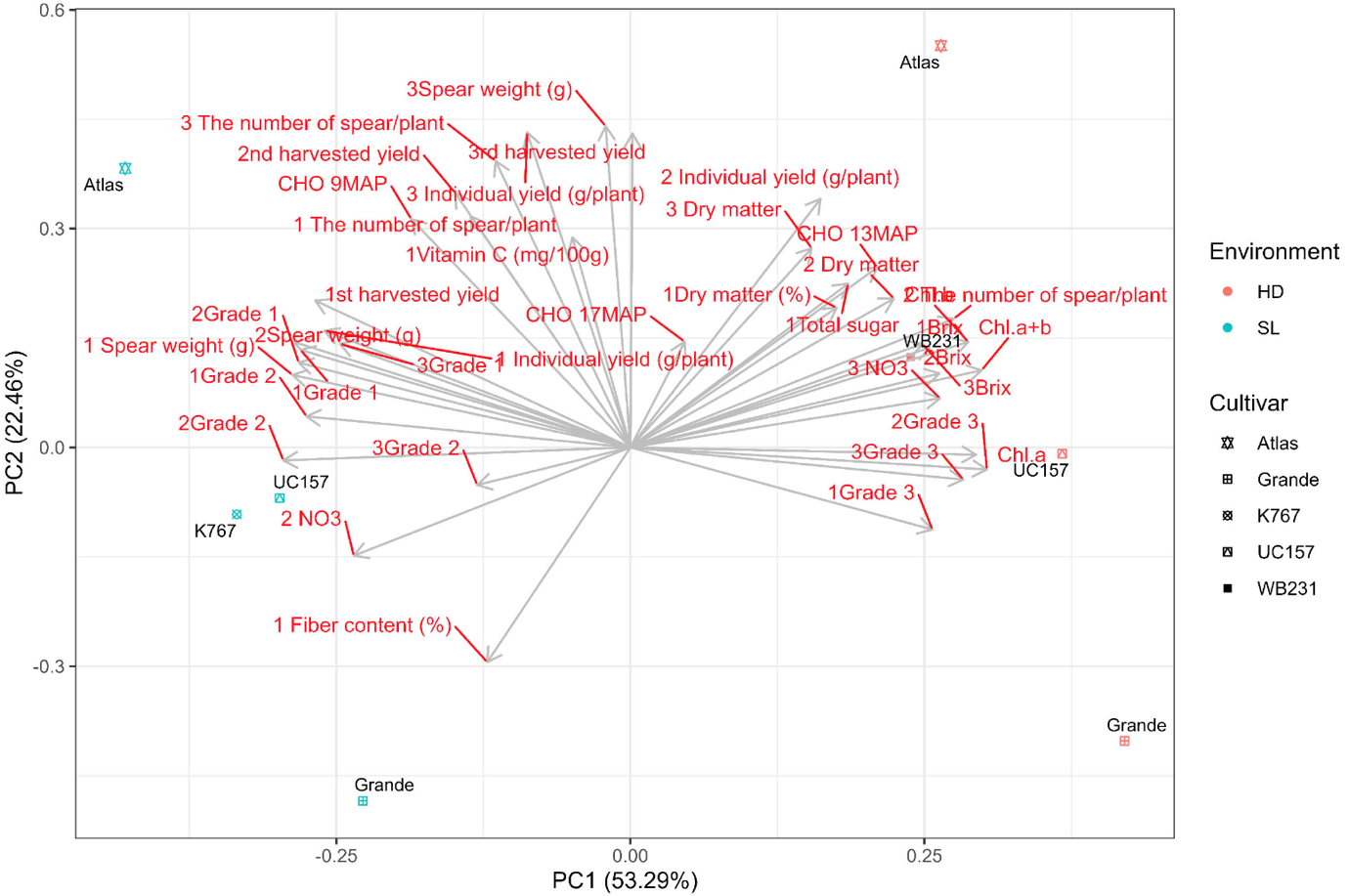
The PCA showed that quality traits of asparagus (fiber, nitrate, spear grade) were significantly influenced by environmental factors, while yield-related traits (CHO, chlorophyll, spear weight, spear number, total yield) were largely driven by the cultivar differences (Figure 1). Atlas was associated with high CHO, spear number, spear weight, and yield. Grande had high fiber content. UC157 had higher chlorophyll and more grade 2 and 3 spears. WB231 had high Brix content. Overall, Atlas excels in yield, Grande in fiber, UC157 in chlorophyll and lower grades, and WB231 in Brix.
This study revealed that environmental factors, particularly temperature and humidity, significantly influenced asparagus yield and spear quality. In Son La, with cooler average temperatures (2- 4°C lower than Hai Duong), provided more favorable conditions for spear development and carbohydrate (CHO) accumulation in roots during early growth stages. These cooler temperatures enhance CHO storage, contributing to greater spear weight and yield (Wilson et al., 2005; Romero-Vergel, 2023; Mákova et al., 2023).
Figure 1. Principal component analysis (PCA) biplot on the relationships among asparagus cultivars, quality traits, physiological and yield parameters grown in Son La and Hai Duong, Northern Vietnam.
Asparagus grown in greenhouses with drip irrigation under tropical conditions exhibited better growth and high yields, as drip irrigation with cool water (26°C) in summer lowers soil temperature, while warm water (28°C) in winter increases it (Hung et al., 2023). In both regions, greenhouse-grown asparagus had more harvests per year compared to field-grown asparagus (Hanh et al., 2024). Notably, the commercial spear emergence rate was high, with Atlas Grade 1 and Grade 2 reaching 74.4% and 52.5%, respectively, in Son La and Hai Duong during the first harvest (Table 5). This can be attributed to the mother-stalk cultural method (Hung et al., 2023; Wang, 1970), which retains ferns above ground, allowing continued photosynthesis and stable CHO content in roots, extending the harvest cycle. Several studies support the strong relationship between CHO content and asparagus yield (Wilson et al., 2005, 2008; Paschold et al., 2002; Mákova et al., 2023; Hanh et al., 2024).
However, yield tended to decline in subsequent harvests, consistent with previous findings (Schofield, 1991; Elmer, 2018). CHO storage in asparagus roots is influenced by air and soil temperatures (Alam et al., 1998; Wantanabe et al., 2019). The optimal temperature range for asparagus growth is 25–30°C (Hung et al., 2023). Temperatures exceeding 33°C reduce photosynthetic capacity and increase respiration, directly reducing yields (Faville, 1999; Bai & Kelly, 1999). Growth slows below 15°C and ceases below 5°C (Hung et al., 2023). During the first harvest, greenhouse temperatures in both regions ranged from 20 to 25°C (Figure 1). The slightly lower temperature in Son La (Table 1) delayed the harvest by one day compared to Hai Duong, but the first harvest yield was higher, likely due to cooler conditions for nine months resulting in larger mother stem diameters. During the second harvest in summer, greenhouse temperatures in Hai Duong exceeded 30°C, reducing yields for some varieties. In Son La, yields also decreased, likely due to high humidity (Table 1) leading to stem blight infections.
Spear weight and quality are key factors in determining market price (Maskova et al., 2023). Optimal temperatures between 28–34°C with adequate irrigation promote sugar accumulation and improve spear development (Chen, 2010; Hughes et al., 1990; Yamaguchi, 2012). In this study, Son La's consistently lower temperature (2–4°C lower than Hai Duong) throughout the growing period (Table 1) affected spear quality (Table 5).
For spear grading, Atlas produced the highest proportion of Grade 1 spears in Son La, while it was WB231 in Hai Duong (Table 6). UC157 had high chlorophyll content (Supplementary Table 1) and a greater proportion of Grade 2 and Grade 3 spears (Table 6), suggesting adaptability to moderate growing conditions but lower overall spear quality. Grande was characterized by consistently high fiber content (Table 5), confirming genotype-dependent variation in spear texture.
The Brix levels and total sugar contents of asparagus cultivars grown in Son La were generally lower than those in Hai Duong (Table 5). For example, the Brix level of the Atlas cultivar was 4.1 in Son La compared to 5.8 in Hai Duong, while the corresponding total sugar contents were 2.0 and 2.3%, respectively. This is attributed to lower temperatures reducing photosynthesis and the activity of sugar-synthesizing enzymes, decreasing soluble carbohydrate accumulation in spears (Alam et al., 1998; Bai & Kelly, 1999; Hung et al., 2023).
Conversely, fiber content was generally higher in Son La than in Hai Duong (Table 5). For example, both Grande and UC157 had fiber contents of 2.1% in Son La compared to 1.9 and 2.1%, respectively, in Hai Duong. This may be due to slower growth rates under cooler conditions, increasing the development of supportive tissues in spears. Also, low temperatures may limit cell elongation, resulting in thicker and tougher spears with higher insoluble fiber accumulation (Heißner et al., 2006; Robb, 1984).
Principal component analysis (PCA) showed that spear weight, CHO content, number of spears per plant, and individual yield were strongly correlated (Fig. 1). Moreover, traits such as fiber content, spear grading, and nitrate content were more associated with environmental factors (location), whereas physiological and growth traits (chlorophyll, CHO, number of spears) were mainly influenced by cultivars.
Multivariate PCA confirmed that yield-related traits were primarily driven by cultivar differences, while spear quality traits were more influenced by environmental conditions. These results emphasize matching asparagus cultivars with appropriate environments to optimize both yield and marketable quality.
While greenhouse cultivation reduced pest and disease pressure, stem blight (Phomopsis asparagi) infections still occurred in Son La under high humidity, particularly during the second harvest. In contrast, insect pressure from whiteflies and beet armyworms was higher in Hai Duong but remained manageable through early intervention using biological control methods (data not shown).
Overall, Atlas emerged as the most promising cultivar adapted to both locations due to its superior yield, spear size, and sugar and vitamin C contents, suggesting broad adaptability. However, continued optimization of greenhouse climate control and fertilization strategies will be essential to sustain yield and quality under varied seasonal conditions.
In summary, Son La's growing environment offers favorable conditions for early growth and higher initial yield due to cooler temperatures supporting CHO accumulation and robust mother stalks, but has relatively lower spear quality (e.g., sweetness). In contrast, the higher temperatures in Hai Duong promoted greater sugar accumulation and Brix values, leading to better spear taste quality, although initial yield was slightly lower due to less CHO stored in the roots (Tables 3 and 4).
The experiment used five F1 asparagus cultivars composed of 4 cultivars from the US (Atlas, Grande, UC157, WB231) and 1 cultivar from the Netherlands (K767). These varieties were sown in the nursery under the same conditions. When the plants of each variety reached 2.5 months old and had developed a strong root system and at least 2 stems per plant, they were transplanted in the soil under the greenhouse condition.
This study was conducted under greenhouse at two locations: Son La and Hai Duong province, Northern Vietnam. Son La and Hai Duong both share a tropical monsoon climate with four distinct seasons, yet their temperatures and humidities vary significantly due to geography. Son La, situated in the higher-altitude mountainous northwest, is the cooler region with a lower mean annual temperature of around 19°C and a slightly lower average relative humidity of approximately 80%, experiencing a drier winter than the delta. In contrast, Hai Duong, located in the low-lying Red River Delta, is warmer with an average annual temperature near 23°C and significantly higher, consistent humidity around 85-87%, with winters often feeling muggier due to persistent drizzle and cloud cover (WorldData, 2025).
Each replication plot measured 20m². In Hai Duong, the greenhouse experiment was conducted at the Institute of Food Crops in Lien Hong Commune, Hai Duong City (20°54′2″N, 106°16′49″E) while in Son La at Greenfarm Company in Ban Ang, Dong Sang Commune, Moc Chau District (20°55′19″N, 104°45′08″E). Soil characteristics for each location are presented in Table 7. Soil samples were collected before the experiment and analyzed at the Soil and Fertilizer Laboratory of the Vietnam National University of Agriculture (VNUA). At each location, the greenhouse experiment was arranged in a randomized complete block design (RCBD) with five asparagus varieties as treatments, replicated three times. The greenhouse, oriented north-south and 4.5 m high, was constructed with a metal frame and covered with PVC film and netting on the roof and all four sides. Natural ventilation was achieved by adjusting the height of the netting on both sides.
Table 7. Selected soil physico-chemical characteristics in Son La (colder environment) and Hai Duong (warmer environment), North Vietnam.
| No | Paremeters | Unit | Son La | Hai Duong |
|---|---|---|---|---|
| 1 | pH | 7.7 | 7.29 | |
| 2 | Organic carbon (OC) | % | 1.91 | 0.84 |
| 3 | Total N | % | 0.17 | 0.06 |
| 4 | Total P2O5 | % | 0.28 | 0.21 |
| 5 | Total K2O | % | 2.05 | 1.84 |
| 6 | Available N | mg100g | 2.1 | 2.1 |
| 7 | Availabl P2O5 | mg/100g | 14.4 | 18.7 |
| 8 | Availabl K2O | mg/100g | 14.7 | 11.1 |
| 9 | Availabl Ca2+ | mg/100g | 186.3 | 255.7 |
| 10 | Availabl Mg2+ | mg/100g | 34.7 | 44.5 |
| 11 | Availabl Fe2+ | mg/100g | 6.7 | 16.5 |
Pre-grown asparagus plants were transplanted on April 1, 2022, into single beds that were 1 meter wide, with 45 cm spacing between plants and a bed height of 35 cm. Fertilization included the equivalent of 30 tons of composted chicken manure, 150 kg of NPK (15-15-15), and 30 kg of MgO per hectare. At planting, 100% of the composted chicken manure and MgO, along with 20% of the NPK, were initially applied. The remaining NPK was applied at 3, 6, and 9 months after planting (MAP) in the first year, and after each harvest in the second year. Plants were drip-irrigated for 2 hours twice daily, in the morning and afternoon, with fertilizer dissolved in the irrigation water.
For physiological traits, the Chlorophyll a, b and a+b content in phylloclade’s at 13 MAP were measured using the method of Wintermans and De Mots (1965). Chlorophyll a and b contents were determined using adsorption spectral analysis following leaf extraction in 96% ethanol. Specifically, one gram of mature fern leaf tissue was added to a closed falcon tube containing 10 mL of 96% ethanol and incubated in darkness for 48 hours to ensure complete chlorophyll extraction. The resulting solution was then analyzed using a UV-2900 spectrophotometer (Hitachi, Japan). Absorbance was measured at wavelengths of 665 nm and 649 nm. Chlorophyll a, chlorophyll b, and total chlorophyll (a+b) contents were calculated using the following equations:mou
Chlorophyll a = 13.7 x A665 – 5.67 x A649 (μg mL-1),
Chlorophyll b = 25.8 x A649 – 7.60 x A665 (μg mL-1),
and
Chlorophy a+b = 6.1 x A665 + 20.04 x A649 (μg mL-1)
The carbohydrate content (CHO) in roots at harvesting was measured using the Brix roots of Wilson et al., (2005) and computed using the formula:
CHO = 21.1 x Brix% + 42.9 (mg g-1)
The natural incidence of stem blight disease (caused by Phomoris asparagi) was assessed monthly in the open field by counting the number of infected stems in 10 randomly selected clusters per plot. Average disease incidence was calculated by dividing the number of infected stems in a cluster by the total number of stems in that cluster.
Whitefly (Bemisia tabaci) populations were assessed by counting the number of adults per plant on three plants from each replication. Beet armyworm (Spodoptera exigua) populations were counted and calculated as the number of worms per aquare meter, following the Vietnamese National Standard TCVN13268-2:2021.
At 10 MAP, ferns were cut off after senescence, and 27 cm-long green spears were harvested daily. The number of spears from 10 plants in each plot was counted, and their weight was recorded to determine individual plot yield. At the end of the 30-day harvest period, all spears from each plot were weighed to record the total harvested yield. Subsequently, spears were harvested every three months, maintaining three ferns (mother stems) per plant, following the method described by Wang (1970).
Spear quality attributes were assessed, including insoluble dietary fiber (AOAC, 1996), Brix content using a Milwaukee MA882 refractometer, total sugar content (Deshavath, 2020), and vitamin C levels (Nielsen, 2017). Spears were graded based on their base diameter: Grade 1 (≥12.0 mm), Grade 2 (10.0-11.9 mm), Grade 3 (7.0-9.9 mm), and Grade 4 (4.0-6.9 mm).
Data were analyzed using ANOVA in Minitab 16 to determine the effects of location, cultivar, and their interactions on asparagus yield and spear quality. Treatment differences were analyzed using Tukey’s test at a 5% significance level.
This study demonstrated that location significantly affects asparagus yield and quality in Northern Vietnam’s greenhouses. Son La's cooler temperatures boosted carbohydrate accumulation in roots, increasing spear weight and yield in the initial harvest. Conversely, Hai Duong's warmer climate promoted sugar accumulation, enhancing spear taste quality as indicated by higher Brix and total sugar content. Among cultivars, Atlas consistently excelled in spear number, weight, yield, and nutritional quality, notably sugar and vitamin C, suggesting its suitability for widespread greenhouse cultivation in both locations. Grande exhibited high fiber content, UC157 showed high chlorophyll content but also a greater proportion of lower-grade spears, and WB231 displayed high Brix levels and good quality specifically in Hai Duong. The study also confirmed a strong link between carbohydrate content and yield and underscored the impact of environmental conditions on spear grading and fiber accumulation.
Greenhouse cultivation with drip irrigation appears promising for stabilizing production and enhancing spear quality across different climates. These results offer a scientific foundation for selecting appropriate asparagus cultivars and tailoring cultivation practices to specific climatic zones in Northern Vietnam.
Future research should focus on nutrient management, disease control, and long-term yield stability to optimize year-round greenhouse asparagus production.
The authors sincerely thank the Ministry of Agriculture and Rural Development of Vietnam for funding this research.
Alam AKMS, Matsui T, Ikeuchi T (1998). Changes in acid invertase spears activity and sugar distribution in asparagus harvested in autumn. Jpn J Trop Agric. 42: 257-262.
Arbol JTD, Pulido RP, La Storia A, Burgos MJ, Lucas R, Ercolini D, Ga ́lvez A (2016). Changes in microbial diversity of brined green asparagus upon treatment with high hydrostatic pressure. International journal of food microbiology 216:1–8.
AOAC Official method 991_43- Association of Official Analytical Chemists (1996) Total, soluble and insoluble fiber in foods. Retrieved from: https://acnfp.food.gov.uk/sites/default/files/mnt/drupal_data/sources/files/multimedia/pdfs/annexg.pdf
Bai Y, Kelly JF (1999) A study of photosynthetic activities of eight asparagus genotypes under field conditions. J Am Soc Hortic Sci. 124: 61–66.
Baxter CT, Feyer CH, Turner J, Rolfe SA, Quick WP (2003) Elevated sucrose phosphate synthase activity in transgenic tobacco sustains photosynthesis in older leaves and alters development. J Exp Bot 54 (389):1813–1820.
Chen RW (2010). Study on the growth phenomenon of green asparagus. In: Tainan District Agricultural Research and Extension Station, COA, vol 3. Research Report, pp 17–20.
Deshavath NN, Mukherjee G, Goud VV, Veeranki VD, Sastri CV (2020) Pitfalls in the 3,5-dinitrosalicylic (DNS) assay for the reducing sugars: Interference of furfural and 5-hydroxymethylfufural. Int J Biol Macromol. 156:180-185.
Drost D (2023) Asparagus (Asparagus officinalis L.) root distribution varies with cultivar during early establishment years. Hortic. 9 (2): 125.
Elmer WH (2018) Asparagus decline and replant problem: A look back and a look forward at strategies for mitigating losses. Acta Hortic. 1223 (1223):195-204.
Faville MJ, Silvester WB, Green TGA, Jermyn WA (1999) Photosynthetic characteristics of three asparagus cultivars differing in yield. Crop Sci. 39:1070–1077.
Guo Q, Wang N, Liu H, Li Z, Lu L, Wang C (2020) The bioactive compounds and biological functions of Asparagus officinalis L. A review. J Funct Foods. 65 (11): 103727.
Hanh NH, Dinh NTN, Huong PTT, Huong DT, Thuy PT, Nghia NTA, Tuan TA (2024) Variation of morpho-agronomical characteristics and genetic diversity of imported asparagus cultivars in Vietnam. Australian Journal of Crop Science, 18(2), 107-115.
Heißner A, Schmidt S, Schonhof I, Feller C, Schreiner M (2006) Spear yield and quality of white asparagus as affected by soil temperature. Eur J Agron. 25 (4): 336-344.
Hughes AR, Nichols MA, Woolley DJ (1990) The effect of temperature on the growth of asparagus seedlings. Acta Hortic. 271:451–456.
Hung KA, Hsu YW, Chen YC, Lin TP (2023) Influence of microclimate control on the growth of asparagus under greenhouse in tropical climates. Int J Biometeorol. 67 (7): 1225-1235.
Mai TL, Nguyen TM, Le VC (2020) Phomopsis asparagi fungus causes asparagus stem blight disease in Thanh Hoa . J Plant Prot. 2: 24-27.
Maskova L, Simmóns RW, Deeks LK, Baets SD, Drost DT (2023) Impacts of long-term application of best management practices on yields and root carbohydrate content in asparagus (Asparagus officinalis). Eur. J Agron. 147: 126828.
Nielsen SS (2017) Vitamin C determination by Indophenol method. Food Analysis Laboratory Manual, Food Science Text Series. Springer International Publishing. pp 143-146.
Paschold PJ, Artelt B, Hermann G (2002) Influence of harvest duration on yield and quality of Asparagus. Acta Hort. 589: 65-71.
Pham TTH (2018) Testing adaptability of introduced asparagus in the Red river delta, 2016 – 2017. J Vietnam Agric Sci Tech. 1(3): 79-82.
Phuong M, Hau M (2022) Find the " King vegetable " variety for the South-Central region. Retrieved from https://vaas.vn/vi/khoa-hoc/tim-giong-vua-rau-cho-khu-vuc-nam-trung-bo#:~:text=Theo%20TS%20Mai%20Văn%20Hào,%2C%20Jersey%2C%20Apollo%2C%20Sunlim. Accessed on 22.9.2022.
Ponce P, Molina A, Cepeda P, Lugo E, MacCleery B (2015) Greenhouse Design and Control (1st ed.). CRC Press. p 9.
Robb, AR (1984) Physiology of asparagus (Asparagus officinalis) as related to the productivity of the crop. New Zealand J Expt Agric. 12: 251–260
Romero-Vergel AP (2023) TURION: A physiological crop model for yield prediction of asparagus using sentinel-1 data. Eur J Agron. 143: 126690.
Sarabi B, Hassandokht MR, Hassani ME, Masoumi TR, Rich T (2010). Evaluation of genetic diversity among some Iranian wild asparagus populations using morphological characteristics and rapid markers. Sci Hortic 126 (1):1–7
Schofield PE (1991) Asparagus decline and replant problem in New Zealand. N Zeal J Crop Hortic Sci. 1: 213-220.
TCVN 13268-2:2021 Vietnamese National Standard: Plant protection - Methods of pest investigation - Part 2: Vegetable crops.
Yamaguchi T (2012) Effects of short-day photoperiod on the growth of asparagus in autumn. Acta Hortic 950:253–260.
Wang CS (1970) Studies on “Mother Stalk Method” of asparagus harvesting. J Chinese Soc Hort Sci. 16(2):16–23.
Wantanabe S, Matsuo M, Kitazawa H, Fukuda M, Yamasaki A, Uragami (2019) Effects of high temperature treatment on the sprouting and elongation rate of asparagus spears. Hortic J. 88(1): 100-105.
Wintermans JFGM, De Mots A (1965) Spectrophotometric characteristics chlorophyll and their pheophytin in ethanol. Biochim Biophys Acta. 109: 448-453.
Wilson DR, Sinton SM, Butler RC, Paschold PJ, Garcin C, Green KR, Drost DT, Van Kriustumn, Poll JTK, Pertierra R, Vidal I (2005) Carbohydrates and yield physiology of Asparagus – A global overview. Acta Hort. 776 (54): 413-428.
WorldData.info (2025) Climate in Northw est/Red River Delta in Vietnam. Retrived at November 3rd from https://www.worlddata.info/asia/vietnam/climate-northwest.php