Australian Journal of Crop Science
Article | https://doi.org/10.21475/ajcs.26.20.06.pne76
Submitted: 16 July 2025 | Revised: 30 April 2026 | Accepted: 28 April 2026
Pages 419-427
Adaptation and development of an introduced teff grass (Eragrostif tef) into tropical region under different planting managements
Feri Sukur Prabowo1, Nafiatul Umami2*, Bambang Suwignyo2, Mohammad Mijanur Rahman3, Wahyu Setyono4
1Graduate Student of Animal Science, Faculty of Animal Science, Universitas Gadjah Mada, Yogyakarta, 55281, Indonesia
2Department of Animal Nutrition and Feed Science, Faculty of Animal Science, Universitas Gadjah Mada, Yogyakarta, 55281, Indonesia
3Livestock Production Program, Faculty of Sustainable Agriculture, Universiti Malaysia Sabah, 90509, Sandakan, Sabah, Malaysia
4Vocational Program of Animal Husbandry, Vocational School, Universitas Sebelas Maret, Surakarta, Indonesia
*Corresponding author: nafiatul.umami@ugm.ac.id
Abstract: The present study aims to determine, identify, and analyze the productivity, nutrient content, and in vitro nutrient digestibility of teff grass at different cutting ages and regrowth phases. The experimental design employed in this study was a split plot design cross-over, consisting of two factors: cutting age (30, 45, and 60 DAP/days after planting) as the main plot (whole periods) and regrowth phase (Initial cutting, Initial regrowth, and Secondary regrowth) as the sub plot (sub periods). The study comprised three replicates for each treatment. The findings and subsequent analysis discourse indicated a substantial interaction effect (P < 0.05) between cutting age and regrowth on various teff grass productivity parameters, with the exception of stem diameter. Furthermore, a substantial interaction was observed on the teff grass nutrient content parameters (P < 0.05), with the exception of organic matter (OM) and nitrogen free extract (NFE). The in vitro nutrient digestibility of teff grass demonstrated no interaction effect (P > 0.05). However, a significant effect was observed (P < 0.05) during the regrowth phase. Overall, the study showed that the interaction between cutting age and regrowth phase had an effect on the productivity and nutritional content of teff grass. In comparison with the initial cutting, there was an enhancement in the digestibility value of nutrients in the regrowth phase of teff grass at all cutting ages. The best results were obtained at 60 DAP for all treatments.
Keywords: Eragrostis tef, cutting age, productivity, nutritient content, digestibility.
Abbreviations: DAP_days after planting, 1stCut_initial cutting phase, R1_initial regrowth, R2_secondary regrowth, DM_dry matter, OM_organic matter, CP_crude protein, EE_ether extract, CF_crude fiber, NFE_nitrogen free extract, IVDMD_in vitro dry matter digestibility, IVOMD_in vitro organic matter digestibilty.
Introduction
Ensuring the availability of high-quality feed is critical to sustaining the livestock sector, especially ruminants. This poses a challenge for farmers due to the limited supply of high-quality and sustainable feed, which is thought to be caused by seasonal changes. The problem is further compounded by the increase in livestock populations and the resultant greater demand for feed. The cultivation of resilient feed crops, with a particular emphasis on drought-resistant varieties, is imperative to surmount constraints imposed by feed limitations.
Teff grass, native to Ethiopia, is a warm-season annual grass (Habte et al., 2019). It thrives in drought-stricken soils and is relatively pest and disease-resistant, making it a low-risk crop (Lombamo, 2020). Teff grass can grows well at elevations ranging from 1,800-2,100 meters above sea level and can be used during emergencies, particularly in summer, due to its tolerance for arid and semi-arid environments and rapid growth (Kimura and Ramirez, 2024).
Teff grass is highly productive as forage, with yields of up to 7 tons/ha in a single cut. It is also highly productive in various regions, reaching 2.47 ton/acre in South Korea and 9.4 ton/acre in the United States (Habte et al., 2019). Teff grass cutting, also known as defoliation, is typically executed at 45 to 55 days after planting (DAP), contingent on factors such as geographical location and the age of the plants. The defoliation of regrowth phase is 45-50 days after initial cutting. This model demonstrates a satisfactory level of productivity, with forage output ranging from 4-5 tons/ha (Young et al., 2014). The nutrient content of teff grass in the initial cutting phase produced dry matter (DM) of 13.8–14.8 g/pot and crude protein (CP) of 195.8–206.3 g/kg DM. The initial regrowth phase yielded 18.3–20.1 g/pot DM and 79.9–84.4 g/kg CP. The secondary regrowth yielded 8.0–8.6 g/pot DM and 58.3–59.8 g/kg CP (Saylor et al., 2021).
In light of the aforementioned rationale, it is imperative that further studies be conducted on the adaptation and development of introduced plant Eragrostis tef in the tropical region of Yogyakarta, Indonesia. The present study was conducted by means of an analysis of productivity, encompassing morphological characteristics and plant production. Furthermore, an analysis of nutrient content and in vitro digestibility was conducted on teff grass at different cutting ages and regrowth phase.
Result and Discussion
The condition of research area
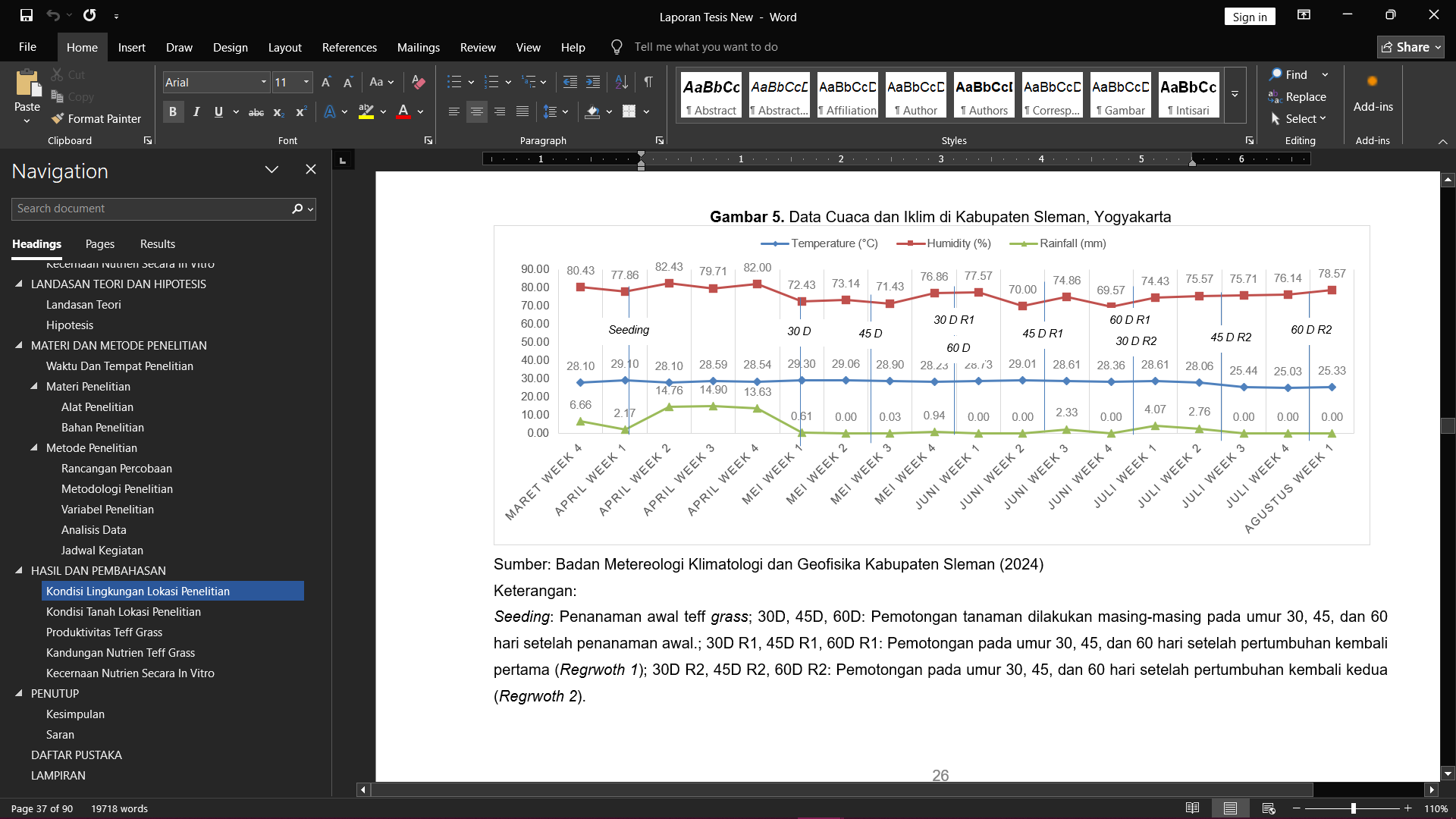
Based on data (Fig 1), changes in weather and climate during the cultivation process impact teff grass productivity and quality (69.57%-82.43% humidity, 25.33%-29.10°C temperature, and 0-14.9 mm/week rainfall). It supports plant growth because teff grass can grow optimally at 21.1-29.4°C (Roseberg et al., 2018). Teff grass requires 10°C for germination, and planting is recommended at temperatures of 18°C or higher (Paff and Asseng, 2018). Teff grass possesses the capacity to survive and adapt to diverse environmental conditions. The optimal annual rainfall and during the growing season are 750–850 mm and 450–550 mm, respectively (Girija et al., 2022). Favorable weather conditions are crucial for optimal plant growth. These conditions include temperature, rainfall, and humidity levels. Climate and weather influence crop production differently. A fatal weather event during the growth period can impact crop production (Iizumi and Ramankutty, 2015).
Based on the results (Table 1), the soil's pH was found to be quite desirable (close to 7) in the research area. However, the percentage of other components in the soil could be considered relatively low as a planting medium (1.86% water content, 1.37% organic matter, and 0.1% nitrogen content). Soil pH analysis in land management efforts provides information on degradation processes affecting productivity, including nutrient availability, soil acidification, salinity, sulfate soil oxidation, conditions, and interactions with soil organisms, such as plant root diseases. Additionally, from a soil fertility perspective, such analysis is crucial to avoid aluminum and manganese toxicity in soils with low pH levels (Mosley et al., 2024).
The relatively low moisture content (1.86%) is thought to be due to the type of soil used in the study. This soil includes Regosol with a dominant sandy component. This component may be linked to problems in the water absorption process. These problems reduce the soil's ability to drain water (permeability). Despite the low moisture content in the soil, teff grass can survive in soils with extreme water conditions combined with low susceptibility to pests and diseases, making it a low-risk crop (Lombamo, 2020).
The amount of soil organic matter is measured at 1.37%, which is considered quite low. Soil organic matter plays a pivotal role in enhancing soil aggregate stability and structure, as well as augmenting water retention capacity (Hartati et al., 2023). Furthermore, the relatively low nitrogen content (0.1%) at the study site may affect the soil's ability to support plant growth and development because plants require nitrogen in large quantities. Organic fertilization before planting and after teff grass cutting should be done to improve yields. However, the amount of nitrogen applied should be adjusted because excessive use can cause lodging and seed loss in teff grass, which is also observed in other cereal crops. Additionally, excess nitrogen released into the environment can contribute to climate change by degrading air and water quality (Halpern et al., 2021).
Morphological characterization
Table 2 presents the morphological characteristic data for teff grass. The interaction between cutting age and regrowth phase exhibited a significant interaction effect on plant height and length (P < 0.05). The maximum plant height was observed during the R2 at 60 DAP (40.07±1.80 cm), while the minimum value was recorded during the initial cutting at 45 DAP (20.03±8.91 cm). The longest plant length was recorded in R1 at 60 DAP (80.94±1.26 cm), while at the same phase, a cutting age of 45 DAP (58.06±4.87 cm), which was also the shortest plant length produced from all treatments. Variations in plant height measurements can be attributed to the propensity of teff grass to exhibit crooked growth patterns as it matures. The final plant height is contingent upon the specific variety and the prevailing growing conditions, with reported values ranging from 20-156 cm (Jifar et al., 2022), with an average of 100 cm (Paff and Asseng, 2018). Jifar et al. (2022) also posited that stems of teff grass are characterized by their elongated, slender structure, which gradually narrows towards the tip. As the plants approach maturity, they exhibit a distinctive tendency to bend under their own weight.
The cutting age and regrowth phase have a significant interaction (P < 0.05) on the number of leaves, with the highest and lowest numbers occurring in the initial cutting at 60 DAP (8.13±0.12 leaf) and 45 DAP (4.00±0.00 leaf), respectively. Furthermore, the number of leaves yielded satisfactory results, with the initial cutting (4–8 leaf), R1 (4–5 leaf), and R2 (4–8 leaf) at all cutting ages, despite a decrease in the R1 phase. Teff grass grows in clumps and has many stems. The process of vegetative propagation can be furthered by the production of additional stems from these initial stems. Consequently, teff grass possesses a comparatively substantial diameter (Jifar et al., 2022). Leaves are pivotal to photosynthesis, the process by which plants convert sunlight into food. An increase in the number of leaves results in an enhancement of photosynthesis. Therefore, it is possible to ascertain the health of plants (Nauw et al., 2021).
Leaf length and width showed differences in averages between regrowth phases. The initial cutting at 30 DAP resulted in significantly shorter leaves (13.22 ± 3.97 cm) and narrower leaves (0.27 ± 0.06 cm) compared to the R1 (20.55±2.53 cm and 0.35±0.052 cm) and R2 (20.31±1.77 cm and 0.41±0.01 cm). However, these measurements were statistically similar to each other between cutting ages at 45 and 60 DAP. This finding suggests that regrowth plants exhibit an increase in leaf surface area is directly correlated with a corresponding increase in the change in leaf angle. This change can illustrate the shifting
Table 1. The following report of the soil analysis conducted at the designated research site.
| Test parameters | Value |
|---|---|
| Soil moisture content (%) | 1.86 |
| pH (H2O) | 6.65 |
| Organic matter (%) | 1.37 |
| N total (%) | 0.10 |
Table 2. Morphological characteristics of teff grass.
| Parameters | Age of Cutting | Regrowth | Mean | ||
|---|---|---|---|---|---|
| 1st Cut0 | R11 | R21 | |||
| Plant Height (cm)* | 30 DAP | 37.86±2.53ab | 35.90±5.38ab | 31.87±4.10ab | 35.21±3.06 |
| 45 DAP | 20.03±8.91b | 29.59±4.3ab | 33.09±3.52ab | 27.57±6.76 | |
| 60 DAP | 21.31±7.54ab | 31.87±4.10ab | 40.07±1.80a | 31.08±9.41 | |
| Mean | 26.40*±9.95b | 32.45±3.20ab | 35.01±4.43a | ||
| Plant Length (cm)** | 30 DAP | 60.88±4.03b | 69.24±9.85ab | 80.94±1.26a | 70.35±10.08 |
| 45 DAP | 66.30±17.99ab | 58.06±4.87b | 63.55±2.93ab | 62.64±4.20 | |
| 60 DAP | 74.87±8.25ab | 80.94±1.26a | 67.63±3.79ab | 74.48±6.67 | |
| Mean | 67.35±7.05 | 69.41±11.44 | 70.71±9.10 | ||
| Number of Leaves (Leaf)* | 30 DAP | 4.80±0.53bc | 4.27±0.70c | 6.00±0.20b | 5.02±0.89ab*** |
| 45 DAP | 4.00±0.00c | 4.40±0.35c | 5.93±0.50b | 4.78±1.02b | |
| 60 DAP | 8.13±0.12a | 4.47±0.23c | 7.67±0.31a | 6.76±1.10a | |
| Mean | 5.64±2.19b*** | 4.38±0.10c | 6.53±0.98a | ||
| Leaf length (cm) | 30 DAP | 16.74±2.69 | 19.49±1.54 | 22.11±3.80 | 19.45*±2.68a |
| 45 DAP | 8.925±0.70 | 18.73±1.66 | 18.57±1.03 | 15.406±5.61b | |
| 60 DAP | 13.99±3.37 | 23.44±2.95 | 20.24±0.65 | 19.22±4.81a | |
| Mean | 13.22±3.97b* | 20.55±2.53a | 20.31±1.77a | ||
| Leaf Width (cm) | 30 DAP | 0.33±0.26 | 0.33±0.03 | 0.41±0.04 | 0.35±0.05 |
| 45 DAP | 0.28±0.10 | 0.32±0.02 | 0.40±0.02 | 0.33±0.06 | |
| 60 DAP | 0.21±0.06 | 0.41±0.03 | 0.41±0.03 | 0.34±0.12 | |
| Mean | 0.27*±0.06b | 0.35±0.052ab | 0.41±0.01a | ||
| Stem Length(cm)* | 30 DAP | 44.14±2.24ab | 49.75±9.88ab | 58.83±2.62a | 50.91±7.41 |
| 45 DAP | 57.38±18.58ab | 39.33±4.62b | 44.98±2.06ab | 47.23±9.23 | |
| 60 DAP | 60.87±9.73a | 57.50±1.82ab | 47.39±3.98ab | 55.25±7.02 | |
| Mean | 54.13±8.83 | 48.86±9.12 | 50.40±7.402 | ||
| Stem Diameterns | 30 DAP | 0.51±0.03 | 0.51±0.01 | 0.50±0.00 | 0.51±0.01 |
| 45 DAP | 0.51±0.02 | 0.49±0.00 | 0.50±0.01 | 0.50±0.01 | |
| 60 DAP | 0.51±0.02 | 0.50±0.01 | 0.51±0.01 | 0.51±0.01 | |
| Mean | 0.51±0.01 | 0.50±0.01 | 0.50±0.01 | ||
Note. Significant codes: ‘***’ 0.001, ‘**’ 0.01, ‘*’ 0.05, ‘.’ 0.1, ‘ ’ 1, ‘ns’ not significant; Treatments with the same letter are not significantly different; DAP = Days After Planting; 1st cut = Initial cutting; R1 = Initial regrowth; R2 = Secomdary regrowth; 0= The process of defoliation is contingent upon the age of the cutting, 1= Defoliation is to be executed at 30-day intervals subsequent to the previous cutting phase.
position of leaves vertically and horizontally relative to the stem. This phenomenon is theorized to be an evolutionary adaptation that enables the plant to optimize its photosynthetic capacity, thereby maximizing its absorption of solar radiation (Usmadi et al., 2024). Teff grass is a plant that efficiently uses carbon dioxide (CO2) during photosynthesis. Teff grass leaves have a central vein surrounded by bundle sheath cells with many chloroplasts, and a relatively low CO2 compensation point in the leaves (Assefa et al., 2015).
Stem length interacted significantly with cutting age and regrowth (P < 0.05). The longest stems were observed in the initial cutting at 60 DAP (60.87 ± 9.73 cm) and the shortest at 45 DAP R1 (39.33 ± 4.62 cm). The length of the stem affects the overall height of the plant, along with the flowers and seeds. In teff grass, the stem to panicle length contributes about 50-67% and averages 59% of the plant height (Muluken et al., 2020). Conversely, stem diameter demonstrated stability across all treatments and ages, showing no significant differences (P > 0.05). This indicates that, while plants invest in vertical growth and leaf production in response to cutting, stem diameter remains constant. This trait is important for resistance to
Table 3. Production parameters of teff grass.
| Parameter | Age of Cutting | Regrowth | Mean | ||
|---|---|---|---|---|---|
| 1st Cut0 | R11 | R21 | |||
| Fresh Production (tons/ha) *** | 30 DAP | 5.18±0.74ab | 6.61±1.12ab | 6.99±0.32ab | 6.26±0.95 |
| 45 DAP | 7.50±0.50ab | 4.00±0.13b | 4.87±0.60b | 5.46±1.82 | |
| 60 DAP | 9.41±2.19a | 4.05±0.24b | 4.34±0.27b | 5.93±3.01 | |
| Mean | 7.36±2.12a*** | 4.89±1.49b | 5.40±1.40b | ||
| Dry Matter Production (tons/ha) *** | 30 DAP | 1.39±0.18bc | 1.61±0.22bc | 1.86±0.02bc | 1.62±0.24b* |
| 45 DAP | 2.16±0.12b | 1.10±0.05c | 1.34±0.18bc | 1.53±0.56b | |
| 60 DAP | 3.23±0.36a | 1.06±0.05c | 1.20±0.18bc | 1.83±1.22a | |
| Mean | 2.26±0.93a*** | 1.25±0.31b | 1.47±0.35b | ||
| Organic Matter Production (tons/ha) *** | 30 DAP | 1.20±0.18bc | 1.43±0.21bc | 1.64±0.02abc | 1.42±0.22 |
| 45 DAP | 1.85±0.11b | 0.97±0.04bc | 1.19±0.16bc | 1.34±0.46 | |
| 60 DAP | 2.80±0.33a | 0.93±0.04c | 1.07±0.16bc | 1.60±1.04 | |
| Mean | 1.95±0.80a*** | 1.11±0.28b | 1.30±0.30b | ||
Note. Significant codes: ‘***’ 0.001, ‘**’ 0.01, ‘*’ 0.05, ‘.’ 0.1, ‘ ’ 1, ‘ns’ not significant; Treatments with the same letter are not significantly different; DAP = Days After Planting; 1st cut = Initial cutting; R1 = Initial regrowth; R2 = Secomdary regrowth; 0= The process of defoliation is contingent upon the age of the cutting, 1= Defoliation is to be executed at 30-day intervals subsequent to the previous cutting phase.
lodging in teff cultivation. Preliminary findings from prior studies have demonstrated a congruence in the measurement outcomes, thereby substantiating the reliability of the methodology. These studies have consistently revealed that the stem diameter of teff grass is 5 millimeters (Paff and Asseng, 2018).
Plant production
The results of the study (Table 3) indicate a highly significant interaction (P < 0.001) between cutting age and regrowth phase for fresh, DM and OM production of teff gras. The maximum fresh yield was obtained from the initial cutting at 60 DAP (9.41 ± 2.19 tons/ha), which was significantly greater than all yields from the regrowth phase (R1 and R2) at 45 and 60 DAP. As in fresh production, the initial cutting at 60 DAP yielded the highest DM production (3.23 ± 0.36 tons/ha). OM production follows a statistical pattern identical to that of DM. The highest OM yield was produced at 60 DAP (2.80 ± 0.33 tons/ha). The average OM yield from the initial cutting (1.95 ± 0.80 tons/ha) was significantly greater than that from the R2 phase. These results are regarded as indicative of sufficiently high production levels, as evidenced by prior studies demonstrating robust teff grass productivity in various regions, including South Korea, where yields reach up to 2.47 tons/acre, and the United States, where yields can reach up to 9.4 tons/acre (Habte et al., 2019).
The yield of teff grass is subject to the influence of internal factors that must be given full consideration. Among these factors is the physiological condition of the plant. Conversely, external factors such as environmental and climatic conditions have been identified as the most significant determinants of production (Sariffudin et al., 2021). Furthermore, defoliaton of teff grass during the boot stage to early heading stage (55 to 60 DAP) has undergone a significant transformation in which the majority of photosynthetic compounds have been converted into structural compounds. It has been demonstrated that structural compounds are largely unavailable to the plant and cannot be used as a nutrient source (Saylor et al., 2021). However, a substantial increase in rainfall was observed during the second regrowth phase, accompanied by a significant increase in teff grass production during this phase compared to the first regrowth phase at all cutting ages. The findings indicate that teff grass biomass yield is significantly higher, which is believed to be due to increased rainfall after planting (Ruggeri et al., 2024).
Nutrient content
The nutrient content of teff grass, including dry matter (DM), organic matter (OM), crude protein (CP), ether extract (EE), crude fiber (CF), and nitrogen-free extract (NFE), exhibited a significant response to variations in cutting age and regrowth phase. The detailed results are presented in Table 4. The effects of various treatments on DM content showed significant interactions (P < 0.01). The initial cutting at 60 DAP exhibited the highest DM content (35.05 ± 4.29%), which was significantly higher than the regrowth phase at the same age. The initial cutting had the highest DM content (30.25 ± 4.27%), followed by the R1 (25.98 ± 1.44%), and R2 (27.26 ± 0.52%). This increase in DM with maturity for the first cut is typical, reflecting a higher proportion of structural carbohydrates. It has been established that prolonging the cutting age will result in an increase in the percentage of DM value in the initial cutting phase. The duration of assimilation in plant growth and development is directly correlated with the observed increase in plant DM (Koten et al., 2013). Teff grass regrowth significantly declined at 60 DAP (26–27%) compared to its DM value at the initial cutting (35.05%). The faster cutting interval (30 days after the previous cutting) in the regrowth phase may be a contributing factor. Cutting intervals that are too short reduce dry material production because the plant did not reach its maximum peak (Bedinan et al., 2022).
Table 4. Nutrient content of teff grass.
| Parameter | Age of Cutting | Regrowth | Mean | ||
|---|---|---|---|---|---|
| 1st Cut0 | R11 | R21 | |||
| DM(%)** | 30 DAP | 26.89±1.87ab | 24.49±0.78b | 26.66±1.40b | 26.01*±1.33b |
| 45 DAP | 28.82±1.46ab | 27.37±0.59ab | 27.53±1.17ab | 27.90±0.79ab | |
| 60 DAP | 35.05±4.29a | 26.09±0.23b | 27.59±2.61ab | 29.58±4.80a | |
| Mean | 30.25±4.27a*** | 25.98±1.44b | 27.26±0.52ab | ||
| OM(%)*** | 30 DAP | 86.39±1.87 | 88.43±1.10 | 88.28±0.65 | 87.70±1.14 |
| 45 DAP | 85.93±0.68 | 88.77±0.24 | 88.60±0.27 | 87.77±1.60 | |
| 60 DAP | 86.46±1.17 | 88.16±0.77 | 88.74±0.35 | 87.79±1.19 | |
| Mean | 86.26***±0.29b | 88.45±0.31a | 88.54±0.23a | ||
| CP(%)* | 30 DAP | 13.40±0.72abc | 14.96±2.30abc | 15.46±0.30abc | 14.61±1.08 |
| 45 DAP | 10.68±0.18c | 15.86±1.06ab | 16.62±1.75ab | 14.39±3.23 | |
| 60 DAP | 11.99±1.41bc | 17.05±0.51ab | 18.16±0.74a | 15.73±3.29 | |
| Mean | 12.02±1.36b | 15.96±1.05a | 16.75±1.36a | ||
| EE(%)** | 30 DAP | 1.38±0.41ab | 1.83±0.42ab | 2.22±0.17a | 1.81±0.42 |
| 45 DAP | 1.62±0.25ab | 1.81±0.44ab | 1.81±0.13ab | 1.75±0.12 | |
| 60 DAP | 2.03±0.29ab | 1.26±0.11b | 1.47±0.14ab | 1.59±0.40 | |
| Mean | 1.68±0.33 | 1.63±0.33 | 1.83±0.38 | ||
| CF(%) | 30 DAP | 31.70±0.64 | 33.31±1.59 | 33.64±0.67 | 32.89±1.04b* |
| 45 DAP | 32.61±0.57ab | 36.30±1.81 | 36.34±0.52 | 35.08±2.14ab | |
| 60 DAP | 36.22±2.76 | 36.14±2.20 | 37.08±0.76 | 36.48±0.53a | |
| Mean | 33.51±2.39b* | 35.25±1.68ab | 35.69±1.81a | ||
| NFE(%) | 30 DAP | 39.91±2.06 | 38.32±5.29 | 36.96±0.47 | 38.40±1.47 |
| 45 DAP | 41.02±0.56 | 34.80±2.83 | 33.83±2.60 | 36.55±3.90 | |
| 60 DAP | 36.22±4.33 | 33.71±2.85 | 32.03±1.74 | 33.99±2.11 | |
| Mean | 39.05±2.51a* | 35.61±2.41ab | 34.27±2.50b | ||
Note. Significant codes: ‘***’ 0.001, ‘**’ 0.01, ‘*’ 0.05, ‘.’ 0.1, ‘ ’ 1, ‘ns’ not significant; Treatments with the same letter are not significantly different; DAP = Days After Planting; 1st cut = Initial cutting; R1 = Initial regrowth; R2 = Secomdary regrowth; 0= The process of defoliation is contingent upon the age of the cutting, 1= Defoliation is to be executed at 30-day intervals subsequent to the previous cutting phase.; DM = Dry matter; OM = Organic matter; CP = Crude protein; EE= Extract Ether, NFE= Nitrogen free extract.
There was no interaction with OM. However, a significant difference was observed in the regrowth phase (p < 0.001). The regrowth phase (R1 and R2) exhibited a substantially elevated mean OM content (88.45% and 88.54%, respectively) in comparison to the initial cutting (86.26%). These findings indicate that the regrown forage contains a lower ash content, as well as a higher proportion of digestible organic components. It has been established that the OM of plants tends to rise with their age (Umami et al., 2019).
The CP analysis showed a significant interaction effect (P < 0.05), with the highest CP content at 60 DAP (18.163%) in the R2 phase and the lowest at 45 DAP (10.68 ± 0.18%) in the initial cutting phase. The initial cutting phase exhibiting the highest CP content was obtained at a cutting age of 30 DAP, while the lowest content was observed at a cutting age of 45 DAP (13.40% at a cutting age of 30 DAP, 11.99% at 60 DAP, and the lowest at 45 DAP, which was 10.68%). It has been observed that earlier cutting, defined at 30 DAP, can result in higher CP content during the initial cutting phase. However, this practice exhibits an inverse effect on teff grass production. This phenomenon is supported by environmental conditions, such as the relatively high temperature of 28°C at the research site, which can influence the maturation process of teff grass. Reduced temperatures have been shown to decelerate the maturation process and the production of structural fiber compounds, consequently increasing CP concentration and enhancing the overall nutritional value of forage (Saylor et al., 2021).
A subsequent analysis conducted during the regrowth phase revealed a notable increase in CP content, with the highest recorded value attained at 60 DAP in the R1 phase (17.05%), followed by 45 DAP (15.86%) and the lowest recorded at 30 DAP (14.96%). In R2 phase, the maximum result was also obtained at a cutting age of 60 DAP (18.16%) in comparison to cutting ages of 30 and 45 DAP (15.463% and 16.62%, respectively). In consideration of the aforementioned results, it can be posited that the regrowth of teff grass has the potential to enhance the CP content. During this phase, which is characterized by relatively shorter cutting intervals, the plants prioritize vegetative growth, particularly the development of leaves and young shoots, over stem and flower growth. During the vegetative growth phase, the proportion of leaves is generally higher than that of stems. As the plant matures, the ratio of leaves to stems declines. A lower leaf-to-stem ratio has been demonstrated to affect crude protein content, energy content, and other nutrient contents (Bedinan et al., 2022).
The EE content was found to be relatively low under all treatments. The highest EE was identified in R2 at 30 DAP (2.217%) and the lowest was observed in R1 at 60 DAP (1.257%). In light of the findings, it was determined that there was a highly significant effect (P < 0.01). However, no consistent pattern emerged between increases and decreases in crude fat content and cutting age or regrowth. The findings on the EE content indicated that the results obtained in this study were lower in comparison to those reported in previous studies. Previous studies had reported that the crude fat content of teff grass ranged from 2.92-3.34 g/100g DM. This range indicates that the EE content of teff grass was slightly higher than that of barley, corn, and wheat, but lower than that of sorghum and oats (Amare et al., 2021).
The findings of this study, as derived from meticulous analysis, yielded substantial results pertaining to the impact of cutting age on the teff grass regrowth process. However, the analysis revealed an absence of interaction between cutting age and teff grass regrowth. The content of CF increased with cutting age, reaching 31.704% (30 DAP) in the initial cutting, followed by increases to 32.608% (45 DAP) and 36.216% (60 DAP). The CF content during the regrowth phase exhibited relatively stability (33–37%) without significant fluctuations between cutting ages. Teff grass is distinguished from legumes, in which, it contains higher structural components, such as hemicellulose, cellulose, and lignin, in its leaves and stems. Consequently, the nutritional value of grass tends to decrease more rapidly in comparison to legumes (Saylor et al., 2021).
The interaction between age of cutting and regrowth phase had no significant effect, but there was a significant effect on the regrowth phase of teff grass (P < 0.05). NFE was highest in the initial cutting at 30 DAP (39.91%) and decreased in R1 (38%) and R2 (36%) phases. Ruminant livestock can use fiber and NFE to get the carbohydrates in their diet that come from forage. Therefore, ruminant livestock are capable of utilizing carbohydrate sources derived from forage that are inaccessible to non-ruminants (Aling et al., 2020).
In vitro nutrient digestibility
The present study found that in vitro dry matter digestibility (IVDMD) and in vitro organic matter digestibility (IVOMD) exhibited a consistent pattern (Table 5). At each cutting age (30, 45, and 60 DAP), the IVDMD values of both the regrowth phase (R1 and R2) were consistently and significantly higher than those of the initial cutting (P < 0.001). The highest mean IVDMD was observed in R2 (72.68%), followed by R1 (71.87%), and the lowest was recorded in initial cutting (64.63%). The IVOMD values for R1 (77.90%) and R2 (78.90%) were analogous, yet both exhibited a significant increase compared to the initial cutting measurement of 70.27%. The increase in IVOMD is directly proportional to that of IVDMD, as organic matter constitutes a component of dry matter, resulting in analogous outcomes. The two fractions have similar results influenced by factors like feed ingredients, plant maturity, and rumen microbes (Umami et al., 2017).
The difference between R1 and R2 was not found to be statistically significant. However, both were statistically better than the initial cutting. The improvement observed in this phase was hypothesized to be due to the relatively shorter cutting interval compared to the previous phase, which lasted 30 days from the previous cutting phase. The hypothesis that cutting occurs when teff grass is in the stage of new tissue formation during the regrowth phase, such as young leaf growth, is based on the premise that there is a direct correlation between the strength and hardness of plant cell walls and the fiber content, including lignin, in plants used as supports. This relationship is believed to be bidirectional, meaning that an increase in fiber content results in stronger cell walls (Oktaviani et al., 2020). Conversely, a lower fiber fraction level is considered to increase energy efficiency in feed degradation by rumen microbes. This will increase the digestibility of nutrients by livestock (Umami et al., 2019).
Table 5. In vitro digestibility of teff grass.
| Parameter | Age of Cutting | Regrowth | Mean | ||
|---|---|---|---|---|---|
| 1st Cut0 | R11 | R21 | |||
| IVDMD (%) | 30 DAP | 67.99±4.96 | 71.71±1.72 | 72.17±0.82 | 70.63±2.29 |
| 45 DAP | 62.56±1.58 | 71.35±1.69 | 72.57±1.23 | 68.82±5.46 | |
| 60 DAP | 63.32±3.34 | 72.56±2.35 | 73.29±1.94 | 69.72±5.55 | |
| Mean | 64.63±2.94b*** | 71.87±0.622a | 72.68±0.56a | ||
| IVOMD (%) | 30 DAP | 73.73±5.21 | 74.97±4.10 | 79.94±1.62 | 76.21±3.29 |
| 45 DAP | 68.88±3.76 | 78.91±2.46 | 76.87±5.83 | 74.89±5.30 | |
| 60 DAP | 68.21±2.64 | 79.82±1.10 | 79.89±4.45 | 75.97±6.72 | |
| Mean | 70.27±3.01b*** | 77.90±2.58a | 78.90±1.76a | ||
Note. Significant codes: ‘***’ 0.001, ‘**’ 0.01, ‘*’ 0.05, ‘.’ 0.1, ‘ ’ 1, ‘ns’ not significant; Treatments with the same letter are not significantly different; DAP = Days After Planting; 1st cut = Initial cutting; R1 = Initial regrowth; R2 = Secomdary regrowth; 0= The process of defoliation is contingent upon the age of the cutting, 1= Defoliation is to be executed at 30-day intervals subsequent to the previous cutting phase; IVDMD = In vitro dry matter digestibility; IVOMD = In Vitro Organic matter digestibility.
Materials and methods
Study site conditions and material preparation
The present study was conducted in Kalijeruk, Widodomartani, Ngemplak District, Sleman Regency, Special Region of Yogyakarta 55584, which served as the location for the planting of teff grass. The present study was conducted at the
Fig 1. Average Temperature (oC), Humidity (%), and Rainfall (mm/week) at the research site during the study Source: Sleman Regency Meteorology, Climatology, and Geophysics Agency (2024). Note. Seeding: Initial teff grass planting; 30D, 45D, 60D: Initial cutting was performed at 30, 45, and 60 DAP. 30D R1, 45D R1, and 60D R1: Crop cutting at 30, 45, and 60 DAP during the initial regrowth phase after the initial cutting (Regrowth 1). 30D R2, 45D R2, and 60D R2: Cutting at 30, 45, and 60 DAP during the secondary regrowth phase (Regrowth 2).
Laboratory of Forage and Pasture, Faculty of Animal Science, Universitas Gadjah Mada, and the Animal Testing and Instrument Standards Laboratory (BPSI-UAT). The research was conducted from April 1, 2024 to December 11, 2024. Climate data recorded during the study period were provided by the Meteorology, Climatology, and Geophysics Agency in Sleman, Yogyakarta (Figure 1). The soil at the study site is classified as Regosol. Prior to the initiation of the study, soil samples were collected from depths of 0 to 20 cm at several sampling points and then combined for chemical analysis (Table 1).
The land of 100 m² was prepared by plowing, followed by the creation of planting areas and irrigation channels. The incorporation of manure as a base fertilizer is attributable to the comparatively limited nutrient content in the soil at the research site as a growing medium. The number of seeds is equivalent to 16.81 kg/ha (Saylor et al., 2021). During the teff grass planting stage, the seeds are evenly mixed with sand at a ratio of 1:2 and then evenly spread over the planting medium. This is due to the relatively small size of the plant seeds. Teff grass produces seeds with a size of 1–1.7 mm and a width of 0.6–1 mm (Jifar et al., 2022), with an average width of approximately 0.5 mm (Paff and Asseng, 2018). Teff grass is cultivated using irrigation water sourced from rivers that flow into irrigation channels. Furthermore, weeds growing around the plants are removed on a weekly basis at the onset of growth and subsequent to cutting. Subsequently, a dose of 20 g/m2 of NPK (16:16;16) fertilizer is applied post-cutting.
Experimental design
The experimental design of the present study employed a split-plot design cross-over, comprising two factors: cutting age (30, 45, and 60 DAP) as the main plot (whole periods) and regrowth (First cutting, Initial regrowth, and secondary regrowth) as the sub plot (sub periods). In this design, one or more treatments are applied to each experimental unit in a precise order over several consecutive periods. This design allows for more accurate comparisons of treatment effects by reducing errors caused by variations between units (Raghavarao and Xie, 2003).
The area was prepared by plowing, then divided into 9 plots, with each plot measuring 1 m by 1 m. The plots were arranged in 3 rows, with each row consisting of 3 plots for replication, with a distance of approximately 1 m between adjacent plots. Teff grass was harvested at a cutting height of 10 centimeters above ground level, comprising three distinct cutting ages: 30, 45, and 60 DAP. The cutting procedure was executed during the regrowth phase, occurring at 30-day intervals following the previous cutting phase, in accordance with the cutting age plot. The regrowth phases were categorized into three distinct stages: initial cutting, initial regrowth, and secondary regrowth.
Data collection of morphological and production parameters
Plant morphology observations were conducted before each defoliation activity according to the cutting's age and the regrowth phase. The morphological characteristics of teff grass were measured by randomly selecting five plants per plot, marking them, and measuring their morphological parameters. The height of the plants was measured from the stem above the ground to the highest part of the plant. The length (plant, leaf, and stem), leaf width, and stem diameter was measured then recorded. The number of leaves was determined by enumerating all the leaves in the plant (Umami et al., 2022). Production (fresh, DM, and OM production) of teff grass were determined by weighing the weight. recorded, and analyzed of each plot according to cutting age and regrowth phase in the plants to determine plant production.
Evaluation of chemical components
Teff grass that has been defoliated is sampled according to its cutting age and regrowth phase. Then, it is placed in paper envelopes of a known weight. The samples are dried in an oven at 55°C for approximately 3 days, until their weight is constant, to determine their dry weight. The samples are ground using a willey mill with a 1 mm screen diameter. Teff grass samples from each cutting age and regrowth phase were analyzed using the AOAC (2005) proximate analysis method to measure dry matter (DM), organic matter (OM), crude protein (CP), crude fiber (CF), extract ether (EE), and nitrogen-free extract (NFE).
Evaluation of in vitro digestibility
Livestock experimental procedures, including the collection of rumen fluid for in vitro analysis, were approved by the Ethical Clearance Committee of the Laboratory for Integrated Research and Testing, Universitas Gadjah Mada (letter number 00004/II/UN1/LPPT/EC/2025), thereby ensuring adherence to animal welfare and ethical research standards. In vitro dry matter digestibility (IVDMD) and in vitro organic matter digestibility (IVOMD) were evaluated using a modified version of the method described by Tilley and Terry (1963) to determine the extent of feed digestibility by rumen microbes.
Statistical analysis
The parameters of the productivity, nutrient content, and in vitro nutrient digestibilty of teff grass were statistically analyzed using analysis of variance (ANOVA). Post-hoc comparisons were performed using Honestly Significant Difference (HSD) test to determine significant differences among cutting age and regrowth phase. Statistical analyses were conducted with R Studio software.
Conclusions
The present study demonstrates that the interaction between cutting age and the regrowth of teff grass has a significant impact on productivity and nutrient content. The highest results were achieved at a cutting age of 60 DAP. The application of a cutting age of 60 DAP resulted in the highest feed productivity at the initial cutting stage, followed by a decline during the regrowth phase. However, an increase in nutrient content was observed during the regrowth phase, which also occurred at a cutting age of 45 DAP. Conversely, a cutting age of 30 DAP yielded relatively stable results, from the initial cutting stage to the regrowth phase, though it did not yield the optimal results. In comparison with the initial cutting stage, there was an enhancement in nutrient digestibility during the regrowth phase of teff grass at all cutting ages. The 60 DAP cutting age exhibited the greatest increase in IVDMD and IVOMD from the initial cutting phase to the regrowth phase.
Acknowledgments
The authors would like to express their gratitude to the various parties that provided support for this research, in particular Crop Mark Seed Company, New Zealand, for the provision of research materials, and the Equity Program from Universitas Gadjah Mada for the provision of research funding.
References
Aling C, Tuturoong RAV, Tulung YLR, Waani MR (2020) Digestibility Of Crude Fiber and Nnfe (Non Nitrogen Free Extract) Complete Feed Based on Corn Forage On Ongole Crossbreed Cattle. Zootec 40(2): 428-438.
Amare E, Grigoletto L, Corich V, Giacomini A, Lante A (2021) Fatty acid profile, lipid quality and squalene content of teff (Eragrostis teff (zucc.) trotter) and amaranth (Amaranthus caudatus L.) varieties from ethiopia. Appl Sci 11(8): 1-12
AOAC (2005) Official methods of analysis (16th ed.). Association of Official Analytical Chemists, International.
Assefa K, Cannarozzi G, Girma D, Kamies R, Chanyalew S, Plaza-Wuthrich S, Blosch R, Rindisbacher A, Rafudeen S, Tadele Z (2015) Genetic diversity in tef (Eragrostis tef (Zucc.) Trotter). Front Plant Sci 6: 1–13.
Bedinan K, Jelantik IGN, Benu I (2022) Effect of Defoliation Age on The Production and Energy Value of Indian Bluegrass (Bothriochloa pertusa). JTAST 4(2): 132–143.
Girija A, Jifar H, Jones C, Yadav R, Doonan J, Mur LAJ (2022). Tef: a tiny grain with enormous potential. Trends Plant Sci 27(3): 220–223.
Habte E, Muktar MS, Negawo AT, Lee SH, Lee KW, Jones CS (2019) An Overview of Teff (Eragrostis teff Zuccagni) Trotter ) as a Potential Summer Forage Crop in Temperate Systems. J Kor Grassl Forage Sci 39(3): 185–188.
Halpern M, Gashu K, Zipori I, Saranga Y, Yermiyahu U (2021) Tef (Eragrostis tef) responses to phosphorus and potassium fertigation under semi-arid mediterranean climate. Agronomy 11(8): 1–19.
Hartati TM, Teapon A, Wati I, Indrawati USYV, Aji K (2023) Analysis of infiltration capacity in several types of dry land in Sasa Village, South Ternate District. Agrikultura 34(3): 401-410.
Iizumi T, Ramankutty N (2015) How do weather and climate influence cropping area and intensity?. Global Food Security 4: 46–50.
Jifar H, Chanyalew S, Tadele Z, Assefa K (2022) Tef taxonomy, origin, distribution and genetic resources. In Principles and Practice of Tef Improvement. Ethiopian Institute of Agricultural Research and Agricultural Transformation Agency, Addis Ababa Ethiopia.
Kimura E, Ramirez J (2024) Teff grass increases summer forage availability in the Rolling Plains of Texas. Agrosystems, Geosciences and Environment 7(2): 1–6.
Koten BB, Soetrisno RD, Ngadiyono N, Suwignyo B (2013) Production of Sorghum Plant (Sorghum bicolor (L.) Moench) of Rote Local Variety as Forage for Ruminant Feed at Different of Harvest Time and Urea Level. Buletin Peternakan 36(3): 150-155.
Lombamo T (2020) Review Paper on: Potential and Constraints of Teff Row Planting for Enhancing Productivity. Journal of Biology, Agriculture and Healthcare, 10(3): 52–63.
Mosley LM, Rengasamy P, Fitzpatrick R (2024) Soil pH: Techniques, challenges and insights from a global dataset. Eur J Soil Sci 75(6): 1–18.
Muluken B, Atsushi T, Nigussie H, Takayoshi I, Getachew A, Mitsuru T, Enyew A, Asaminew T, Wataru T, Fekremariam A, Tsugiyuki M (2020) Biomechanical Properties and Agro-Morphological Traits for Improved Lodging Resistance in Ethiopian. Agronomy: 1–20.
Nauw S, Sawen D, Nuhuyanan L. Junaidi M (2021) Growth Response of Setaria Grass (Setaria sphacelata) on Application of Cuscus Manure In The Second Defoliation. Pastura 11(1): 29-34.
Oktaviani W, Khairani L, Indriani NP (2020) The Effect of Variety of Sweet Corn Varieties (Zea mays saccharata sturt) onHigh Crop, Number of Leaves, and Lignin Contents of Corn Crop. J. Trop Anim Nutr and Feed Sci 2(2): 60–70.
Paff K, Asseng S (2018) A review of tef physiology for developing a tef crop model. Eur J Agron, 94: 54–66.
Raghavarao D, Xie Y (2003) Split-plot type cross-over designs. J Stat Plann Inference 116(1): 197–207.
Roseberg R, Norberg S, Charlton B (2018) Teff Grass for Forage: Nitrogen and irrigation requirements: 1–10. https://catalog.extension.oregonstate.edu/pnw709/html
Ruggeri R, Rossini F, Ronchi B, Primi R, Stamigna C, Danieli P P (2024) Potential of teff as alternative crop for Mediterranean farming systems: Effect of genotype and mowing time on forage yield and quality. J Agric Food Res 17: 101-257.
Sariffudin AN, Umami N, Suhartanto B, Suwignyo B, Kustantinah (2021) Effect of Types and Dosages of Foliar Fertilizers on Morphology and Production of Clitoria ternatea. Indonesian J Anim Vet 26(4): 179–186.
Saylor, B. A., Min, D., Bradford, B. J. (2021). Effects of cultivar and harvest days after planting on dry matter yield and nutritive value of teff. J Anim Sci Technol 63(3): 510–519
Tilley JMA, Terry DR (1963) A two‐stage technique for the in vitro digestion of forage crops. Grass Forage Sci 18(2):104-111.
Umami N, Prasojo YS, Haq MS (2022) Morphological Characteristics and Biomass Production Brassica rapa var. Marco During the Dry Season. Anim. Prod., 24(1), 31–36.
Umami N, Respati AN, Suhartanto B, Suseno N (2017). Nutrient Composition and In Vitro Digestibility of Brachiaria decumbens Cv. Basilisk With Different Level of Fertilizer. International Seminar Trop Anim Prod: 143–146.
Umami N, Suhartanto B, Wahyono T (2019) Development of New Elephant Grass Varieties Through Gamma Radiation Mutation.
Usmadi U, Rahma ND, Harsanti RS (2024) Morphological and Physiological Characteristics of Semi-Corn Plants (Zea mays L.) in Three Planting Systems. Cemara, 21(1).
Young A, Creech E, ZoBell D, Israelsen C, Eun J (2014). Integrating teff into livestock operations. Utah State University: 1–5.