Australian Journal of Crop Science
Article | https://doi.org/10.21475/ajcs.26.20.07.pne106
Submitted: 10 July 2025 | Revised: 13 May 2026 | Accepted: 29 April 2026
Pages 504-511
Efficiency of use of symbiotic bacteria in maize culture
Leonardo César Pradebon1, Ivan Ricardo Carvalho1*, Jaqueline Piesanti Sangiovo1, Murilo Vieira Loro2, Luis Fernando Maranho Watanabe3, Aline Dutra3
1Regional University of the Northwest of the State of Rio Grande do Sul, Ijuí - RS, Brazil
2Federal University of Santa Maria, Santa Maria – RS, Brazil
3Biotrop Biological Technology Solutions, Vinhedo - SP, Brazil
*Corresponding author. carvalho.irc@gmail.com
Abstract: Although Brazil has an effective participation in the world maize market, grain productivity is still considered low. In this context, new technologies are essential for increasing the productivity of this crop, mainly linked to soil fertility. The use of growth-promoting bacteria presents itself as a new technology, which aims to reduce dependence on chemical fertilizers, promoting greater sustainability in grain production. The experiment was carried out in the municipalities of Santa Barbara do Sul- RS, Palmeira- PR, Santo Antônio de Posse- SP, Maracaju- MS, Diamantino- MT, Primavera do Leste- MT, Tangará da Serra- MT, Chapadão do Céu- GO, Uberlândia- MG and Lavras- MG. The experimental design was randomized blocks, with treatments differing between environments, totaling 75 treatments. Subsequently, the method based on Restricted Maximum Likelihood (REML) was used to estimate the variance components and genetic parameters where significance was obtained through Deviance analysis at 5% probability using the Chi-square test (x2). Subsequently, the stratified BLUP model was used to specifically recommend treatments adapted to a given region. The use of Azospirillum brasiliense and Pseudomonas fluorencens via aerial spraying, in the sowing furrow and seed treatment, using 50% and 75% of the fertilizer dose demonstrated satisfactory results for maize grain productivity.
Keywords: Azospirillum brasiliense; Pseudomonas fluorencens; fertility; Zea mays L.; productivity.
Introduction
Maize (Zea mays L.) is an important cereal of the grass family (Poaceae). Its cultivation is mainly for human and animal food with various applications, being a component of a multitude of products ranging from the manufacture of feed to the cosmetics industry (Silva et al., 2020). Brazil is the third largest producer in the world, behind only the United States of America and China. According to data from the National Supply Company, the area cultivated with this cereal in the 2023/2024 harvest was 21.07 million cultivated hectares, with a production of 117.6 thousand tons of grains (CONAB, 2024).
Although Brazil has an effective participation in the world maize market, grain productivity is still considered low. In this sense, there is room to maximize productivity through some challenges that need to be overcome, such as managing insect pests, diseases and improving fertility and soil quality (Contini et al., 2019). In this context, new technologies are essential for increasing the productivity of this crop, mainly linked to soil fertility.
Improving soil fertility is essential, since maize has a high nutritional demand and many Brazilian soils are poor in the availability of some nutrients, requiring high amounts of fertilizers (Resende et al., 2019; Pinheiro et al., 2020). Studies by Silva et al. (2016), evaluating the rate of nutrient absorption by maize, observed a nutrient export rate for grains of 14 kg of N, 4.2 kg of P and 3.5 kg of K per ton of grains produced. In this way, the use of growth-promoting microorganisms appears as an alternative to minimize the use of synthetic fertilizers, based on a nutritional balance of the plant, advocating the development of new technologies that increase the efficiency of fertilizers.
The use of growth-promoting bacteria presents itself as a new technology, which aims to reduce dependence on chemical fertilizers, promoting greater sustainability in grain production. The use of these bacteria can be carried out via seed treatment, inoculation in the sowing furrow or foliar application. Among the benefits of these bacteria are the increased availability of nutrients, mainly through the solubilization of phosphorus (P), and the synthesis and release of phytohormones (such as indoleacetic acid - IAA) and volatile organic compounds, which stimulate root growth and shoot plant (Bhattacharyya et al., 2017; Ferreira et al., 2019; Zohaib et al., 2019; Faria et al., 2022).
Furthermore, inoculation with Pseudomonas fluorescens results in increased wheat productivity (Naiman et al., 2009) and maximizes maize germination, growth and productivity (Gholami et al., 2009). Despite all the positive reports on the use of P. fluorescens as a growth promoter, little is known about its action and viability in Brazilian conditions, where there are few commercial inoculants containing the species available. So far, only Azospirillum brasilense is successfully used in Brazil and will promote the growth and productivity of field-grown maize and wheat (HUNGRIA et al., 2010), growth and biomass production by Brachiaria spp. in degraded pastures (HUNGRIA et al., 2016) and nodulation and productivity when coinoculated with rhizobia in Glycine max and Phaseolus vulgaris L. (Hungria et al., 2013).
In this way, growth-promoting bacteria present themselves as a promising technology to promote more productive, profitable and sustainable agriculture. The use of these bacteria can contribute to increasing the productivity of maize crops, reducing production costs with greater sustainability. The objective was to evaluate the influence of using the bacteria Azospirillum brasilense and Pseudomonas fluorescens and method of application on maize grain productivity.
Results and Discussion
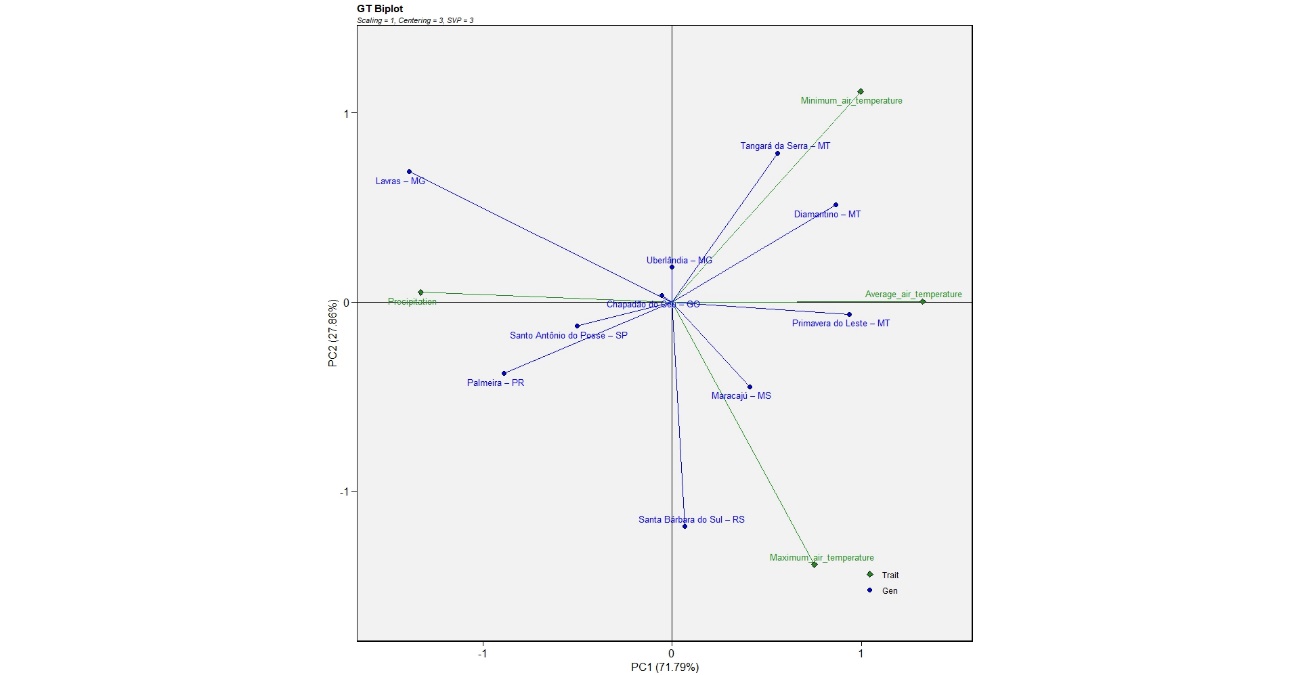
Through analysis of Biplot main components, it is possible to observe that the environments Tangará da Serra- MT and Diamantino- MT, showed greater affinity for the minimum temperature and average air temperature, with averages of 25ºC and minimums of 17ºC. Lavras-MG had a greater affinity for precipitation, with an average of 5.68 mm daily. The maximum air temperature (Figure 1), was observed greater affinity for Primavera do Leste- MT, Maracaja- MS and Santa Barbara do Sul- RS, where the maximums reached close to 36ºC. Temperatures are higher than the upper base temperature (35ºC) (Renato et al., 2013), thus stopping the development of the genotype, resulting in a decrease in the plant's physiological processes.
The descriptive analysis, stratified by phenological stage and maize cultivation environments (Figure 2), showed that in the vegetative emergence (VE) stage, the mean temperatures remained within the optimum range for the crop in all environments, with Diamantino- MT and Tangará da Serra- MT with the highest mean temperatures (25.7ºC to 29.2ºC). At the V4 stage, there was a predominance of lower mean temperatures with values between 14.7 and 22ºC in all environments with the exception of Diamantino- MT. In the V6 stage, there was a predominance of temperatures above 25ºC, unlike the reproductive period (R1 and R6), where the means were concentrated between 22 and 23.9ºC.
The maximum air temperatures (figure 2b), at the emergency stage, were higher frequencies inferred for temperatures above 31ºC, with the exception of Santa Barbara do Sul-RS and Palmeira-PR, which were environments with milder temperatures. In the other stages of crop development, maximum temperatures were within the optimum range, only in Santa Barbara do Sul-RS, in R6 temperatures above 31ºC were observed. Temperatures above the optimum range for maize (>32ºC), the photosynthesis process is reduced, stomatal closure occurs as the rate of water loss to the atmosphere is greater than the water absorbed by the roots in the soil. This minimizes CO2 assimilation, while respiration rates increase, decreasing biomass accumulation (Roig-Oliver et al., 2021).
Air temperature has a great influence on the growth and development of maize, as according to Laudien et al. (2020), events with higher minimum temperatures (18ºC) and greater rainfall promote greater productivity of maize grains in tropical climates. Therefore, it was observed that the minimum temperatures were very close to this range for most of the cultivation period, not being a limiting factor for crop productivity (Figure 2c). From accumulated precipitation, it was inferred that all locations, with the exception of Santa Barbara do Sul-RS and Palmeira-PR, presented satisfactory precipitation volumes. Several negative responses occur in water deficits that precede pollination, such as grain abscission, even if water is available at the time of pollination. Water deficit is one of the main reasons related to meteorological conditions for the low productivity of maize grains (Laudien et al., 2020), a fact that justifies the lower grain productivity in Santa Barbara do Sul- RS and Palmeira- PR.
The variance components were estimated using restricted maximum likelihood (Table 2), and the Deviance analysis showed significance (p<0.10) of probability for the effects of environments in relation to grain productivity. According to Loro et al. (2022), this indicates that there is different behavior of treatments depending on the location. These results reveal the possibility of recommending different treatments for all environments.
In Chapadão do Céu- GO, Palmeira- PR, Tangará da Serra- MT, Lavras- MG and Santo Antonio de Posse- SP, high genotypic variance was observed, with values above 0.54 and residual variance below 0.45 (Table 3). This indicates a high contribution of treatments to maize grain productivity and a low contribution of the environment to the expression of this characteristic. However, in other locations, high values of residual variance and low contribution of genotypic variance were inferred. Thus, there was a great contribution from the environment in Diamantino- MT, Maracaju- MS, Primavera do Leste- MT, Santa Barbara do Sul- RS and Uberlândia- MG.
Therefore, it can be stated according to the REML analysis (Table 2), that the heritability (H2) for the grain productivity variable was considered low to moderate, this indicates that the environment has a high influence on the expression of this character in, in Diamantino- MT, Maracaju- MS, Primavera do Leste- MT, Santa Barbara do Sul- RS and Uberlândia- MG. Studies by Resende (2002) consider low heritability with values alternating between 0.01 and 0.15 and moderate between 0.16 and 0.49 for grain productivity.
In relation to the average heritability of genotypes (H²mg), this is used when using averages as an evaluation or selection unit (Maia et al., 2009). In other words, this value shows how much of the percentage of phenotypic variation comes from a genetic nature (Pupin et al., 2015). High values were measured in the environments of Chapadão do Céu- GO, Lavras- MG, Maracaju- MS, Palmeira- PR, Primavera do Leste- MT, Santo Antônio de Posse- SP and Tangará da Serra- MT. Pradebon et al. (2023), when evaluating soybean grain productivity, they observed values of 0.56, thus attributing most of the variation in grain productivity to genetic effects.
Accuracy is a parameter used to infer the experimental precision of competition tests. Within the REML analysis (Table 3), values greater than 0.7 were observed for the locations Chapadão do Céu- GO, Lavras- MG, Maracaju- MS, Palmeira- PR, Primavera do Leste- MT, Santo Antônio de Posse- SP and Tangará da Serra- MT. Cargnelutti Filho et al. (2012) and
Table 1. Description of the treatments used.
| TT | Application mode | Inoculants | Treatment | Fertilizer Dose | Formulation | Inoculant Dose |
|---|---|---|---|---|---|---|
| T1 | Pulverization | Biofree | 100% | 190 Kg | Triple superphosphate + 120 Ammonium sulfate + 80 KCL | 0.3 |
| T2 | Pulverization | Biofree | 100% | 250 Kg | NPK 10-15-15 + 200 Kg Urea | 0.3 |
| T3 | Pulverization | Biofree | 50% | 300 Kg | NPK 04-14-08 + 300 Kg Urea | 0.3 |
| T4 | Furrow | Biofree | 100% | 360 Kg | NPK 04-14-08 + 160 Kg Urea | 0.3 |
| T5 | Pulverization | Biofree | 100% | 400 Kg | NPK 08-24-12 + 100 Kg Urea | 0.3 |
| T6 | Pulverization | Absence | 100% | 190 Kg | Triple superphosphate + 120 Ammonium sulfate + 80 KCL | |
| T7 | Pulverization | Absence | 100% | 190 Kg | Triple superphosphate + 120 Ammonium sulfate + 80 KCL | |
| T8 | Pulverization | Absence | 100% | 250 Kg | NPK 10-15-15 + 200 Kg Urea | |
| T9 | Pulverization | Absence | 100% | 250 Kg | NPK 10-15-15 + 200 Kg Urea | |
| T10 | Pulverization | Absence | 100% | 300 Kg | NPK 04-14-08 + 300 Kg Urea | |
| T11 | Pulverization | Absence | 100% | 300 Kg | NPK 04-14-08 + 300 Kg Urea | |
| T12 | Pulverization | Absence | 100% | 360 Kg | NPK 04-14-08 + 100 Kg Urea | |
| T13 | Pulverization | Absence | 100% | 360 Kg | NPK 04-14-08 + 160 Kg Urea | |
| T14 | Pulverization | Absence | 100% | 400 Kg | NPK 08-24-12 + 100 Kg Urea | |
| T15 | Pulverization | Absence | 100% | 400 Kg | NPK 08-24-12 + 100 Kg Urea | |
| T16 | Pulverization | Absence | 50% | 125 Kg | NPK 10-15-15 + 100Kg Urea | |
| T17 | Pulverization | Absence | 50% | 150 Kg | NPK 04-14-08 + 150 Kg Urea | |
| T18 | Pulverization | Absence | 50% | 180 Kg | NPK 04-14-08 + 80 Kg Urea | |
| T19 | Pulverization | Absence | 50% | 200 Kg | NPK 08-24-12 + 50 Kg Urea | |
| T20 | Pulverization | Absence | 50% | 80 Kg | Triple superphosphate + 60 Ammonium sulfate +40 KCL | |
| T21 | Pulverization | Absence | 50% | 125 Kg | NPK 10-15-15 + 100 Kg Urea | |
| T22 | Pulverization | Absence | 50% | 125 Kg | NPK 10-15-15 + 100 Kg Urea | |
| T23 | Pulverization | Absence | 50% | 150 Kg | NPK 04-14-08 + 150 Kg Urea | |
| T24 | Pulverization | Absence | 50% | 150 Kg | NPK 04-14-08 + 150 Kg Urea | |
| T25 | Pulverization | Absence | 50% | 180 Kg | NPK 04-14-08 + 80 Kg Urea | |
| T26 | Pulverization | Absence | 50% | 180 Kg | NPK 04-14-08 + 80 Kg Urea | |
| T27 | Pulverization | Absence | 50% | 200 Kg | NPK 08-24-12 + 50 Kg Urea | |
| T28 | Pulverization | Absence | 50% | 200 Kg | NPK 08-24-12 + 50 Kg Urea | |
| T29 | Pulverization | Absence | 50% | 80 Kg | Triple superphosphate + 60 kg Ammonium sulfate +40 kg KCL | |
| T30 | Pulverization | Absence | 50% | 80 Kg | Triple superphosphate + 60 kg Ammonium sulfate +40 KCL | |
| T31 | Furrow | 0 | 0% | 0 | 0 | 0 |
| T32 | Furrow | Biofree | 100% | 250 Kg | NPK 05-35-00 + 10% de Ca + 10% de S | 0.3 |
| T33 | Furrow | Biofree | 100% | 250 Kg | NPK 10-15-15 + 200 Kg Urea | 0.3 |
| T34 | Furrow | Biofree | 100% | 350 Kg | NPK 10-15-15 | 0.3 |
| T35 | Furrow | Biofree | 100% | 360 Kg | NPK 04-14-08 + 160 Kg Urea | 0.3 |
| T36 | Furrow | Biofree | 100% | 400 Kg | NPK 04-30-15 + 200 Kg Urea + 100 KCL | 0.3 |
| T37 | Furrow | Absence | 100% | 250 Kg | NPK 05-35-00 + 10% de Ca + 10% de S | |
| T38 | Furrow | Absence | 100% | 250 Kg | NPK 05-35-00 + 10% de Ca + 10% de S | |
| T39 | Furrow | Absence | 100% | 250 Kg | NPK 10-15-15 + 200 Kg Urea | |
| T40 | Furrow | Absence | 100% | 250 Kg | NPK 04-14-08 + 160 Kg Urea | |
| T41 | Furrow | Absence | 100% | 350 Kg | NPK 10-15-15 | |
| T42 | Furrow | Absence | 100% | 350 Kg | NPK 10-15-15 | |
| T43 | Furrow | Absence | 100% | 360 Kg | NPK 04-14-08 + 160 Kg Urea | |
| T44 | Furrow | Absence | 100% | 360 Kg | NPK 04-14-08 + 160 Kg Urea | |
| T45 | Furrow | Absence | 100% | 400 Kg | NPK 4-30-15 + 200 Kg Urea + 100 KCL | |
| T46 | Furrow | Absence | 100% | 400 Kg | NPK 04-30-15 + 200 Kg Urea + 100 KCL | |
| T47 | Furrow | Biofree | 50% | 125 Kg | NPK 0-15-15 + 100 Kg Urea | 0.3 |
| T48 | Furrow | Biofree | 50% | 180 Kg | NPK 04-14-08 + 80 Kg Urea | 0.3 |
| T49 | Furrow | Biofree | 50% | 200 Kg | NPK 04-30-15 + 100 Kg Urea + 50 KCL | 0.3 |
Benin et al. (2013), when evaluating experimental precision in irrigated rice trials and wheat positioning in different regions, it is classified as high (>0.7).
Regarding the coefficient of variation of the proportion between genotypic and residual variation coefficient (CVratio), for grain productivity, it presented satisfactory values only in Chapadão do Céu- GO, Lavras- MG, Palmeira- PR, Santo Antonio de Posse- SP and Tangará da Serra- MT (>1.0). According to Veconvski and Barriga (1992), the occurrence of values greater than 1 means the selection of treatments is favorable and promising.
Table 2. Description of the treatments used.
| T50 | Furrow | Absence | 50% | 125 Kg | NPK 10-15-15 + 100 Kg Urea | |
|---|---|---|---|---|---|---|
| T51 | Furrow | Absence | 50% | 125 Kg | NPK 10-15-15 + 100 Kg Urea | |
| T52 | Furrow | Absence | 50% | 180 Kg | NPK 04-14-08 + 80 Kg Urea | |
| T53 | Furrow | Absence | 50% | 180 Kg | NPK 04-14-08 + 80 Kg Urea | |
| T54 | Furrow | Absence | 50% | 200 Kg | NPK 04-30-15 + 100 Kg Urea + 50 KCL | |
| T55 | Furrow | Absence | 50% | 200 Kg | NPK 04-30-15 + 100 Kg Urea + 50 KCL | |
| T56 | Furrow | Biofree | 75% | 187.5 Kg | NPK 05-35-00 + 10% de Ca + 10% de S | 0.3 |
| T57 | Furrow | Biofree | 75% | 262 Kg | NPK 10-15-15 | 0.3 |
| T58 | Furrow | Absence | 75% | 187.5 Kg | NPK 05-35-00 + 10% de Ca + 10% de S | |
| T59 | Furrow | Absence | 75% | 187.5 Kg | NPK 05-35-00 + 10% de Ca + 10% de S | |
| T60 | Furrow | Absence | 75% | 262 Kg | NPK 10-15-150 | |
| T61 | Furrow | Absence | 75% | 262 Kg | NPK 10-15-15 | |
| T62 | Furrow | Absence | 0% | 0 | 0 | |
| T63 | TS | Biofree | 100% | 250 Kg | NPK 05-35-00 + 10% de Ca + 10% de S | 0.3 |
| T65 | TS | Biofree | 100% | 350 Kg | NPK 10-15-15 | 0.3 |
| T66 | TS | Absence | 100% | 250 Kg | NPK 05-35-00 + 10% de Ca + 10% de S | |
| T67 | TS | Absence | 100% | 250 Kg | NPK 05-35-00 + 10% de Ca + 10% de S | |
| T68 | TS | Absence | 100% | 350 Kg | NPK 10-15-15 | |
| T69 | TS | Absence | 100% | 350 Kg | NPK 10-15-15 | |
| T70 | TS | Biofree | 75% | 187.5 Kg | NPK 05-35-00 + 10% de Ca + 10% de S | 0.3 |
| T71 | TS | Biofree | 75% | 262 Kg | NPK 10-15-15 | 0.3 |
| T72 | TS | Absence | 75% | 187.5 Kg | NPK 5-35-00 + 10% de Ca + 10% de S | |
| T73 | TS | Absence | 75% | 187.5 Kg | NPK 5-35-00 + 10% de Ca + 10% de S | |
| T74 | TS | Absence | 75% | 262 Kg | NPK 10-15-15 | |
| T75 | TS | Absence | 75% | 262 Kg | NPK 10-15-15 |
Figure 1. Biplot main components for growing environments and meteorological variables.
Multivariate BLUP allows the identification of superior treatments, reducing distortions induced by fluctuations in cultivation environments (Carvalho et al., 2020). This result shows the usefulness of mixed models and REML/BLUP procedures to perform treatment selections in different locations. Thus, in Santa Barbara do Sul-RS, yields below the general average of the experiment (2500 kg ha-1 of grains) were observed for treatments T27 and T15 respectively (Figure 3a), that is, treatments that used only chemical fertilization. However, superior performance was observed for T14, T5, T19 and T28.

Figure 2. Typification of maize growing environments in relation to meteorological variables, Mean air temperature (Tmean, ºC), Maximum air temperature (Tmax, ºC), minimum air temperature (Tmin, ºC) and Precipitation (P, mm).
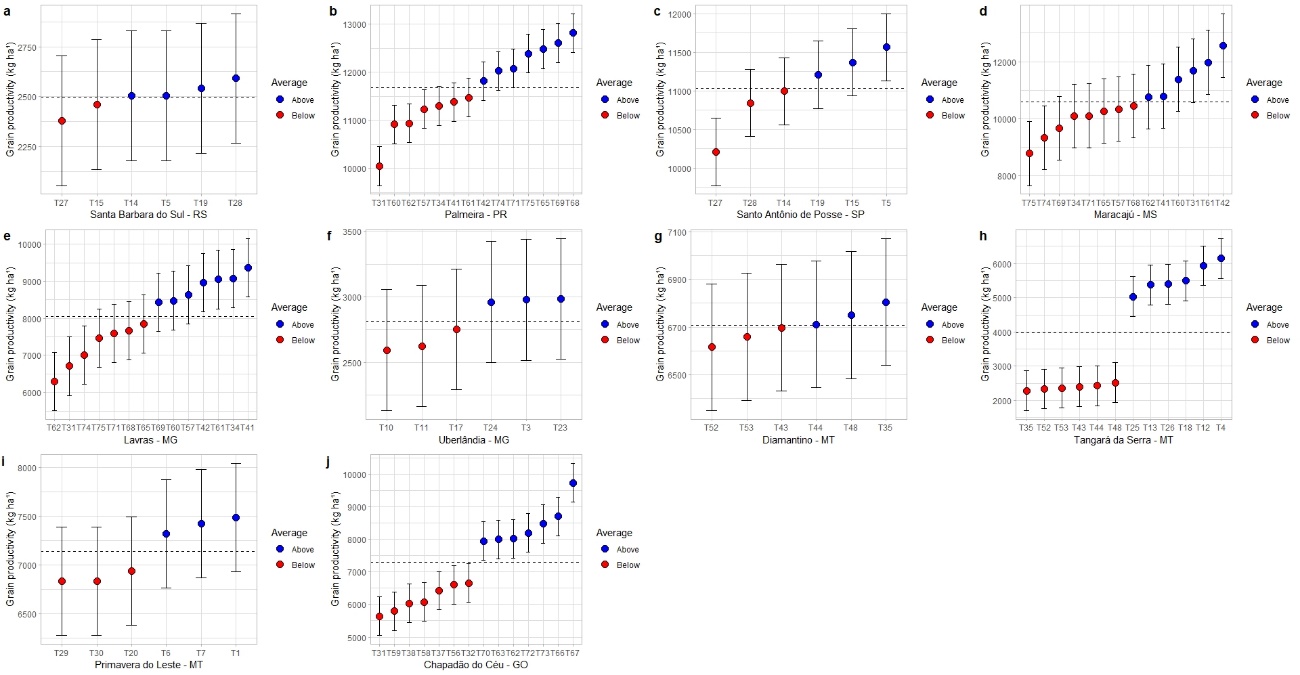
Figure 3. Estimates of components of average maize grain yields per specific BLUP measured in 75 treatments and 10 environments.
Shaharoona et al. (2008), who observed the effectiveness of some strains of P. fluorescens as a growth promoter in wheat, reducing the need for NPK fertilizer added to the soil. In the Palmeira-PR environment, a superior response for grain productivity was observed for treatments T42, T74, T71, T75, T65, T69 and T68 (Figure 3b). Studies by Sandini et al. (2019), report that the use of bacteria such as Pseudomonas fluorencens and Azospirillum brasiliense can reduce the need for chemical fertilizers by up to 25%, mitigating production costs, in addition to the effects related to CO2 emissions.
Grain productivity in Santo Antônio de Posse- SP performed above average (>11.1 thousand kg ha-1) for T19, T15 and T5 (Figure 3c). In Maracaju-MS, the superior treatments were T68, T62, T41, T60, T31, T61 and T42 (Figure 3d). Thus, in the latter environment, greater productivity was achieved by using 400 kg ha-1 of 08-24-12 NPK fertilizer, associated with growth-promoting bacteria (Azospirillum brasiliense and Pseudomonas fluorescens) via aerial spraying at a dose of 0.3 L ha-1. Studies by Tang et al. (2020), observed greater efficiency of fertilization combined with growth-promoting bacteria. In this same study, the authors report that greater efficiency was in relation to nitrogen and phosphorus. Similar results were found by Phares et al. (2022) using Bacillus spp. and Pseudomonas spp., showed greater efficiency in nutrient absorption by maize.
Table 3. Estimates of variance components for grain yield depending on locations and different treatments with inoculants and fertilizers.
| Environment | MODEL | LOGLINK | AIC | LRT | PR > (CHISQ) | |||||
|---|---|---|---|---|---|---|---|---|---|---|
| Chapadão céu- GO | GEN | -458 | 925 | 50.9 | 9.96E-13 | |||||
| Diamantino- MT | GEN | -156 | 322 | 0.154 | 0.0695 | |||||
| Lavras | GEN | -454 | 917 | 22.0 | 0.00000272 | |||||
| Maracaju- MS | GEN | -467 | 943 | 13.3 | 0.000268 | |||||
| Palmeira- PR | GEN | -433 | 877 | 44.2 | 3.01e-11 | |||||
| Primavera do Leste- MT | GEN | -166 | 342 | 1.48 | 0.0223 | |||||
| Santa Barbara do sul- RS | GEN | -145 | 300 | 0.116 | 0.0734 | |||||
| Santo Antônio de Posse- SP | GEN | -163 | 337 | 7.03 | 0.00802 | |||||
| Tangará da Serra- MT | GEN | -590 | 1189 | 94.7 | 2.20e-22 | |||||
| Uberlândia- MG | GEN | -163 | 337 | 0.607 | 0.0436 | |||||
| Parameters | Chapadão Céu- GO | Diamantino- MT | Lavras- MG | Maracaju- MS | Palmeira- PR | Primavera do Leste- MT | Santa Barbara do Sul- RS | Santo Antônio de Posse- SP | Tangará da Serra- MT | Uberlândia- MG |
| Gen_var | 1726288 | 18317 | 1075963 | 1391631 | 647763 | 163062 | 25927 | 275939 | 2891079 | 78687 |
| Gen (%) | 82.1 | 7.48 | 59.6 | 46.9 | 785 | 24.7 | 6.64 | 54.7 | 89.0 | 15.4 |
| Res_var | 377552 | 226643 | 729721 | 1574283 | 177658 | 496702 | 364686 | 228320 | 357767 | 433428 |
| Res (%) | 17.9 | 92.5 | 40.4 | 53.1 | 215 | 75.3 | 93.4 | 45.3 | 11.0 | 84.6 |
| σ²F | 2103841 | 244961 | 1805685 | 2965914 | 825421 | 659763 | 390613 | 504260 | 3248847 | 512114 |
| H2 | 0.821 | 0.0748 | 0.596 | 0.469 | 0.785 | 0.247 | 0.0664 | 0.547 | 0.890 | 0.154 |
| H2mg | 0.948 | 0.244 | 0.855 | 0.780 | 0.936 | 0.568 | 0.221 | 0.829 | 0.970 | 0.421 |
| Accuracy | 0.974 | 0.494 | 0.925 | 0.883 | 0.967 | 0.753 | 0.471 | 0.910 | 0.985 | 0.649 |
| CVg | 18.0 | 2.02 | 12.9 | 11.1 | 6.89 | 5.66 | 6.45 | 4.76 | 42.8 | 9.96 |
| CVr | 8.41 | 7.10 | 10.6 | 11.9 | 3.61 | 9.87 | 24.2 | 4.33 | 15.0 | 23.4 |
| CV ratio | 2.14 | 0.284 | 1.21 | 0.940 | 1.91 | 0.573 | 0.267 | 1.10 | 2.84 | 0.426 |
Model: Model; Log Lik: Restricted Maximum Likelihood Logarithm; AIC: Akaike Informational Criterion; LRT: Restricted Maximum Likelihood Ratio; PR: Probability by Chi-Square test (x2): Gen_var: Genotypic variance; GEN %: Percentage of genotypic variance; Res_var: Residual Variance; Res %: Percentage of residual variance; σ²F: Phenotypic variance; H²: broad sense heritability; H2mg: Heritability of the genotype mean; RGE: genotypic correlation between genotype x environment performance; CVg: Genotypic coefficient of variation; Cvr: Coefficient of residual variation; CV ratio: coefficient of variation of the proportion between genotypic and residual coefficient of variation.
In the Lavras-MG environment, superiority was inferred for T69, T60, T57, T42, T61, T34 and T41, with grain productivity greater than 8 tons of grains ha-1 (Figure 3e). For Uberlândia-MG, above average performance (2800 kg of grains ha-1) was observed only for treatments T24, T3 and T23 (Figure 3f). Diamantino- MT, the superior treatments were T44, T48 and T35, with grain yields above 6700 kg ha-1 of grains (Figure 3g). Studies by Mattos et al. (2023), with inoculation in rice, they observed increases of 5% in the grain productivity of this cereal using A. brasilense + P. fluorescens. Tangará da Serra-MT, superiority was found for treatments T25, T13, T26, T18, T12 and T4 (Figure 3h), that is, treatments without the use of inoculants were superior.
In the Primavera do Leste-MT environment, the superior treatments were T6, T7 and T1 (Figure 3i). In Chapadão do Céu- GO, superiority was observed for T70, T63, T62, T72, T73, T66 and T67 (Figure 3j). Morais et al. (2016), observed maximum maize yield with fertilization of 40 kg ha-1 of N, combined with Azospirillum spp. It can, therefore, be inferred that inoculation is not efficient in increasing maize grain productivity. Hungary et al. (2021), observed an increase in the concentration of nitrogen, phosphorus and potassium in brachiaria, which received treatment with A. brasiliense and P. fluorencens.
The inoculation of plants with plant growth-promoting bacteria is a new sustainable technology that promotes the growth and increase in productivity of agricultural crops and can reduce the amount of mineral fertilizers used in the cultivation of large crops. Therefore, inoculants have proven to be an important tool for agriculture in general, as several studies show the efficiency of using microorganisms as growth promoters and suppressors of phytopathogens. Furthermore, there is also the possibility of improving fertilization efficiency and, in some cases, even reducing the amount of some nutrients.
Materials and Methods
The experiment was carried out in the municipalities of Santa Barbara do Sul- RS (28°21'21” S and 53°15'12” W, 511m), Palmeira- PR (21°12'54.7” S, 45°03'16.9” W, 900m), Santo Antônio de Posse - SP (22°36'24” S, 46°55'9” W, 600m), Maracaju- MS (18º46'44” S, 52º36'59” W, 786m), Diamantino- MT (14°24'11” S and 56°25'37” W, 560m), Primavera do Leste- MT (21°12'54.7” S, 45°03'16.9” W, 900m), Tangará da Serra- MT (14°37'40” S and 57°30'25” W, 427m), Chapadão do Céu- GO (18°21'25.2'' S and 52°38'11.0''W, 840m), Uberlândia- MG (18°54'41” S and 48°15'44” W, 863m) and Lavras- MG (21°12'54.7” S, 45°03'16.9” W and 900m).
The experimental design was randomized blocks, with treatments differing between environments, totaling 75 treatments (Tables 1 and 2), arranged in four replications. The experimental units were composed of five sowing lines, spaced 0.45 m apart, with a sowing density of three seeds per linear meter and five meters in length. The hybrid used was AS1633 PRO3, with sowing carried out in the first fortnight of December 2022. The evaluations took place in the useful area of each experimental unit, represented by the three central sowing lines and four meters in length.
The inoculant composed of Azospirillum brasiliense and Pseudomonas fluorescens was applied via seed treatment at the time of sowing the maize, via the sowing furrow and via the foliar route. For application via seed treatment, equipment called a rotating drum was used to constantly move the seeds to obtain a homogeneous layer covering the products. The volume of syrup used was 500 mL.100 kg-1 of seeds.
For application in the furrow, the product was sprayed on the planting line with a spray volume of 60 L ha-1, using a Camaleão ProSolos flow rate controller adapted to the seeder. In this method, the product was placed before closing the furrow, in the same sowing line where the seed was deposited. The spray tips used were a 0.62 Solid Jet nozzle with a 3 KGF Nozzle Valve pressure of 3bar. For foliar applications, a knapsack sprayer was used with constant pressure, propelled by pressurized CO2, with a spray volume of 150 L ha-1.
Assessments and collections
At the end of the cycle, the ears present in the useful area of each experimental unit were harvested, threshed and weighed, subsequently determining the grain productivity corrected at 13% humidity.
Statistical analysis
The statistical analysis was performed using the method based on Restricted Maximum Likelihood (REML) was used to estimate the variance components and genetic parameters, where significance was obtained through Deviance analysis at 5% probability using the Chi-square test (x2). In this way, we estimated the phenotypic variance (σ²F), broad-sense heritability (H²), genotype mean heritability (H²mg), coefficient of determination of the effects of the genotype-environment interaction (GEI), genotypic correlation between genotypes x environment performance (RGE), genotypic coefficient of variation (CVg), residual coefficient of variation (CVr) and coefficient of variation of the proportion between genotypic and residual coefficient of variation (CVratio). Subsequently, the stratified BLUP model was used to specifically recommend treatments adapted to a given region. To carry out the statistical analyses, the Exp.Des.pt (Ferreira et al., 2021), metan (Olivoto and Lucio, 2020) and ggplot2 (Wickham, 2016) packages were used, through the R Software (R Core Team, 2024).
Conclusion
The use of Azospirillum brasiliense and Pseudomonas fluorencens via aerial spraying, in the sowing furrow and seed treatment, using 50% and 75% of the fertilizer dose demonstrated satisfactory results for maize grain productivity.
References Asterisks mark book chapters/conference items or entries that should be manually checked.
Benin G, Storck L, Marchioro VS, Franco FA, Schuster I (2013) Experimental precision of wheat trials in homogeneous regions of adaptation. Pesquisa Agropecuária Brasileira 48: 365–372.
Bhattacharyya C, Bakshi U, Mallick I, Mukherji S, Bera B & Ghosh A (2017) Genome-guided insights into the plant growth promotion capabilities of the physiologically versatile Bacillus aryabhattai strain AB211. Frontiers in Microbiology 8: 411.
Cargnelutti Filho A, Marchesan E, Silva LS & Toebe M (2012) Measures of experimental precision and number of replications in irrigated rice genotype trials. Pesquisa Agropecuária Brasileira 47: 336–343.
Carvalho IR, Szareski VJ, Silva JAG, Nunes ACP, Rosa TC, Magano DA, Conte GG, Caron BO & Souza VQ (2020) Multivariate best linear unbiased predictor as a tool to improve multi-trait selection in sugarcane. Pesquisa Agropecuária Brasileira 55.
*Contini E, Mota MM, Marra R, Borghi E, Miranda RA, Silva AFS, Silva DD & Machado J (2019) Maize: characterization and technological challenges. Embrapa, Brasília. (Challenges of Brazilian Agribusiness, 2).
Faria TC, Ventura MVA, Souza TR, Neto MR & Sei EL (2022) Agronomic efficiency and phosphate solubilization of Pseudomonas fluorescens and Bradyrhizobium japonicum in leaf-spray inoculation and seed treatment in soybean. Journal of Agricultural Science 14(8): 117.
*Ferreira EB, Cavalcanti PP & Nogueira DA (2021) EXPDES.PT: Package Experimental Designs (Portuguese). R package version 1.2.2. Available at: https://cran.r-project.org/package=expdes.pt
Ferreira MJ, Silva H & Cunha A (2019) Siderophore-producing rhizobacteria as a promising tool for empowering plants to cope with iron limitation in saline soils: a review. Pedosphere 29(4): 409–420.
Gholami A, Shahsavani S & Nezarat S (2009) The effect of plant growth promoting rhizobacteria (PGPR) on germination, seedling growth and yield of maize. International Journal of Biological, Biomolecular, Agricultural, Food and Biotechnological Engineering 3: 9–14.
Hungria M, Nogueira MA & Araujo RS (2015) Alternative methods and time for soybean inoculation to overcome adverse conditions at sowing. African Journal of Agricultural Research 10: 2329–2338.
Hungria M, Nogueira MA & Araujo RS (2013) Co-inoculation of soybeans and common beans with rhizobia and azospirilla: strategies to improve sustainability. Biology and Fertility of Soils 49: 791–801.
Hungria M, Nogueira MA & Araujo RS (2016) Inoculation of Brachiaria spp. with the plant growth-promoting bacterium Azospirillum brasilense: an environment-friendly component in the reclamation of degraded pastures in the tropics. Agriculture, Ecosystems & Environment 221: 125–131.
Hungria M, Rondina ABL, Nunes ALP, Araujo RS & Nogueira MA (2021) Seed and leaf-spray inoculation of PGPR in brachiarias (Urochloa spp.) as an economic and environmental opportunity to improve plant growth, forage yield and nutrient status. Plant and Soil 463: 171–186.
Loro MV, Carvalho IR, Silva JAG, Sfalcin IC & Pradebon LC (2022) Decomposition of white oat phenotypic variability by environmental covariates. Brazilian Journal of Agriculture 97(3): 279–302.
Maia MCC, Resende MDV, Paiva JR, Cavalcanti JJV & Barros LMB (2009) Simultaneous selection for production, adaptability and genotypic stability in cashew clones via mixed models. Tropical Agricultural Research 39: 43–50.
Morais TP, Brito CH, Brandão AM & Rezende WS (2016) Inoculation of maize with Azospirillum brasilense in the seed furrow. Journal of Agricultural Science 47: 290–298.
Muthuraja R & Muthukumar T (2022) Co-inoculation of halotolerant potassium solubilizing Bacillus licheniformis and Aspergillus violaceofuscus improves tomato growth and potassium uptake in different soil types under salinity. Chemosphere 294: 133718.
Naiman AD, Latrónico A & Salamone IEGD (2009) Inoculation of wheat with Azospirillum brasilense and Pseudomonas fluorescens: impact on the production and culturable rhizosphere microflora. European Journal of Soil Biology 45: 44–51.
*Olivoto T & Lúcio ADC (2020) metan: an R package for multi-environment trial analysis. Methods in Ecology and Evolution 11(6): 783–789. https://doi.org/10.1111/2041-210X.13384
Pinheiro CHN, Lima VMM, Stival MM & Silva VL (2020) Use of Azospirillum brasilense and nitrogen fertilization in maize crop. Scientific Electronic Archives 13: 43.
Pradebon LC, Carvalho IR, Loro MV, Port ED, Bonfada B, Sfalcin IC, Santos IJ, Bruinsma GMW, Silva JAG, Alban AA & Challiol MA (2023) Soybean adaptability and stability analyses to the organic system through AMMI, GGE biplot and mixed models methodologies. Ciência Rural 53.
Pupin S, Santos AVA, Zaruma DUG, Miranda AC, Silva PHM, Marino CL, Sebben AM & Moraes MLT (2015) Productivity, stability and adaptability in open-pollinated progenies of Eucalyptus urophylla ST Blake. Scientia Forestalis 43: 127–134.
*R Core Team (2024) R: A language and environment for statistical computing. R Foundation for Statistical Computing, Vienna, Austria. Available at: https://www.r-project.org
Renato NS, Silva JBL, Sediyama GC & Pereira EG (2013) Influence of methods for calculating degree days under conditions of increased temperature for maize and bean crops. Revista Brasileira de Meteorologia 28: 382–388.
*Resende MDV (2002) Biometria e estatística no melhoramento de plantas perenes. Embrapa Florestas, Colombo.
*Resende M et al. (2019) Pedology, fertility, water and plants: interrelationships and applications. Editora UFLA, Lavras.
Sandini IE, Percentchuk F, Hungria M, Nogueira MA, Cruz SP, Nakatani AS & Araujo RS (2019) Seed inoculation with Pseudomonas fluorescens promotes growth, yield and reduces nitrogen application in maize. International Journal of Agriculture and Biology 22: 1369–1375.
Shaharoona B, Naveed M, Arshad M & Zahir ZA (2008) Fertilizer-dependent efficiency of Pseudomonas for improving growth, yield and nutrient use efficiency of wheat (Triticum aestivum L.). Applied Microbiology and Biotechnology 79: 147–155.
Silva CGM, Resende AV, Gutiérrez AM, Moreira SG, Borghi E & Almeida GO (2018) Absorption and export of macronutrients in transgenic maize under two levels of fertilization. Pesquisa Agropecuária Brasileira 53(12): 1363–1372.
Silva LEB, Silva JCS, Souza WCL, Lima LLC & Santos RLV (2020) Development of maize (Zea mays L.): literature review. Diversitas Journal 5(3): 1636–1657.
Tang A, Haruna AO, Majid NMA & Jalloh MB (2020) Effects of selected functional bacteria on maize growth and nutrient use efficiency. Microorganisms 8(6): 854.
*Vencovsky R & Barriga P (1992) Genética biométrica no fitomelhoramento. Sociedade Brasileira de Genética, Ribeirão Preto.
*Wickham H (2016) ggplot2: Elegant Graphics for Data Analysis. Springer, New York.
Zohaib A, Yousaf S, Anjum SA, Tabassum T, Abbas T, Muzaffar W & Ikram W (2019) Growth, allometry and dry matter yield of soybean genotypes in response to seed inoculation with plant growth-promoting rhizobacteria. Pakistan Journal of Agricultural Research 32(1): 102–110.
Roig-Oliver M, Fullana-Pericás M, Bota J & Flexas J (2021) Adjustments in photosynthesis and leaf water relations are related to changes in cell wall composition in Hordeum vulgare and Triticum aestivum subjected to water deficit stress. Plant Science 311: 111015.
Laudien R, Schauberger B, Makowski D & Gornott C (2020) Robustly forecasting maize yields in Tanzania based on climatic predictors. Scientific Reports 10(1): 1–12.