Australian Journal of Crop Science
Article | https://doi.org/10.21475/ajcs.26.20.07.pne179
Submitted: 12 November 2025 | Revised: 19 February 2026 | Accepted: 11 May 2026
Pages 556-564
Drought tolerance and identification of the metabolomic profile of rice doubled haploid lines derived from anther culture
Zendi Alhamami1, Bambang Sapta Purwoko1*, Willy Bayuardi Suwarno1, Iswari Saraswati Dewi2
1Department of Agronomy and Horticulture, IPB University, Jl. Kamper, IPB Darmaga Campus, Bogor 16680, Indonesia
2Center for Food Crops Research, National Research and Innovation Agency, Cibinong Science Center, Jl. Raya Jakarta-Bogor km 46, Cibinong-Bogor 16911, Indonesia
*Corresponding author: bspurwoko@apps.ipb.ac.id
Abstract: Rice (Oryza sativa L.) is a strategic food commodity that serves as the backbone of global food security in Asia, including Indonesia. Rice productivity has declined because of various factors, particularly unpredictable climate change. The development of drought-tolerant rice varieties has become an important solution to address this issue. This study aimed to evaluate drought tolerance in four doubled haploid (DH) rice lines obtained from anther cultures of F1s, derived from crossing high-yielding varieties to drought-tolerant parents KP4, namely G2, G6, G7, and G9, and to identify metabolite profiles associated with drought response. The drought experiment was conducted at the BBPSI Biogen greenhouse using a randomized complete block design with three replications, while metabolite identification was conducted at the DKI Jakarta Health Laboratory using GC-MS. Drought tolerance was evaluated through leaf rolling, leaf drying, and the recovery ability, using IR 20 and Salumpikit as drought-sensitive and drought-tolerant check varieties. The results showed that all DH lines G2, G6, G7, G9 were categorized as tolerant based on their positive selection index values. Metabolite analysis based on PLS-DA identified compounds such as linalyl acetate, phytol, pentadecanoic acid, d-limonene, 9-octadecenoic acid, and linalool as potentially involved in adaptation to drought conditions. Selection using VIP values revealed 17 dominant compounds that could serve as markers of the metabolite profiles of the selected DH lines. Linalyl acetate, which was only found in the shoots of all DH rice lines and Salumpikit under drought, has potential as a marker of drought tolerance.
Keywords: abiotic stress, doubled haploid, drought stress, metabolomics, rice breeding.
Abbreviations: DH_Doubled Haploid; FV_Friedman Value; HS_Highly Sensitive; LD_Leaf Dryness; LR_Leaf Rolling; MS_Moderate Sensitive; MT_Moderate Tolerant; PLSDA_Partial Least Squares Discriminant Analysis; RA_Recovery Ability; S_Sensitive; SS_Slightly Sensitive; T_Tolerant; VIP_ Variable Importance in Projection.
Introduction
Rice (Oryza sativa L.) is a strategic food commodity that serves as the backbone of global food security, particularly in Asian countries, including Indonesia. Rice production and consumption not only play a central role in the economy but also support daily life, considering that approximately 50% of the world’s population regularly consumes this staple food (Wang et al., 2023). According to the Food and Agriculture Organization (2024), global rice production has reached 538.9 million tons, with over 90% of this output contributed by the Asian region. However, over the past five years, Indonesia has experienced a downward trend in rice production. Data from Statistics Indonesia (2024) indicated that rice production decreased from 54.60 million tons of harvested dry grain in 2019 to 52.66 million tons in 2024, a reduction of 0.62 million tons. This poses a serious challenge to maintain the sustainability of national rice production. Meanwhile, Indonesia’s population, the majority of which relies on rice as a staple food, continues to increase.
Globally, beside the land conversion and soil fertility degradation, the unpredictable climate change patterns had increased and caused unstable rice production due to its impact on drought, extreme temperatures, shifts in precipitation patterns, and fluctuating weather conditions (Algarni et al., 2025). Therefore, in the coming decades, the development of drought-tolerant rice varieties would become a vital solution to address these challenges (Zhang et al., 2021). Technology that can be used to rapidly develop new rice varieties is doubled haploid (DH) technology such as anther culture (Gunarsih et al., 2022). This technique utilizes F1 or selected F2 progenies from crosses of superior parents to obtain homozygous pure lines just 1-2 generations. Thus, it effectively and efficiently shortened the breeding cycle (Purwoko and Dewi, 2025). Previous research by Hadianto et al. (2023a and 2023b) successfully selected DH lines-derived from the F1 anther culture obtained from crossing high-yield variety to superior parent KP4, which is tolerant to abiotic stress. Through preliminary and advanced yield trials, those DH rice lines were identified to have superior agronomic traits and high yield potential. However, those lines shall be tested further for their tolerance to drought to avoid unexpected crop failure.
Drought stress is categorized as a major abiotic stress event that causes a substantial decrease in crop yield (Habibpourmehraban et al., 2022). The physiological impact of drought and also high-temperature stress have been reported to be the excessive accumulation of certain metabolites, which disrupt plant biochemical processes (Cattivelli et al., 2008). Therefore, metabolite analysis is required to identify marker compounds involved in tolerance mechanisms. Metabolomic techniques can be used to comprehensively detect these compounds in selected DH lines. Metabolomic analysis is a scientific method to study the profile of metabolites. In this analysis, a GC-MS instrument was used to obtain information on volatile, non-ionic, heat-stable, and low-molecular-weight compound components (Megawati and Khairudin, 2023). According to Sawada et al. (2009), hundreds of metabolites can be comprehensively detected using metabolomic analysis. The identified compounds are associated with specific biochemical pathways that enable plants to survive under drought conditions by responding to environmental stress through various molecular signalling pathways (Noman and Azhar, 2023). This study aimed to identify drought-tolerant doubled haploid rice lines resulting from anther culture and to analyze the response of metabolic compounds under drought and irrigated (control) conditions. The results of this study are expected to serve as a basis for developing improved varieties that are adaptable to drought stress.
Results and Discussion
Response of doubled-haploid rice lines to drought stress
The doubled-haploid rice lines exhibited significant variations in leaf rolling response, leaf dryness, and recovery ability score (Table 1). The ranking values in the Friedman test indicated the tolerance level of the DH rice lines to drought stress. According to Munandar et al. (2025), the lower the ranking value of a line in the Friedman test, the better the ability of the genotype to respond to drought stress. An alternative approach to assess drought tolerance can also be performed using the drought score (Fen et al., 2015). Important characteristics observed when plants experience drought stress include leaf rolling, premature senescence (Anjum et al., 2011; Bhandari et al., 2023), and recovery ability (Munandar et al., 2025).
Leaf rolling response
The initial response of rice plants to drought stress is characterized by leaf rolling, which is a mechanism to avoid drought stress and related to three main processes, i.e., reduced leaf expansion, stomatal conductance, and transpiration rate (Cooper and Hammer, 1996; Suwarno et al., 2016). This physiological reaction to drought can help reduce water loss (Wang et al., 2023). Moreover, drought stress induced the formation of reactive oxygen species, which caused oxidative stress in plants (Rusdiana et al., 2024). The ability of a line to maintain leaf greenness during this process could be an indicator of a drought tolerance that made the leaf rolling parameter important to be evaluated as an early response to water stress (Panda et al., 2021). Based on the Friedman ranking values (Table 2), lines G2, G6, and G7 showed the best performance with moderately tolerant criteria, approaching the tolerant line Salumpikit. Conversely, G9 was classified as moderately sensitive, while IR20 was highly sensitive. This variation in response indicates that lines G2, G6, and G7 adapt better to drought. Such adaptation is mediated by the ability of tolerant lines to adjust transpiration rates in order to maintain high leaf water potential under drought conditions (Afrianingsih et al., 2018).
Table 1. Results of the Friedman test on the character traits of DH rice lines at the seedling stage.
| Character | 𝓧2 Value | P-value |
| Leaf rolling | 76.75** | <0.001 |
| Leaf drying | 76.75** | <0.001 |
| Recovery ability | 13.00** | <0.001 |
| Wet weight of the plant | 17.68** | <0.001 |
| Dry weight of the plant | 14.42** | <0.001 |
𝒳2= Chi-square value, **= significant at p< 0.01.
Table 2. Drought-tolerance scores and criteria, and selection index values based on leaf rolling, leaf drying, and recovery ability.
| Genotype | LRS | LRC | FV | LDS | LDC | FV | RAS | RAC | FV | Index |
| G2 (FS3-29-1-3) | 3.45 | MT | 7 | 3.92 | MT | 7 | 1.66 | T | 8.5b | 3.99 |
| G6 (FS3-69-1-1) | 3.82 | MT | 12 | 3.99 | MT | 8 | 1.66 | T | 8.5b | 4.60 |
| G7 (FS4-24-3-1) | 3.63 | MT | 8 | 4.21 | SS | 12 | 1.66 | T | 8.5b | 4.53 |
| G9 (FS4-28-1-1) | 5.91 | MS | 15 | 6.26 | S | 15 | 3.66 | MT | 13.5ab | 1.69 |
| K1/IR 20 | 8.21 | HS | 18 | 8.50 | HS | 18 | 6.33 | SS | 18.0a | -2.23 |
| K2/Salumpikit | 1.11 | T | 3 | 1.19 | T | 3 | 1.00 | T | 6.0b | 6.39 |
LRS= leaf rolling score, LRC= leaf rolling criteria, LDS= leaf dryness score, LDC= leaf dryness criteria, RAS= recovery ability score, RAC= recovery ability criteria, T= tolerant, MT= moderately tolerant, MS=moderately sensitive, HS= highly sensitive, SS= slightly sensitive, FV= Friedman value, K1 = drought-sensitive check, K2 = drought-tolerant check.
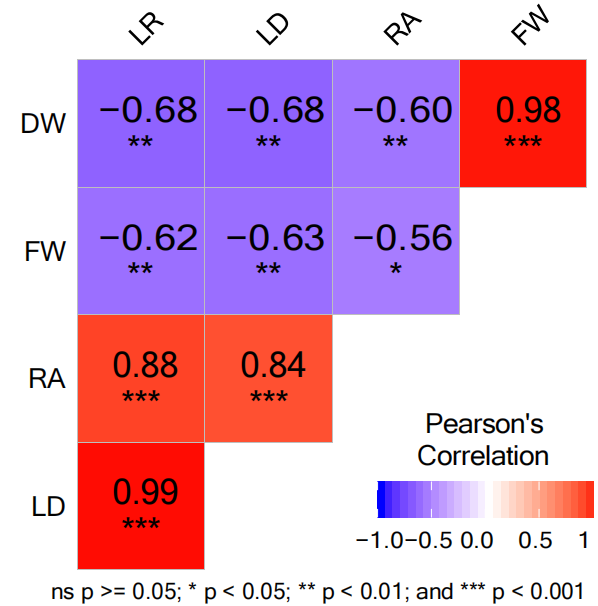
Fig 1. Pearson correlation of rice field-doubled haploid lines with drought tolerance traits. DW= plant dry weight, FW= plant fresh weight, RA= recovery ability, LR= leaf rolling, and LD= leaf drying.
Leaf drying symptom
The leaf drying phase is a subsequent response to leaf rolling. According to Fang and Xiong (2015), a lack of carbon dioxide due to stomatal closure can cause plants to experience leaf drying. This was observed in plant groups subjected to drought stress with insufficient water supply, which showed the highest levels of leaf drying. According to Saglam et al. (2014); Chandarak et al. (2025), drought-tolerant genotypes usually roll their leaves more slowly and maintain higher leaf water potential compared to genotypes that are sensitive to drought. Based on leaf drying observations, lines G2 and G6 are considered quite tolerant to drought, while line G7 is slightly sensitive (Table 2). Line G9 has the lowest Friedman ranking compared to the other lines. However, none of the DH lines tested fell into the highly sensitive category (IR 20). According to Akbar (2019), DH lines that are tolerant to drought stress can be identified by their ability to maintain green leaf conditions and their capacity for regrowth.
Recovery ability
The plant’s ability to recover after experiencing drought stress is an important indicator of drought tolerance (Swapna and Shylaraj, 2017). This recovery trait plays a crucial role and is closely related to the adaptability of plants to drought stress compared to other drought tolerance traits. According to Yang et al. (2019), a good recovery ability is essential for maintaining high grain yield and can be used as a selection trait in developing drought-tolerant rice cultivars. The results showed that the tolerant lines G2, G6, and G7 were able to maintain leaf greenness and demonstrated recovery ability comparable to that of the drought-tolerant check variety, Salumpikit. Line G9 was categorized as moderately tolerant, and the check variety IR20 showed a slightly sensitive criterion. The physiological mechanisms supporting this recovery ability include osmotic adjustment through solute accumulation, increased water absorption, and maintenance of the cell turgor potential (Taryono et al., 2023; Munandar et al., 2025). The interaction of good recovery ability in the tested doubled haploid (DH) lines indicated a more optimal adaptation to drought conditions.
Correlation between drought tolerance traits
The correlations between drought tolerance traits range from -0.68 to 0.99, indicating varying directions and strengths of relationships (Fig 1). The recovery ability score is the most crucial characteristic in drought tolerance valuation. This trait had a strong positive correlation with leaf rolling and leaf drying and a negative correlation with fresh weight (-0.56) and dry weight (-0.60). The analysis showed a strong positive correlation between the characteristics of leaf rolling and drought tolerance and recovery ability; the better the performance of these characteristics (lower Friedman values), the better the recovery ability of the plant. Conversely, plant fresh and dry weights were significantly negatively correlated with recovery ability. This is consistent with research by Blum (2010), that the plant dry weight is often negatively correlated with drought tolerance traits.
The assignment of weights in the weighted selection index is based on the selection objectives or economic value of a trait (Olievera et al., 2014). The results of the selection index calculation (Table 2) for the drought test traits showed that all DH lines (G2, G6, G7, and G9) had positive selection index values. According to Munandar et al. (2025) these positive values indicated that these lines had good drought tolerance at the seedling stage. Therefore, these lines could be selected as putative drought-tolerant lines.
Partial Least Squares Discriminant Analysis
GC-MS analysis successfully identified 59 compounds that play a role in secondary metabolite responses (data not presented). In this study, we used Partial Least Squares Discriminant Analysis (PLS-DA) as a supervised multivariate analysis method that identified relationships between variables and utilizes sample class information to maximize separation between groups (Hastie et al., 2009; Asimi et al., 2022). Unlike Principal Component Analysis (PCA), which is unsupervised and only performs dimensionality reduction without considering group labels, PLS-DA optimizes data projection by maintaining the classification structure. The result was the PLS-DA model which produced validation

Fig 2. Partial Least Squares Discriminant Analysis (PLS-DA), IA = irrigated root sample (control), IIA = drought root sample, IT = irrigated shoot sample (control), IIT = drought shoot sample.
parameters that met the criteria for model feasibility, with R2X = 0.419, R2Y = 0.939, and Q2 = 0.897. According to Worley and Powers (2016), R2X, Q2, R2Y, and Q2Y2 values of at least 0.5 are acceptable, but in some studies, values of 0.4 can also be accepted. The R2Y value indicated a high predictive ability of the model, whereas a high Q2 value suggested the model's resistance to overfitting. The result demonstrated that the constructed PLS-DA model had good reliability and stability in distinguishing metabolite profiles between sample groups (Fig 2). PLS-DA revealed three distinct metabolic patterns based on the plant response to treatment conditions. The first cluster was characterized by roots under control conditions with an optimal metabolic pattern, whereas the second cluster included shoots (both under control and drought) that showed metabolic stability, indicating better adaptive capacity in shoot tissues. The third cluster consisted of roots undergoing drought stress with significant physiological changes, such as osmolyte accumulation and decreased metabolic activity, demonstrating the higher sensitivity of root tissues to drought stress compared to shoots.
PLS-DA biplot analysis (Figure 3) identified marker compounds based on the spatial relationship between metabolites and genotypes. The principle of this analysis is that the closer a metabolite is positioned to a sample group, the higher its concentration (Kim et al., 2020). In this study, these compounds were divided into three distinct clusters (Figure 3), each dominated by specific metabolites that respond to environmental changes. Interestingly, there were an overlap of metabolite compounds in the shoot under both control and drought conditions (cluster II), indicating a similarity in metabolic responses.
Metabolite analysis revealed the adaptation mechanisms of rice to environmental conditions through three distinct metabolic response patterns. Under irrigated root conditions (control), pentadecanoic acid was dominant. This compound acted as an antifungal and antibacterial compound (Yogeswari et al., 2012). Shoot tissues under control and drought exhibited a more stable protection mechanism through the accumulation of positively correlated compounds, such as neophytadiene with antimicrobial activity (Stojanovic et al., 2000), phytol involved in the photosynthesis process (Fujimoto et al., 2021), and linalyl acetate, which serves as an antimicrobial and antifungal (Jianu et al., 2013; Diass et al., 2023), particularly when shoots are under drought conditions. Meanwhile, roots experiencing drought develop complex defense strategies through the production of stress-related compounds, such as d-limonene, which acts as an insecticide (Li et al., 2023); linalool, which acts as a plant defense against stress (Taniguchi et al., 2013); and 9-octadecenoic acid (z), which plays a role in modulating pathogen responses (Zaid et al., 2023). These compounds are strongly suspected to be involved in plant adaptation to environmental conditions.
Volatile compounds associated with VIP score
The dominant compounds in the PLS-DA analysis can be identified further by interpreting the coefficient graphs presented in Table 3. The marker compound selection process is conducted by selecting the most significant coefficients that do not intersect the X-axis, indicating a significant impact on group separation. The selection considers the Variable Importance in Projection (VIP) values using strict criteria, in which only compounds with VIP values >1 were selected. However, according to Zainudin et al. (2021), VIP values of 0.7–0.8 can be used as a threshold for determining significant compounds. These VIP values were then validated with the coefficient values to ensure statistical significance. The selected compounds were dominant within their respective classes, allowing them to serve as significant differentiators in the metabolite profiles of the DH rice lines studied (Table 3).
Out of 59 compounds, 17 compounds that play a role in secondary metabolite responses were selected based on VIP 1 and VIP 2. The selected compounds were involved in various physiological processes, such as photosynthesis, response to drought stress, antibacterial and antimicrobial activity, and plant defense mechanisms against pests and diseases. In addition to being fundamental components of metabolism, the compounds in the VIP 2 group collectively form a complex
Table 3. Marker volatile compounds that play a role based on VIP 1 and VIP 2.
| No | Compound | VIP 1 | VIP 2 | Location of identified compounds | |
| 1 | 9-octadecenoic acid (z) | 1.57 | 1.52 | Shoot : - Root : G2r, G6r, G7r, G9r, K1r, K2r |
|
| 2 | Linoelaidic acid | 1.05 | 0.78 | Shoot : G2s, G6s, G7s, G9s, K1s, K2s Root : - |
|
| 3 | 9,12,15-Octadecatrienoic | 1.34 | 1.20 | Shoot : G2Ss, G6Ss, G7Ss, G9Ss, K1Ss, K2Ss Root : G7r, K2r |
|
| 4 | 15-Hydrocy-Pentadecanoic acid | 1.31 | 1.26 | Shoot : - Root : G2R, G6R, G7Rr, G9R, K1Rr, K2R |
|
| 5 | Hexadecanoic acid | 1.05 | 1.03 | Shoot : G2Ss, G6Ss, G7Ss, G9Ss, K1Ss Root : G2Rr, G6Rr, G7Rr, G9Rr, K1Rr |
|
| 6 | 9,12-octadecanoic acid | 0.58 | 1.75 | Shoot : - Root : G2r, G6r, G7r, G9r, K1r, K2r |
|
| 7 | Pentadecanoic acid | 0.79 | 2.06 | Shoot : - Root : G2R, G6R, G7Rr, G9R, K1Rr, K2R |
|
| 8 | 9,12, octadecadienoic acid (Z,Z) | 0.26 | 1.13 | Shoot : G2Ss, G6Ss, G7Ss, G9Ss, K1Ss, K2Ss Root : G2R, G6R, G7R, G9R, K1R, K2R |
|
| 9 | Methyl stearate | 1.07 | 1.04 | Shoot : - Root :G2r, G7r, G9r, K1r, K2r |
|
| 10 | 2-hexaderen-1-ol | 1.17 | 1.00 | Shoot : G2Ss, G6Ss, G7Ss, G9S, K1S, K2S Root : G9r, K1r, K2r |
|
| 11 | D-limonene | 1.95 | 1.89 | Shoot : G2S, G7S Root : G2r, G6r, G7r, G9r, K1r, K2r |
|
| 12 | Linalool | 1.55 | 1.50 | Shoot : - Root : G2r, G6r, G7r, G9r, K1r, K2r |
|
| 13 | Phytol | 2.09 | 1.64 | Shoot : G2Ss, G6Ss, G7Ss, G9Ss, K1Ss, K2Ss Root : - |
|
| 14 | Neophytadiene | 2.01 | 1.55 | Shoot : G2Ss, G6Ss, G7Ss, G9Ss, K1Ss, K2Ss Root : - |
|
| 15 | Linalyl aceate | 1.50 | 1.11 | Shoot : G2s, G6s, G7s, G9s, K2s Root : - |
|
| 16 | 2-Hexadecene | 1.15 | 0.88 | Shoot : G2Ss, G6s, G7Ss, G9Ss, K1Ss, K2S Root : - |
|
| 17 | Stigmasterol | 1.53 | 1.20 | Shoot : G2Ss, G6S, G7S, G9S, K1Ss, K2S Root : G6Rr, G9Rr, K1Rr, K2Rr |
|
Note: G2, G6, G7, G9 = DH lines, K1= IR20 (sensitive check), K2= Salumpikit (tolerant check), R = irrigated root sample (control), r = drought root sample, S = irrigated shoot sample (control), s =drought root sample, Rr = irrigated root sample (control) and drought, Ss = irrigated shoot sample (control) and drought. - = not detected.

Fig 3. Biplot of Partial Least Squares Discriminant Analysis (PLS-DA). Cluster 1= roots (control), Cluster 2= shoots under drought and control conditions, Cluster 3= roots (drought), X-axis= identified compounds, Y-axis= coordinates of each treatment, M9.DA(IT)= irrigated shoot treatment, M9.DA(IIT)= drought shoot treatment, M9.DA(IA)= irrigated root treatment, and M9.DA(IIA)= drought root treatment.
plant defense system, reflecting the plant's metabolic strategies to adapt to various environmental stress conditions.
In this study, while the PLS-DA analysis identified unique compounds that potentially served as markers for the selection of drought-tolerant DH lines (Table 3), we found the unique compound, linalyl acetate. This compound is located in the shoot and increases when the genotype experiences drought stress. Linalyl acetate compound is only found in lines G2, G6, G9, and Salumpikit (drought-tolerant check), so it can be used as a potential marker in the selection of superior DH lines.
Materials and Methods
Drought tolerance evaluation
This study was conducted in a greenhouse at the Center for Instrument Standard Testing for Biotechnology and Agricultural Genetic Resources (BBPSI Biogen), Bogor, West Java-Indonesia, from February to July 2025. The genetic material used consisted of four DH rice lines selected by Hadianto (2024), namely G2, G6, G7, and G9, as well as two check varieties, Salumpikit (drought-tolerant check) and IR20 (drought-sensitive check). The experiment was conducted using a randomized complete block design with three replications, including all six genotypes, resulting in 18 experimental units. Each genotype was planted in a single row containing 14 seeds, with a spacing of 5 cm × 5 cm in benches measuring 3 m × 0.6 m × 0.8 m. Plant responses to drought stress were evaluated based on the Standard Evaluation Systems for rice (IRRI 2014) to determine the tolerance levels of the genotypes tested. Data analysis for the drought tolerance test included the Friedman test and the weighted selection index. The data were analyzed using the Friedman test (Conover, 1999), with the following formula:
\[R_{j} = \ \sum_{i = 1}^{b}{R\left( X_{ij} \right);A =}\sum_{i = 1}^{b}{\sum_{j = 1}^{k}{\lbrack R\left( X_{ij} \right)\rbrack^{2};}C} = \ \frac{bk\ (k + 1)^{2}}{4}\ \ \]
\[T_{1} = \frac{(k - 1)}{A - C}x\ \left\lbrack \sum_{j = 1}^{k}R_{j}^{2} - bxC \right\rbrack;\ T_{2} = \ \frac{(b - 1)T_{1}}{b\ (k - 1)T_{1}}\]
Note:
\(R_{j}\) : Total rank score of each j-th line across all groups
𝐴 : Sum of the squares of each observed value
𝐶 : Correction factor
𝑇1 : Friedman test statistics based on the Chi-squared distribution
𝑇2 : Friedman test statistics based on the F distribution
𝑏 : Group
k : Number of strains
i : 1, 2, 3 (group)
j : 1, 2, 3, , n (lines)
Each drought tolerance trait was analyzed for correlation. The correlations between traits were calculated based on Pearson's rank correlation. The Pearson's rank correlation values were calculated using the following formula:
\[r = \frac{n\left( \sum_{}^{}{XY} \right) - \left( \sum_{}^{}X \right)(\sum_{}^{}Y)\ }{\sqrt{\lbrack n\sum_{}^{}{X^{2} - (\sum_{}^{}{{X)}^{2}\rbrack\lbrack nY^{2} - (\sum_{}^{}Y)^{2}\rbrack}\ \ \ \ \ }}}\]
Note:
r : Pearson correlation coefficient (-1≤ r ≤ 1)
n : number of data pairs
X and Y : measured variable
\(\sum_{}^{}{XY}\) : The number of products for each pair of X and Y
\(\sum_{}^{}X\) and \(\sum_{}^{}Y\) : The total value of X and Y
\(\sum_{}^{}X^{2}\) and \(\sum_{}^{}Y^{2}\) : Sum of the squares of the values of X and Y
The weighted selection index is used to rank DH lines based on rice plant characteristics related to leaf rolling, drought, and recovery ability after drought treatment. According to Falconer Kang (2015), the determination of the weighted selection index is based on:
𝐼 = ∑ 𝑏𝑖𝑧𝑖 = 𝑏1𝑧1 + 𝑏2𝑧2 + ⋯ + 𝑏𝑛𝑧𝑛
Note: 𝐼: Selection index; 𝑏𝑛: Weight of the n-th trait; 𝑧𝑛: Standardized observed phenotypic values (leaf rolling, leaf drought, and recovery ability)
Metabolite analysis
Metabolite analysis used six genotypes: four DH lines, namely G2, G6, G7, and G9, and two check varieties, namely Salumpikit (drought-tolerant check), and IR 20 (sensitive check). The treatments included drought and irrigation (control) conditions in a randomized complete block design with three replicates, resulting in 18 experimental units per treatment. Each part of the plant (shoot and root) was separated to determine its response to the treatment when the IR 20 plants reached a drought score of 7/9, resulting in 72 samples to be extracted. Metabolite extraction was performed using the maceration method with analytical-grade absolute ethanol at 25°C for 35 minutes. The extract from 100 mg sample was then dissolved in 15 ml of ethanol in a 15 ml tube (Barding et al., 2013). Subsequent metabolite analysis was performed using Gas Chromatography-Mass Spectrometry (GC-MS) for compound identification.
Gas chromatography was conducted using an Agilent Technologies 7.890 gas chromatograph with an autosampler, 5.975 mass selective detector, and a ChemStation data system. The column used was an HP Ultra-2 with dimensions of 30 m × ID 0.20 mm × film thickness 0.11 μm. The injector temperature was set at 250°C, and the column temperature program started at 80°C, increasing by 3°C per minute to 150°C. The temperature was then increased at 20°C/min to 280°C and held for 26 min. The helium (He) gas flow was set at a rate of 1.2 ml per minute, the ion source temperature at 230°C, and the electron energy at 70 eV in electron impact ionization mode. Compound identification was performed by comparing the sample mass spectra with those in the Spectral Library.
Metabolite data analysis begins with converting raw data to mass spectrometry (MS) format using the Mzconvert software. The data were then corrected using RT alignment, peak integration, and peak alignment with XCMS. A comparative analysis was conducted based on the retention time (RT) and peak intensity pairs. Next, multivariate analysis using PCA was applied, while potential marker analysis was performed using S-plot-based PLS-DA. Secondary metabolite pathways were identified using the Kyoto Encyclopedia of Genes and Genomes (KEGG). The results of the statistical and quantitative analyses were interpreted using SIMCA 18.0 (Sartorius-Umetric, Sweden) to reveal the metabolite profile patterns between the different sample groups.
Conclusions
The DH lines were significantly varied in leaf rolling, leaf drought, and recovery ability. The recovery ability showed a moderate positive correlation with leaf rolling and leaf drought and a moderate negative correlation with plant fresh and dry weights. All DH lines (G2, G6, G7, and G9) had positive selection index values indicated that these lines had good drought tolerance at the seedling stage. Fifty-nine compounds were successfully identified, and 17 compounds were successfully selected based on the VIP value. PLS-DA analysis (R²Y = 0.939; Q² = 0.897) was able to distinguish metabolic responses. It is suspected that pentadecanoic acid, phytol, d-limonene, and linalool play important roles in the adaptation to drought. A specific compound, linalyl acetate, was found only in the shoot parts under drought conditions in all DH rice lines tested and tolerant check variety (Salumpikit), but was absent in the drought-sensitive check (IR 20). This compound, therefore, has the potential to be used as a marker in the selection of drought-tolerant DH lines.
Acknowledgement
The first author would like to express gratitude to the Higher Education Service Center (Ministry of Higher Education, Research, and Technology of the Republic of Indonesia) for providing a master's degree scholarship. The authors would also like to express their appreciation to BBPSI Biogen (Ministry of Agriculture of the Republic of Indonesia) for providing the greenhouse facility and technicians to conduct the research.
References
Anjum SA, Xie X, Wang L, Saleem MF, Man C, Lei W (2011) Morphological, physiological and biochemical responses of plants to drought stress. African J Agric Res. 6: 2026-2032. https://doi:10.5897/AJAR10.027
Akbar MR (2019) Breeding of doubled-haploid rainfed rice lines derived from anther culture tolerant to drought. [dissertation]. Bogor (ID): Faculty of Agriculture, IPB University.
Algarni SM, Elshekh ME, Agiza AMA, Nassar FS (2025) Analyzing the impact of climate change on rice production and strategies for enhancing efficiency, sustainability, and global food security. Internat J Innov Res Sci Stud. 8(2): 9246-2957.
Asimi S, Ren X, Liang S, Wang Z, Zhang M, Li S, Guan L, Wang Z (2022) Fingerprinting of volatile organic compounds for the geographical discrimination of rice samples from Northeast China. Foods. 11: 1695. https://doi.org/10.3390/foods11121695
Afrianingsih S, Susanto U, Ardiarini NR (2018) Toleransi genotipe padi (Oryza sativa L.) pada fase vegetatif dan fase generatif terhadap cekaman kekeringan. J Prod Tan. 6(3): 355–363.
Barding GAJ, Beni S, Fukao T, Bailey-Serres J, Larive KC (2013) Comparison of GC-MS and NMR for metabolite profiling of rice subjected to submergence stress. J Prot Res. 12: 898−909. https://doi.org/10.1021/pr300953
Bhandari U, Gajurel A, Khadka B, Thapa I, Chand I, Bhatta D, Poudel A, Pandey M, Shrestha S, Shestha J (2023) Morpho-physiological and biochemical response of rice (Oryza sativa L.) to drought stress: A review. Heliyon. 9: e13744. https://doi:10.1016/j.heliyon.2023.e13744
Blum A (2010) "Plant water relations, plant stress and plant production." Plant Breeding for Water-Limited Environments. Springer, New York, NY. https://doi.org/10.1007/978-1-4419-7491-4_2
[BPS] Badan Pusat Statistik (2024) Luas Panen dan Produksi Padi di Indonesia [internet]. [held on May 20, 2025]. Available from : https://www.bps.go.id/luas-panen-dan-produksi-padi-di Indonesia-2023-Badan-Pusat-Statistik-Indonesia.
Cattivelli L, Rizza F, Badeck FW, Mazzucotelli E, Mastrangelo AM, Francia E, Marè C, Tondelli A, Stanca AM (2008) Drought tolerance improvement in crop plants: An integrated view from breeding to genomics. Field Crops Res. 105: 1–14. https://doi:10.1016/j.fcr.2007.07.004
Chandarak N, Wang X, Liu S, Xiong D (2025) Does leaf rolling serve as a phenotype index for drought tolerance in grasses? A review. Plant Ecophysiology. 1(2): 3. https://doi.org/10.53941/plantecophys.2025.100012
Cooper M, Hammer GL (1996) Plant Adaptation and Crop Improvement. CAB International.
Conover WJ (1999) Practical Nonparametric Statistics. 3rd Edition. Amerika Serikat: John Wiley and Sons.
Diass K, Merzouki M, Elfazazi K, Azzouzi H, Challioui A, Azzaoui K, Hammouti B, Touzani R, Depeint F, Gotor AA, Rhazi L (2023) Essential oil of Lavandula officinalis: chemical composition and antibacterial activities. Plants. 12: 1571. https://doi.org/10.3390/plants12071571
Fang Y, Xiong L (2015) General mechanisms of drought response and their application in drought resistance improvement in plants. Cell Mole Life Sci. 72: 673–689. https://doi:10.1007/s00018-014-1767-0
[FAO 2024] Food and Agriculture Organization (2024) Food Outlook: Biannual Report on Global Food Markets [Internet]. [held on 2025 November 7]. Available from: content.
Fen LL, Ismail MR, Zulkarami B, Rahman MSA, Ismail RM (2015) Physiological and molecular characterization of drought responses and screening of drought tolerant rice varieties. Bio J. 31(3): 709-718.
Fujimoto T, Abe H, Mizukubo T, Seo S (2021) Phytol, a constituent of chlorophyll, induces root-knot nematode resistance in Arabidopsis via the ethylene signaling pathway. Molecular Plant-Microbe Interactions. 34 (3): 279–285. https://doi.org/10.1094/MPMI-07-20-0186-R
Gunarsih C, Purwoko BS, Dewi IS, Suwarno WB, Nafisah (2022) Doubled haploid rice lines production through anther culture of F1 derived from abiotic stress-tolerant parents. Sains Malaysiana. 51(12): 3937-3948. http://doi.org/10.17576/jsm-2022-5112-06.
Habibpourmehraban F, Wu Y, Wu JX, Hamzelou S, Masoomi-Aladizgeh F, Kamath KS, Amirkhani A, Atwell BJ, Haynes PA (2022) Multiple abiotic stresses applied simultaneously elicit distinct responses in two contrasting rice cultivars. International J Mole Sci. 23: 1739. https://doi.org/10.3390/ijms23031739
Hadianto W, Purwoko BS, Dewi IS, Suwarno WB, Purnama H (2023a) Selection index and agronomic characters of double haploid lines from anther culture. Biodiversitas. 24: 1511–1517. https://doi:10.13057/biodiv/d240321
Hadianto Purwoko BS, Dewi IS, Suwarno WB, Purnama H, Lubis I (2023b) Agronomic performance, yield stability, and a selection of double haploid rice lines in advanced yield trials. AIMS Agric Food. 8(4): 1010– 1027. https://doi:10.3934/AGRFOOD.2023054
Hadianto W (2024) Resistance to brown planthopper and tolerance to drought in high yielding doubled haploid rice lines [dissertation]. Bogor (ID): Faculty of Agriculture, IPB University.
Hastie T, Tibshirani R, Friedman JH, Franklin J (2009) The Elements of Statistical Learning: Data Mining, Inference and Prediction. By. Math. Intelligencer. 27: 83-85. [CrossRef].
[IRRI] International Rice Research Institute (2014) Standard Evaluation System for Rice. Inger IRRI, Manila, PH.
Jianu C, Pop G, Lukinich-Gruia A, Horhat F (2013) Chemical composition and antimicrobial activity of essential oils of lavender (Lavandula angustifolia) and Lavandin (Lavandula x Intermedia) grown in Western Romania. Int J Agric Biol. 15: 772–776.
Kang MS (2015) Efficient SAS programs for computing path coefficients and index weights for selection indices. J Crop Improvement. 29(1): 6–22. https://doi.org/10.1080/15427528.2014.959628
Kim TJ, Park JG, Kim HY, Ha SH, Lee B, Park SU, Seo WD, Kim JK (2020) Metabolite profiling and chemometric study for the discrimination analyses of geographic origin of perilla (Perilla frutescens) and sesame (Sesamum indicum) seeds. Foods. 9 (2-16): 989. https://doi.org/10.3390/foods9080989
Li CP, Wu DH, Huang SH, Meng M, Lai MH, Chen LJ, Shih HT, Jena KK, Hechanova SL, Ke TJ, Chiu TY, Tsai ZY, Chen GK, Tsai KC, Leu WM (2023) The Bph45 gene confers resistance against brown planthopper in rice by reducing the production of limonene. Int J Mol Sci. 24: 1798. https://doi.org/10.3390/ijms24021798
Megawati, Khairudin (2023) Profil senyawa ekstrak dan fraksi batang bidara laut (Strychnosligustrina blume) dengan metode KLT dan GC-MS. J Multidisiplin Ilmu. 2(1): 235-241. https://doi.org/10.31004/koloni.v2i1.436
Munandar A, Purwoko BS, Dewi IS, Suwarno WB, Hadianto W, Nurhidaya S (2025) Early identification of potentially drought-tolerant doubled haploid rice lines during the seedling stage. J Trop Crops Sci. 12(2): 346 – 357. https://doi.org/10.29244/jtcs.12.02.346-357
Noman MU, Azhar S (2023) Metabolomics is a potential way to improve abiotic stress tolerance in cereal crops. Inter J Agric Bio. 12(1): 47-55. https://doi.org/10.47278/journal.ijab/2023.043
Panda D, Mishra SS, Behera PK. 2021. Drought tolerance in rice: focus on recent mechanisms and approaches. Rice Sci. 28(2): 119–132. https://doi.org/10.1016/j.rsci.2021.01.002
Purwoko BS, Dewi IS (2025). Teknologi Doubled Haploid Untuk Percepatan Pemuliaan Tanaman. 130p. IPB Press. ISBN: 978-623-111-860-8.
Rusdiana RY, Sa’diyah H, Hadi AF (2024) Analysis of drought stress on Inpari germination: survival method. Hayati J Biosci. 32(1) : 223-232.
Sawada Y, Akiyama K, Sakata A, Kuwahara A, Otsuki H, Sakurai T, Saito K, Hirai MS (2009) Widely targeted metabolomics based on large-scale MS/MS data for elucidating metabolite accumulation patterns in plants. Plant Cell Physiol. 50(1): 37–47. https://doi.org/10.1093/pcp/pcn183
Suwarno PM, Wirnas D, Junaedi A (2016) Kendali genetik toleransi kekeringan pada padi sawah (Oryza sativa L.). Agron Indonesia. 44(2): 119–125.
Saglam A, Kadioglu A, Demiralay M, Terzi R (2014) Leaf rolling reduces photosynthetic loss in maize under severe drought. Acta Botanica Croatica. 73(2): 315–332. https://doi.org/10.2478/botcro-2014-0012
Swapna S, Shylaraj KS (2017) Screening for osmotic stress responses in rice varieties under drought condition. Rice Sci. 24 (5): 253–263. https://10.1016/j.rsci.2017.04.004
Stojanovic G, Palic R, Alagic S, Zeković Z (2000) Chemical composition and antimicrobial activity of the essential oil and CO2 extracts of semi-oriental tobacco, Otlja. Flavour fragrance J. 15: 335–338. [CrossRef].
Taniguchi S, Shinonaga YH, Tamaoki D, Yamada S, Akimitsu K, Gomi K (2013) Jasmonate induction of the monoterpene linalool confers resistance to rice bacterial blight and its biosynthesis is regulated by JAZ protein in rice. Plant Cell Env. 37: 451–461. https://doi.org/10.1111/pce.12169
Taryono, Supriyanta, Basunanda P, Wulandari RA, Nurmansyah Ambarwati E, Arsana IGKD, Aristya VE, Purba AE, Aisya AW, Alam T (2023) Selection of drought-tolerant rice genotypes under cajuput (Melaleuca cajuputi subsp. cajuputi) agroforestry system. Biodiversitas. 29(4): 4791–4802. https://doi:10.13057/biodiv/d240920
Wang X, Chang X, Ma L, Bai J, Liang M, Yan S (2023) Global and regional trends in greenhouse gas emissions from rice production, trade, and consumption. Environmental Impact Assessment Review. 01,107141. https://doi.org/10.1016/j.eiar.2023.107141
Wang X, Huang J, Peng S, Xiong D (2023) Leaf rolling precedes stomatal closure in rice (Oryza sativa) under drought conditions, J Exp Botany. 74(21): 6650- 6661. https://doi.org/10.1093/jxb/erad316
Worley B, Power R (2016) PCA as a practical indicator of OPLS-DA model reliability. Curr Metabolomics. 4(2): 97-103. https://doi:10.2174/2213235X04666160613122429
Yang X, Wang B, Chen L, Li P, Cao C (2019) The different influences of drought stress at the flowering stage on rice physiological traits, grain yield, and quality. Sci Rep. 9(1):1–12. https://doi.org/10.1038/s41598- 019-40161-0
Yogeswari S, Ramalakshmi S, Neelavathy R, Muthumary J (2012) Identification and comparative studies of different volatile fractions from Monochaetia kansensis by GC-MS. Global J Pharm. 6: 65–71.
Zaid DS, Li W, Yang S, Li Y (2023) Identification of bioactive compounds of Bacillus velezensis HNA3 that contribute to its dual effects as plant growth promoter and biocontrol against post-harvested fungi. Microbiology Spectrum. Volume 11 issue 6: page 1–26. https://doi.org/10.1128/spectrum.00519-23
Zainudin SF, Osman R, Juahir H, Zakaria SR (2021) Combining chemometrics, sensory analysis and chromatographic fingerprint of volatile, and phenolic compositions for systematic classification of pineapple (Ananas comosus L.). Malaysian J Chem. 23(2): 183–198.
Zhang X, Zhou S, Bi J, Sun H, Wang C, Zhang J (2021) Drought-resistance rice variety with water-saving management reduces greenhouse gas emissions from paddies while maintaining rice yields. Agriculture, Ecosystems and Environment. 320. https://doi.org/10.1016/j.agee.2021.107592