
Australian Journal of Crop Science
Article | https://doi.org/10.21475/ajcs.26.20.07.pne161
Submitted: 29 October 2025 | Revised: 11 February 2026 | Accepted: 01 May 2026
Pages 533-539
Effects of single and co-inoculation with Azospirillum brasilense, Pseudomonas fluorescens, and Bacillus subtilis combined with nitrogen fertilization on a perennial millet × napier grass hybrid
Angelo Ferreira Magalhães1, Dirk Daniel Dijkstra1, Alessandro José Marques Santos1, Patrícia Costa Silva2, Danilo Correa Baião1, Arthur Gabriel Teodoro1, Patrick Bezerra Fernandes3, Adriana Aparecida Ribon4, Helivânia Alves dos Santos1, Paulo Vitor Xavier de Freitas1*, Clarice Backes1
1Goiás State University – West Campus, São Luís de Montes Belos, Goiás, Brazil
2Goiás State University – Southwest Campus, Quirinópolis, Goiás, Brazil
3Centro Tecnológico COMIGO, Rio Verde Campus, Rio Verde, Goiás, Brazil
4Goiás State University – Palmeiras de Goiás Campus, Palmeiras de Goiás, Goiás, Brazil
*Corresponding author: paulo.freitas@ueg.br
Abstract: The objective was to evaluate single and co-inoculation with Azospirillum brasilense, Pseudomonas fluorescens, and Bacillus subtilis, combined with different N rates, on morphophysiological and yield parameters of a Pennisetum glaucum × P. purpureum hybrid. The experiment was conducted in randomized blocks over two years. Treatments comprised inoculation and nitrogen fertilization: control (no inoculation, no N); 100% of the N rate; 80% of the N rate; A. brasilense + 80% N; P. fluorescens + 80% N; B. subtilis + 80% N; A. brasilense + P. fluorescens + 80% N; and A. brasilense + B. subtilis + 80% N. Pearl millet plant height, tiller density, leaf-to-stem ratio, dry matter yield, and relative leaf chlorophyll index were measured. Tiller density varied by harvest, with B. subtilis + 80% N exhibiting the highest values. The application of P. fluorescens combined with 80% N resulted in the highest dry matter yield, exceeding the 100% N treatment without inoculation and representing a 29% increase with a 20% reduction in N application. Co-inoculation did not provide additional dry matter yield increases in the pearl millet × napier grass hybrid. Thus, under the tested conditions, the most effective strategy was inoculation with P. fluorescens combined with 80% of the recommended N rate.
Keywords: Cerrado biome; Growth-promoting bacteria; Forage yield; Pennisetum glaucum; P. purpureum.
Introduction
Pastures are the main source of feed for ruminant animals in Brazil and around the world; however, a substantial proportion of these areas is affected by varying degrees of degradation, necessitating the implementation of more effective management practices for their restoration (Santos et al., 2022). Restoration of these areas can enhance ecosystem services and biodiversity, with modeling studies suggesting strategic trade-offs between agricultural expansion and environmental conservation (Schüler, 2022).
The application of microbial inoculants based on plant growth-promoting bacteria is among the sustainable approaches for restoring these areas. This approach serves as a partial substitute for synthetic fertilizers, promoting more sustainable livestock practices for forage dry matter production (Raghavan et al., 2024; Aarti et al., 2024).
The adoption of this technology has demonstrated potential to reduce the reliance on fertilizers, particularly nitrogen-based ones, as evidenced by studies showing that areas treated with plant growth-promoting bacteria achieved biomass yields comparable to those receiving nitrogen fertilization but with reduced synthetic fertilizer application (Sullins et al., 2023). This reduction in the use of synthetic fertilizer lowers production costs and enhances environmental sustainability by mitigating adverse impacts on soil and water resources (Suarna et al., 2023).
Inoculation of forage grasses with plant growth-promoting bacteria, including genera such as Azospirillum and Pseudomonas, has demonstrated significant positive effects, including a 16.8% increase in shoot biomass and enhanced nutrient uptake, leading to improved forage quality for livestock (Hungria et al., 2021). Additionally, evidence suggests that these bacteria improve germination rates and initial establishment of forage plants, facilitating faster and more efficient growth and development of species such as pearl millet (Pennisetum purpureum) (Espíndola et al., 2024).
Bacillus subtilis is a rhizobacterium that colonizes roots, enhancing nutrient uptake and serving as a natural barrier against pathogens. It also contributes to reducing ammonia emissions and enhances plant resistance to biotic and abiotic stresses (Mahapatra et al., 2022). In pastures, its application can increase biomass and forage quality, primarily by promoting root growth and improving nutrient uptake efficiency through microbial inoculants (Guimarães et al., 2022).
The simultaneous use of multiple rhizobacteria (co-inoculation) seeks to leverage their synergistic effects to enhance plant growth and nutrition. This practice enhances nutrient availability, stress resistance, and the vigor of pastures and other forage crops. Although several studies report biomass increases in grain and forage crops with single bacterial inoculations, gaps remain regarding the synergistic effect of co-inoculation with reduced N rates in field experiments under Cerrado biome conditions (Gupta, 2017).
The objective of this study was to assess the effect of single and co-inoculation with plant growth-promoting bacteria (Azospirillum brasilense, Pseudomonas fluorescens, and Bacillus subtilis) combined with different nitrogen (N) rates on morphophysiological and yield parameters of a Pearl Millet × Napier Grass hybrid (Pennisetum glaucum × P. purpureum).
Results and Discussion
In the first cycle, only one evaluation was conducted due to the late sowing date (November 29, 2020) and the slow establishment of the pearl millet × napier grass hybrid (Pennisetum glaucum × P. purpureum). Chemical weed control, conducted 60 days after sowing, may have reduced millet development due to the growth-regulating effects of the herbicide.
Table 1 presents plant height measurements for the first and second production cycles. In the first cycle, the treatment with 100% of the recommended nitrogen rate resulted in the greatest plant heights, whereas the B. subtilis + 80% N treatment led to the lowest plant heights. No significant differences were observed among treatments in the second cycle during any of the four evaluation periods (Table 1).
Table 1. Plant height (cm) of the pearl millet × napier grass hybrid (Pennisetum glaucum × P. purpureum) subjected to single and co-inoculation with Azospirillum brasilense, Pseudomonas fluorescens, and Bacillus subtilis combined with nitrogen (N) fertilization, in the first and second production cycles. São Luís de Montes Belos, Goiás, Brazil.
| Treatment | First cycle | Second cycle | |||
| Evaluation time | |||||
| 1st | 1st | 2nd | 3rd | 4th | |
| A. brasilense + 80 % N | 74.6 ab | 62.8 a | 92.1 a | 64.5 a | 86.3 a |
| P. fluorescens +80% N | 76.7 ab | 61.5 a | 108.6 a | 64.0 a | 94.6 a |
| B. subtilis + 80% N | 64.3 b | 51.9 a | 96.3 a | 61.7 a | 84.9 a |
| A. brasilense + P. fluorescens + 80% N | 71.8 ab | 56.5 a | 92.9 a | 64.9 a | 86.5 a |
| A. brasilense + B. subtilis + 80% N | 75.8 ab | 56.7 a | 103.1 a | 64.4 a | 87.8 a |
| 100% N | 79.3 a | 63.8 a | 94.2 a | 70.4 a | 89.2 a |
| 80% N | 72.3 ab | 53.8 a | 90.1 a | 66.3 a | 84.9 a |
| Control | 78.3 ab | 65.5 a | 89.1 a | 71.0 a | 95.5 a |
| CV% | 6.26 | 12.23 | 13.11 | 9.48 | 9.97 |
Means followed by different letters within a column are significantly different by the Tukey's test (p < 0.05).
The lack of an inoculation effect on plant height has been reported in multiple studies across various forage crops. Patel et al. (2014) reported no effect in Pennisetum glaucum inoculated with Azotobacter under varying N rates. Kaur et al. (2017) observed plant heights ranging from 0.45 to 1.02 m in a P. glaucum and P. purpureum hybrid under different N rates. Haran et al. (2022) found no effect when inoculating millet seeds with A. brasilense.
Rodrigues et al. (2022) observed similar results in P. purpureum cv. BRS Kurumi inoculated with A. brasilense and B. subtilis. Thus, the lack of effect of inoculation combined with N fertilization was corroborated by multiple studies across different periods and locations.
Tiller density differed significantly among treatments in the second cycle during the first and third evaluations (Table 2). In the first evaluation period of the second cycle, the B. subtilis + 80% N treatment resulted in the highest tiller density, although it did not differ significantly from the P. fluorescens + 80% N and 100% N treatments.
A similar pattern was observed in the third evaluation period, in which B. subtilis + 80% N and A. brasilense + B. subtilis + 80% N exhibited the highest mean tiller densities, although they did not differ from the other treatments, except for the control. Cruz et al. (2010) evaluated N rates ranging from 30 to 150 kg ha-1 on established P. purpureum (Cameroon grass) grown on Typic Quartzipsamment (‘Neossolo Quartzarênico Órtico’) and Typic Hapludult (‘Argissolo Vermelho Eutroférrico’), observing a positive effect of N rate in the Typic Hapludult, with up to 27 tillers at 60 kg ha-1, but no effect in the Typic Quartzipsamment.
Moreover, Ebrahim et al. (2020) investigated the effect of inoculation and N rates (69 to 161 kg ha-1) on newly established P. purpureum, reporting a higher tiller density at the highest N rate. Leite et al. (2019) evaluated inoculation with a biofertilizer containing A. brasilense on Megathyrsus maximus cv. Mombaça and found that inoculation influenced tiller density depending on the N fertilizer rate applied, enhancing N utilization, which increased tiller density and improved establishment. Similarly, Rodrigues et al. (2022) reported increased tiller density in P. purpureum cv. BRS Kurumi due to inoculation with A. brasilense and B. subtilis.
Table 2. Tiller density (tillers m−2) of a pearl millet × napier grass hybrid (Pennisetum glaucum × P. purpureum) subjected to single and co-inoculation with Azospirillum brasilense, Pseudomonas fluorescens, and Bacillus subtilis combined with nitrogen (N) fertilization, in the first and second production cycles. São Luís de Montes Belos, Goiás, Brazil.
| Treatment | First cycle | Second cycle | |||
| Evaluation time | |||||
| 1st | 1st | 2nd | 3rd | 4th | |
| A. brasilense + 80 % N | 80 a | 233 b | 388 a | 355 ab | 336 a |
| P. fluorescens +80% N | 83 a | 263 ab | 365 a | 344 ab | 364 a |
| B. subtilis + 80% N | 75 a | 305 a | 325 a | 385 a | 369 a |
| A. brasilense + P. fluorescens + 80% N | 79 a | 245 b | 341 a | 332 ab | 356 a |
| A. brasilense + B. subtilis + 80% N | 73 a | 239 b | 352 a | 379 a | 347 a |
| 100% N | 78 a | 259 ab | 389 a | 368 ab | 367 a |
| 80% N | 71 a | 228 b | 356 a | 348 ab | 348 a |
| Control | 77 a | 228 b | 337 a | 317 b | 324 a |
| CV% | 6.71 | 8.70 | 7.90 | 6.83 | 16.52 |
Means followed by different letters within a column are significantly different by the Tukey's test (p < 0.05).
The leaf-to-stem ratio showed significant variation only in the first cycle, with all N-fertilized treatments exhibiting higher ratios compared to the control, regardless of inoculation. Although all N-fertilized treatments outperformed the control, the B. subtilis + 80% N, A. brasilense + 80% N, and 100% N treatments had the highest mean leaf-to-stem ratios, indicating the effect of inoculation in achieving comparable outcomes with a reduced N rate (Table 3). Leite et al. (2019) reported an increased leaf-to-stem ratio in Megathyrsus maximus cv. Mombaça due to inoculation with A. brasilense and varying N fertilizer rates, indicating that inoculation enhances forage production traits when N fertilizer is applied as recommended, regardless of the targeted nutrient. Sá et al. (2019) conducted a greenhouse experiment with Mavuno grass, a hybrid of (Urochloa ruziziensis × U. brizantha cv. Marandu) × apomictic U. brizantha, and observed that inoculation with A. brasilense, P. fluorescens, and Rhizobium tropici combined with N fertilization increased dry matter yield, tiller density, and relative leaf chlorophyll index.
Kumar et al. (2020), in a greenhouse trial with Cymbopogon citratus Stapf., reported positive effects on grass production and development but emphasized the need for field trials under natural conditions. Thus, the lack of effect of inoculation combined with nitrogen fertilization (regardless of rate) on morphophysiological parameters (leaf-to-stem ratio, relative chlorophyll index, plant height, and tiller density) in this study may be attributed to the natural field conditions under which the experiment was conducted.
Table 3. Leaf-to-stem ratio and relative leaf chlorophyll index of a pearl millet × napier grass hybrid (Pennisetum glaucum × P. purpureum) subjected to single and co-inoculation with Azospirillum brasilense, Pseudomonas fluorescens, and Bacillus subtilis combined with nitrogen (N) fertilization, in the first and second production cycles. São Luís de Montes Belos, Goiás, Brazil.
| Treatment | Leaf-to-stem ratio | Relative leaf chlorophyll index | ||
| First cycle | Second cycle | First cycle | Second cycle | |
| A. brasilense + 80 % N | 1.00 a | 2.52 a | 47.3 a | 40.9 a |
| P. fluorescens +80% N | 0.92 ab | 2.48 a | 43.3 a | 39.2 a |
| B. subtilis + 80% N | 1.05 a | 2.94 a | 42.6 a | 39.3 a |
| A. brasilense + P. fluorescens + 80% N | 0.94 ab | 2.61 a | 42.8 a | 37.9 a |
| A. brasilense + B. subtilis + 80% N | 0.91 ab | 2.52 a | 46.8 a | 41.5 a |
| 100% N | 1.10 a | 2.77 a | 43.8 a | 39.2 a |
| 80% N | 0.73 ab | 2.47 a | 46.7 a | 40.6 a |
| Control | 0.66 b | 2.32 a | 45.2 a | 39.4 a |
| CV% | 16.57 | 10.02 | 4.49 | 4.58 |
Means followed by different letters within a column are significantly different by the Tukey's test (p < 0.05).
Mean forage dry matter yields (FDMY) of the pearl millet × napier grass are presented in Table 4. In the first cycle, FDMY was higher for the treatments with A. brasilense + 80% N, P. fluorescens + 80% N, and 100% N without inoculation. The other treatments in the first cycle, including the control, were equivalent, indicating that inoculation with B. subtilis alone or in combination with other inoculants provided yields comparable to those of the treatment without N fertilization.
In the second cycle, no significant differences in FDMY were observed among inoculation, co-inoculation, and N rate treatments during the third evaluation period; however, yield was affected in all other periods, including the cumulative total (Table 4).
Table 4. Mean and cumulative forage dry matter yield (FDMY; kg ha-¹) of a pearl millet × napier grass hybrid (Pennisetum glaucum × P. purpureum) subjected to single and co-inoculation with Azospirillum brasilense, Pseudomonas fluorescens, and Bacillus subtilis combined with nitrogen (N) fertilization, in the first and second production cycles. São Luís de Montes Belos, Goiás, Brazil.
| Treatment | First cycle | Second cycle | Cumulative FDMY | |||
| Evaluation time | ||||||
| 1st | 1st | 2nd | 3rd | 4th | ||
| A. brasilense + 80 % N | 1485 a | 1378 ab | 1816 cd | 1146 a | 2233 bc | 8057 ba |
| P. fluorescens +80% N | 1435 a | 1239 b | 2942 b | 1275 a | 3196 a | 10086 a |
| B. subtilis + 80% N | 1187 b | 961 cd | 3711 a | 1302 a | 1923 bcd | 9085 ab |
| A. brasilense + P. fluorescens + 80% N | 1095 b | 1161 bc | 2677 b | 1099 a | 2418 b | 8450 bc |
| A. brasilense + B. subtilis + 80% N | 1091 b | 835 d | 2517 b | 1231 a | 3084 a | 8759 bc |
| 100% N | 1480 a | 1548 a | 1553 cd | 1226 a | 2008 bcd | 7816 cd |
| 80% N | 1067 b | 988 cd | 1993 c | 1248 a | 1655 d | 6951 de |
| Control | 1022 b | 1179 bc | 1472 d | 1248 a | 1760 cd | 6673 e |
| CV% | 7.25 | 8.91 | 8.48 | 12.71 | 9.96 | 5.32 |
Means followed by different letters within a column are significantly different by the Tukey's test (p < 0.05).
In the first evaluation period of the second cycle, the co-inoculation with A. brasilense + P. fluorescens resulted in the lowest FDMY, lower than that of the control treatment. The FDMY of the control treatment was statistically similar to that of other treatments, except for the 100% N treatment.
In the second evaluation period of the second cycle, the 100% N rate and inoculation with A. brasilense resulted in FDMY comparable to the control treatment. However, during this period, the highest mean FDMY was observed in millet plants inoculated with B. subtilis, whereas the other treatments showed no significant differences. In the fourth evaluation period, treatments differed, with the highest FDMY observed in the P. fluorescens + 80% N and A. brasilense + B. subtilis + 80% N treatments, yielding 3,196 kg ha-1 and 3,084 kg ha-1, respectively. The lowest FDMY was observed in the 80% N treatment without inoculation (1,655 kg ha-1).
Although the control and 80% N rate treatments frequently provided FDMY comparable to the other treatments in both cycles, their cumulative FDMY across periods was the lowest. The highest cumulative FDMY was achieved with the P. fluorescens + 80% N treatment, although the B. subtilis + 80% N treatment did not differ significantly.
Inoculation resulted in higher FDMY compared to N fertilization alone. From a biomass production perspective, inoculation provided greater cumulative FDMY, as treatments with N fertilization alone resulted in FDMY of 1 to 2 Mg ha-1 harvest-1, whereas P. fluorescens inoculation ranged from 1.4 to 3.2 Mg ha-1 harvest-1. The P. fluorescens + 80% N treatment achieved a cumulative FDMY 2.2 Mg ha-1 higher than the 100% N treatment.
Leite et al. (2019) reported that inoculation alone, without nitrogen fertilization, can increase Megathyrsus maximus cv. Mombaça yield by up to 36%, as it enhances nutrient uptake and the availability of other nutrients (Torres-Cuesta et al., 2023). Although conducted with a different grass species, these findings align with the present study, in which FDMY was higher with inoculation and the 80% N rate, surpassing both the 100% N rate and the 80% N rate without inoculation. Compared to the 100% N treatment (7,816 kg ha-1), the P. fluorescens + 80% N treatment achieved a cumulative FDMY of 10,086 kg ha-1, representing a 29.1% increase, whereas B. subtilis + 80% N yielded 9,085 kg ha-1, a 16.2% increase. These results indicate the potential to reduce the recommended N rate by up to 20% without compromising FDMY, combining fertilizer savings with enhanced productivity.
Figure 1, which is derived from table 4, presents the estimated cumulative FDMY difference relative to the control treatment, expressed in kg ha-1. The P. fluorescens + 80% N treatment was the most effective, increasing FDMY by approximately 3,450 kg ha-1 above the control, surpassing the B. subtilis + 80% N treatment (≈2,420 kg ha-1) and the co-inoculations A. brasilense + P. fluorescens + 80% N (≈1,800 kg ha-1) and A. brasilense + B. subtilis + 80% N (≈2,100 kg ha-1). Co-inoculation did not provide additional forage dry matter yield increases, possibly due to competition between bacterial strains or niche saturation. Although co-inoculations (A. brasilense + P. fluorescens, and A. brasilense + B. subtilis) increased FDMY by approximately 1,800 and 2,100 kg ha-1, respectively, these values were lower than those observed for P. fluorescens alone (≈3,450 kg ha-1).
This pattern suggests competition for niches and resources (root exudates) in the rhizosphere rather than synergistic effects, consistent with Sampaio et al. (2021), who investigated single and co-inoculation with A. brasilense (Ab-V5, Ab-V6) and B. subtilis (CCTB04) in U. brizantha cv. Marandu pastures with N rates ranging from 0 to 200 kg ha-1.
Material and Methods
The experiment was conducted at the experimental field of the State University of Goiás, São Luís de Montes Belos Campus, Goiás, Brazil (16°32'30"S, 50°25'21"W, and altitude of 569 m). According to the Köppen classification, the regional climate is Aw, with a mean temperature of 23.5 °C, ranging from 20.7 °C (June) to 25.0 °C (December). The mean annual rainfall is 1,785 mm, with 87% concentrated between October and March, and the region experiences a four-month rainfall deficit annually (Alvares et al., 2014). The experiment spanned two years, encompassing only the rainy season, with the first cycle
Figure 1. Estimated difference in cumulative forage dry matter yield (kg ha-1) relative to the control treatment for the pearl millet × napier grass hybrid (Pennisetum glaucum × P. purpureum) subjected to single and co-inoculation with Azospirillum brasilense (Ab), Pseudomonas fluorescens (Pf), and Bacillus subtilis (Bs) combined with nitrogen (N) fertilization, in the first and second production cycles. São Luís de Montes Belos, Goiás, Brazil. NS= not significant.
from November 2020 to May 2021 and the second cycle from November 2021 to May 2022. Figure 1 presents the mean temperature and rainfall data during the experimental period.
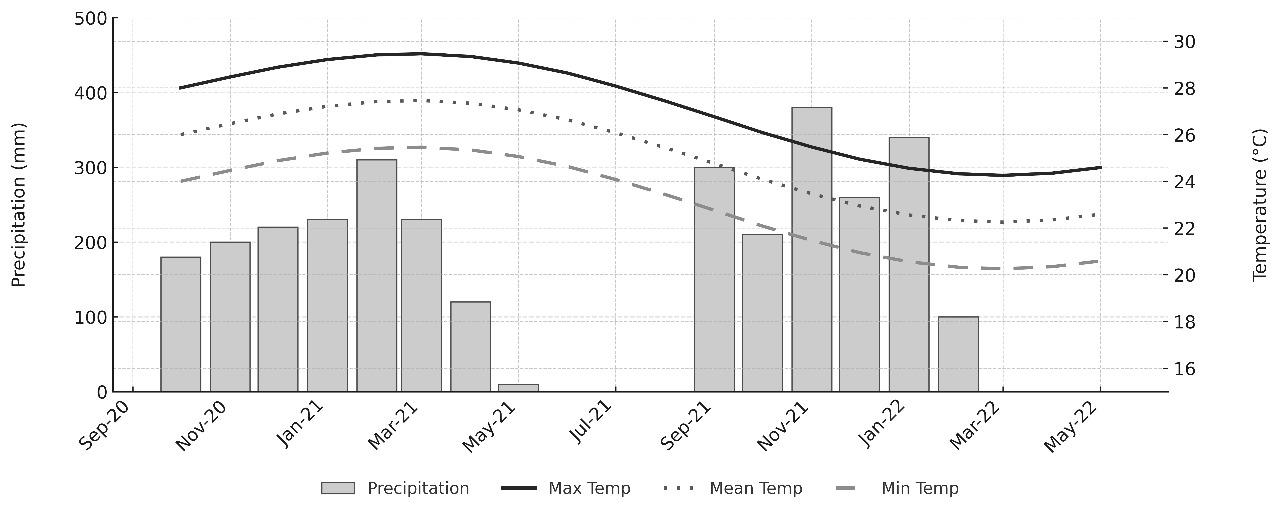
Figure 2. Mean, minimum, and maximum temperatures and precipitation during the experimental period (November 2020 to May 2022). São Luís de Montes Belos, Goiás, Brazil.
Soil samples were collected for chemical and particle characterization before the implementation of the experiment. Fifteen samples were collected from the 0-0.20 m layer, combined into a composite sample, and analyzed in the laboratory following the methodology described by EMBRAPA (2017). The soil was classified as a eutric Typic Hapludox (Latossolo Vermelho Eutrófico; Santos et al., 2018), with a clayey texture (510, 100, and 390 g kg-1 of sand, silt, and clay, respectively). Soil chemical analysis revealed the following results: pH 5.0 (CaCl2); 23 g kg-1 organic matter; 1.0 mg dm-3 phosphorus (Mehlich-1); 3.1 cmolc dm-3 potential acidity (H+Al); 0.14 cmolc dm-3 potassium (K); 2.70 cmolc dm-3 calcium (Ca); 0.70 cmolc dm-3 magnesium (Mg); 6.60 cmolc dm-3 cation exchange capacity; and 54% base saturation.
A randomized block design was used, comprising eight treatments with four replications, resulting in 32 experimental plots. Treatments consisted of inoculation strategies with microorganisms and nitrogen fertilization as follows: control (no inoculation, no N); 100% of the recommended N rate for the crop; 80% of the recommended N rate; Azospirillum brasilense + 80% N; Pseudomonas fluorescens + 80% N; Bacillus subtilis + 80% N; A. brasilense + P. fluorescens + 80% N; and A. brasilense + B. subtilis + 80% N. Each experimental plot measured 2.5 m in length and 2.5 m in width, with a total area of 6.25 m2.
The crop used was the pearl millet × napier grass hybrid, derived from the cross between Pennisetum glaucum and P. purpureum (Schumach.). The experimental area was prepared conventionally with one plowing and two harrowing operations, followed by liming with 1.3 Mg ha-1 of dolomitic limestone applied on October 11, 2020, to achieve a base saturation of 70%.
On November 29, 2020, seeds were inoculated according to the respective treatments, using 200 mL of each inoculant per kilogram of seed, followed by manual sowing at a rate of 40 seeds per linear meter in furrows 0.01 to 0.03 m deep, with 0.40 m spacing between furrows.
At sowing, basal fertilization was applied based on soil analysis and crop requirements, consisting of 140 kg ha-1 of P₂O₅ and 60 kg ha-1 of K₂O (Sousa and Lobato, 2004). Weeds were controlled by applying the selective herbicide 2,4-D at the manufacturer’s recommended rate of 2 L ha-1, 60 days after millet sowing, using a 20 L backpack sprayer.
A uniform cut was performed at 0.30 m above the soil surface after the establishment of the forage crop, followed by nitrogen topdressing application. The nitrogen rates applied were 0, 80, and 100 kg ha-1, corresponding to 0%, 80%, and 100% of the recommended rate, with urea as the nitrogen source. In the second production cycle, at the onset of the rainy season in October 2021, when plants exhibited 40% to 50% ground cover, microorganisms were reapplied using a 20 L backpack sprayer at a rate of 300 mL ha-1.
Evaluations of the pearl millet × napier grass hybrid were conducted on April 13, 2021, for the first cycle, and on November 15, 2021, January 9, 2022, February 13, 2022, and March 16, 2022, for the second cycle. The following parameters were measured in all cycles and evaluations: plant height (cm), tiller density (tiller m-2), leaf-to-stem ratio, forage dry matter yield (kg ha-1), and relative leaf chlorophyll index.
Plant height was measured in each plot using a ruler at five distinct points, from the soil surface to the curvature of the uppermost fully expanded leaf blade. Tiller density was determined by counting tillers at three random points within each experimental unit using a square frame (0.25 × 0.25 m).
Leaf-to-stem ratio was determined as follows: 10 tillers were randomly collected, and leaves and stems were separated, placed in paper bags, and dried in a forced-air circulation oven at 65 °C until constant weight. After drying, weights were measured, and the leaf-to-stem ratio was calculated by dividing leaf weight by stem weight.
Forage dry matter yield was measured using a 1 × 1 m metal frame, randomly placed in the center of each plot. All forage within the frame was cut at a height of 0.30 m above the soil surface and weighed. Subsequently, a 300 g subsample was dried in a forced-air circulation oven at 65 °C until constant weight to determine dry matter content.
Relative leaf chlorophyll index was measured using a chlorophyll meter before each forage harvest, on the middle third of two fully expanded leaves from the apex of each plant, in 20 plants per plot.
Data were analyzed using Tukey's test at a 5% significance level, with statistical analyses performed using Sisvar software (Ferreira, 2014).
Conclusions
Inoculation of the pearl millet × napier grass hybrid (Pennisetum glaucum × P. purpureum) with Azospirillum brasilense, Pseudomonas fluorescens, and Bacillus subtilis improved productivity under reduced nitrogen fertilization.
Although plant height and chlorophyll index showed no consistent variation, P. fluorescens combined with 80% of the recommended nitrogen (N) rate achieved the highest cumulative forage dry matter yield (10,086 kg ha-1), surpassing even the 100% N rate without inoculation (7,816 kg ha-1), representing a 29% increase with a 20% reduction in N fertilization.
Tiller density varied by harvest, with the B. subtilis + 80% N treatment exhibiting the highest means, suggesting that tillering responses are harvest-specific.
Co-inoculation did not provide additional forage dry matter yield increases in the pearl millet × napier grass hybrid.
Thus, the most effective strategy under the tested conditions was inoculation with P. fluorescens combined with 80% of the recommended nitrogen rate.
Acknowledgments
The authors thank the State University of Goiás for financial support through the Institutional Platform for Research and Innovation in Bioinputs and the Pro-Programa. Financial resources were provided by Pro-Programas—Call for Proposals 01/2024, SEI case no. 202400020009497.
Authors' contributions:
A.F. Magalhães: project administration, supervision, conceptualization, methodology, writing – review and editing. D.D. Dijkstra: formal analysis, investigation, writing – review and editing. C. Backes: methodology, investigation, validation, writing – review. A.J.M. Santos: formal analysis, software, validation, data visualization. P.C. Silva: investigation, data collection, writing – review. D.C. Baião: methodology, investigation, statistical analysis, validation. A.G. Teodoro: investigation, data collection, data curation. P.B. Fernandes: investigation, writing – review and editing. A.A. Ribon: supervision, resources, project administration. H.A. dos Santos: methodology, investigation, validation. P.V.D.X. de Freitas: conceptualization, writing – original draft, and final revision of the manuscript.
References
Alvares CA, Stape JL, Sentelhas PC, Gonçalves JLM, Sparovek G (2014) Köppen’s climate classification map for Brazil. Meteorol. Z. 22(6): 711–728. 10.1127/0941-2948/2013/0507
Cruz RS, Santos AC, Aastro JGD, Alexandrino E, Caraça DC, Diniz JC (2010) Produtividade do capim-cameroon estabelecida em duas classes de solos e submetido a doses crescentes de nitrogênio no norte tocantinense. Acta Sci., Anim. Sci. 32(4), 393-399. 10.4025/actascianimsci.v32i4.6209
Ebrahim H, Negussie F, Animut G (2020) Effects of nitrogen fertilizer rate and cutting height on morphological characteristcs and yield of elephant grass (Pennisetum purpureum L.). East Afr. J. Sci. 14(2): 141-150.
EMBRAPA (2017) Manual de métodos de análise de solo. 3ª ed. Revisada e ampliada). Embrapa, Brasília, DF, Brasil. https://www.infoteca.cnptia.embrapa.br/handle/doc/1085209
Espíndola NL, de Siqueira Tavares BM, Santos JMG, Barbosa VMS, Santos IB, Oliveira JTC (2024) Inoculation of plant growth-promoting bacteria on Pennisetum purpureum Schumach cultivar BRS Capiaçu. Rev Bras Cienc Ambie. 59: e1916-e1916. https://doi.org/10.5327/Z2176-94781916
Ferreira DF (2014) Sisvar: A Guide for its Bootstrap procedures in multiple comparisons. Ciênc. agrotec. 38(2): 109-112. https://doi.org/10.1590/S1413-70542014000200001
Guimarães GS, Rondina ABL, Santos MS, Nogueira MA, Hungria M (2022) Pointing out opportunities to increase grassland pastures productivity via microbial inoculants: Attending the society’s demands for meat production with sustainability. Agronomy, 12(8): 1748. https://doi.org/10.3390/agronomy12081748
Gupta A (2017) Coinoculation of Azospirillum with PGPR for plant growth promotion. IJRASET. 5(6): 833–836. 10.22214/ijraset.2017.8053
Haran MS, Ghofran GAAA, Al-Azzawi S (2022) Response of the millet plant Pennisetum americanum L. to inoculation with Azospirillum brasilense. Ann. For. Res. 65(1): 8405-8414.
Hungria M, Rondina ABL, Nunes ALP, Araujo RS, Nogueira MA (2021) Seed and leaf-spray inoculation of PGPR in brachiarias (Urochloa spp.) as an economic and environmental opportunity to improve plant growth, forage yield and nutrient status. Plant Soil. 463: 171-186. https://doi.org/10.1007/s11104-021-04908-x
Kaur R, Goyal M, Tiwana US (2017) Yield and quality attributes with seasonal variation in napier bajra hybrid (Pennisetum purpureum x Pennisetum glaucum) under diferente nitrogen environments. J. Appl. Nat. Sci. 9(3), 1350-1357. https://doi.org/10.31018/jans.v9i3.1365
Kumar A, Gupta A, Aggarwall A, Bhargav V (2020) Efficacy of bioinoculants on biomass, nutritional status and yield of lemon grass, Cymbopogon citratus (DC.) STAPF. JOSAC. 29(1): 59-66. https://doi.org/10.25081/josac.2020.v29.i1.6004
Leite RC, Santos AC, Santos JGD, Leite RC, Oliveira LBT, Hungria M (2019) Mitigation of mombasa grass (Megatyrsus maximus) dependence on nitrogen fertilization as a function of inoculation with Azospirilum brasilense. RBCS. 43: e0180234. https://doi.org/10.1590/18069657rbcs20180234
Mahapatra S, Yadav R, Ramakrishna W (2022) Bacillus subtilis impact on plant growth, soil health and environment: Dr. Jekyll and Mr. Hyde. J. Appl. Microbio. 132(4): 2748–2764. https://doi.org/10.1111/jam.15480
Patel PR, Patel BJ, Vyas KG, Yadav BL (2014) Effect of integrated nitrogen management and bio-fertilizer in kharif pearl millet (Pennisetum glaucum L.). ARJCI. 2014, 5(2), 122-125. 10.15740/HAS/ARJCI/5.2/122-125
Raghavan R, Vidya P, Balakumaran MD, Ramya GK, Nithya K (2024) Plant Growth-Promoting Bacteria: A Catalyst for Advancing Horticulture Applications. Biosci. Biotechnol. Res. Asia. 21(3): 947-966. http://dx.doi.org/10.13005/bbra/3276
Rodrigues DA, Meireles J, Melo JD, Oliveira Júnior OB (2022) Desenvolvimento da forrageira Pennisetum purpureum (SCHUMACH) cv. BRS kurumi sobre a aplicação Azospirillum brasiliense (N), Bacillus subtilis (P). Res. Soc. Dev. 11(9), e7111931551. http://dx.doi.org/10.33448/rsd-v11i9.31551
Sá GCR, Carvalho CML, Moreira A, Hungria M, Nogueira MA, Heinrichs R, Soares Filho, CV (2019) Biomass yield, nitrogen acumulation and nutritive value of mavuno grass inoculated with plant growth-promoting bacteria. Commun Soil Sci Plant Anal. 50(15): 1931-1942. https://doi.org/10.1080/00103624.2019.1648498
Sampaio AR, Teixeira-Filho MCM, Oliveira CES, Jalal A, Boleta EHM, Lima BH, Rosa PAL, Galindo FS, Souza JS (2021) Nitrogen supply associated with rhizobacteria in the first productive cycle of Marandu grass. J. Crop Sci. Biotechnol. 2021: 1-11. https://doi.org/10.1007/s12892-021-00091-8
Santos COD, Pinto ADS, Silva JRD, Parente LL, Mesquita VV, Santos MPD, Ferreira LG (2022) Monitoring of carbon stocks in Pastures in the Savannas of Brazil through ecosystem modeling on a regional scale. Land. 12(1): 60. https://doi.org/10.3390/land12010060
Santos HG, Jacomine PKT, Anjos LHC, Oliveira, VA, Lumbreas JF, Coelho MR, Almeida JA, Araújo-Filho JC, Oliveira JB, Cunha TJF (2018) Sistema Brasileiro de Classificação de Solos. 5. ed., rev. e ampl. Embrapa, Brasília, DF, Brasil. https://www.agroapi.cnptia.embrapa.br/portal/assets/docs/SiBCS-2018-ISBN-9788570358004.pdf
Schüler J, Bustamante MM (2022) Spatial planning for restoration in Cerrado: Balancing the trade‐offs between conservation and agriculture. J. Appl. Ecol. 59(10): 2616-2626. https://doi.org/10.1111/1365-2664.14262
Sousa DMG, Lobato E (2004) Cerrado: correção do solo e adubação. 2 ed. Embrapa Informação Tecnológica; Planaltina, DF, Brasil. 416p. https://www.infoteca.cnptia.embrapa.br/infoteca/handle/doc/555355
Suarna IW, Suryani NN, Lindawati SA, Duarsa MAP (2023) Increasing Forage Yields through Application of Plant Growth Promoting Rhizobacteria (PGPR). Int. J. Agric. Sci. 2(12): 505-513.
Aarti, Sujata, Parmar S, Kumar A (2024) Plant Growth Promoting Rhizobacteria as a sustainable solution for modern Agriculture. J. Sci. Innov. Nat. Earth. 4(2): 40-46. https://doi.org/10.59436/Jsianev4i2/270
Sullins KN, Dillard SL, Held DW, Carroll EP (2023) Utility of plant growth-promoting Rhizobacteria for sustainable production of Bermudagrass forage. Microorganisms, 11(4): 863, 2023. https://doi.org/10.3390/microorganisms11040863
Torres-Cuesta D, Mora-Motta D, Chavaro-Bermeo JP, Olaya-Montes A, Vargas-Garcia C, Bonilla R, Estrada-Bonilla G (2023) Phosphate-solubilizing bacterea with low-solubility fertilizer improve soil p availability and yield of kikuyu grass. Microorganisms, 11(7): 1748. https://doi.org/10.3390/microorganisms11071748