Australian Journal of Crop Science
Article | https://doi.org/10.21475/ajcs.26.20.08.pne171
Submitted: 05 November 2025 | Revised: 16 July 2026 | Accepted: 23 July 2026
Pages 656-661
Effect of different concentrations of indole-3-butyric acid on rooting and development of Piper nigrum L.
Basílio Cerri Neto1, Vinicius de Souza Oliveira1,2,*, Fernando Gomes Hoste¹, Janyne Soares Braga Pires3, Ana Júlia Câmara Jeveaux-Machado1, Pietra de Souza Rodrigues3, Thayanne Rangel Ferreira1, Jeane Crasque1, Johnatan Jair de Paula Marchiori2, Simone Alves Fernandes3,4, Antelmo Ralph Falqueto3, Edilson Romais Schmildt3, Carla da Silva Dias2, Lúcio de Oliveira Arantes2, Enilton Nascimento de Santana, Sara Dousseau-Arantes1,2,3,*
1Federal University of Espírito Santo- Center for Human and Natural Sciences, Vitória, Espírito Santo, Brazil
2Capixaba Institute of Research, Technical Assistance and Rural Extension, Linhares, ES, Brazil
3Federal University of Espírito Santo, North University Center of Espírito Santo, São Mateus, ES -Brazil
4Homeoplant LTDA., Pinheiros, ES-Brazil
*Corresponding author: souzaoliveiravini@gmail.com; saradousseau@gmail.com
Abstract: This study aimed to investigate the effects of different doses of indole-3-butyric acid (IBA) on the formation of Piper nigrum cultivar Kottanadan seedlings in relation to photosynthesis, anatomy, and dry mass accumulation. Cuttings used as propagation material were collected from mother plants approximately three years old. The treatments consisted of applying different doses of IBA: 0, 500, 1000, 1500, and 2000 mg L⁻¹. After immersion in IBA, the cuttings were planted in 280 cm³ tubes for 90 days. The experimental design was a randomized complete block design with four replications, five plants per plot, totaling 100 plants. At the end of the experiment, analyses of chlorophyll 'a' fluorescence, shoot dry mass, root system dry mass, and leaf, stem, and root anatomy were performed. After being subjected to different concentrations of IBA, the plants remained photosynthetically active, as evidenced by the characteristic polyphasic increase in OJIP curves. Higher initial fluorescence (Fo) was observed in plants subjected to concentrations of 1500 and 2000 mg L⁻¹. There was an increase in the k band (ΔVOJ), with a positive amplitude in plants subjected to concentrations of 1500 and 2000 mg L⁻¹. Regarding the L band (ΔVOk), there was an increase and a positive amplitude in plants subjected to 1000, 1500, and 2000 mg L⁻¹. Furthermore, the anatomical structures showed differences in relation to the different IBA concentrations to which the plants were subjected. Regarding dry mass accumulation, a greater dry mass was observed in the leaves of plants subjected to 1500 mg L⁻¹, with no difference between the others. For stem mass, there was no significant difference between the concentrations. However, root dry mass was higher at concentrations of 1500 and 2000 mg L-1. Therefore, exogenous application of IBA promoted improvements in photosynthesis, conducting tissue, and dry mass accumulation; however, these improvements are observed only at mild concentrations. Concentrations of 1500 and 2000 mg L-1 caused damage to the photosynthetic apparatus due to impaired electron transport. Thus, the use of 1000 mg L-1 of IBA is recommended, as this concentration was beneficial for growth parameters, anatomy, and did not harm the photosynthetic apparatus.
Keywords: anatomy; ‘chlorophyll “a” fluorescence; dry mass; ‘Kottanadan’.
Abbreviations: DXVL_diameter of leaf xylem vessels; DXVR_diameter of xylem vessels in the root; DXVS_diameter of stem xylem vessels; IBA_ indole-3-butyric acid; IAA_ indole acetic acid; LDM_leaves dry mass; LXL_Leaf xylem length; RXL_root xylem length; SXL_stem xylem length; NXVR_number of xylem vessels in the root; NXVL_number of leaf xylem vessels; NXVS_number of stem xylem vessels; RDM_ root dry mass; SDM_stem dry mass
Introduction
Piper nigrum L. is internationally known as black pepper. This species stands out within the Piperaceae genus and family as it is an important spice commercialized worldwide as a condiment (George et al., 2017). In addition to its importance for agriculture, black pepper plays a fundamental role in the production of drugs, being used against pathogens such as bacteria, viruses, and fungi (Ahmad et al., 2012). Among the countries that stand out in the production of crops such as Vietnam, India, and Indonesia, in 2019, Brazil ranked second place in world production, behind Vietnam, and surpassed the production of other countries (FAO, 2021).
The propagation of P. nigrum occurs mainly asexually through parent plants, these plants must be vigorous and free from signs of disease and the nutritional deficiency (Ambrozim et al., 2017). Vegetative propagation is one of the most used techniques for seedling production, due to the ease and speed of seedlings reaching commercial standards. However, some species have rooting problems, such as slow rooting, this delay in the development of the root system is a problem in the propagation of P. nigrum cultivars to nurseries and farmers (de Souza et al., 2020). Therefore, the need to seek agronomic protocols aimed at improving both the growth and quality of plants is of great interest in the cultivation of P. nigrum.
The induction of the root system is caused by indole acetic acid (IAA) (Albertino, 2011). Thus, the use of phytoregulators is shown as an alternative to assist in the morphological and physiological processes of plants. Among these, indole-3-butyric acid (IBA) is a growth regulator that stands out as the main synthetic auxin in seedling propagation because of its high effectiveness in stimulating rooting (Oliveira et al., 2020). Thus, a vigorous and well-developed root system during the early phenological stages can exploit the soil volume, and ensure the stability of photosynthetic activity and seedling mass gain (Lucini et al., 2018).
Considering that the application of the ideal IBA concentration in the cuttings benefits the root growth, forming quality seedlings in a shorter time (Lone et al., 2010) and that the use of inadequate concentrations drastically impairs the quality of the seedling, the objective of this work was to investigate the effects of different doses of IBA on the formation of seedlings of P. nigrum of the cultivar Kottanadan concerning photosynthesis, anatomy, and dry mass accumulation.
Results
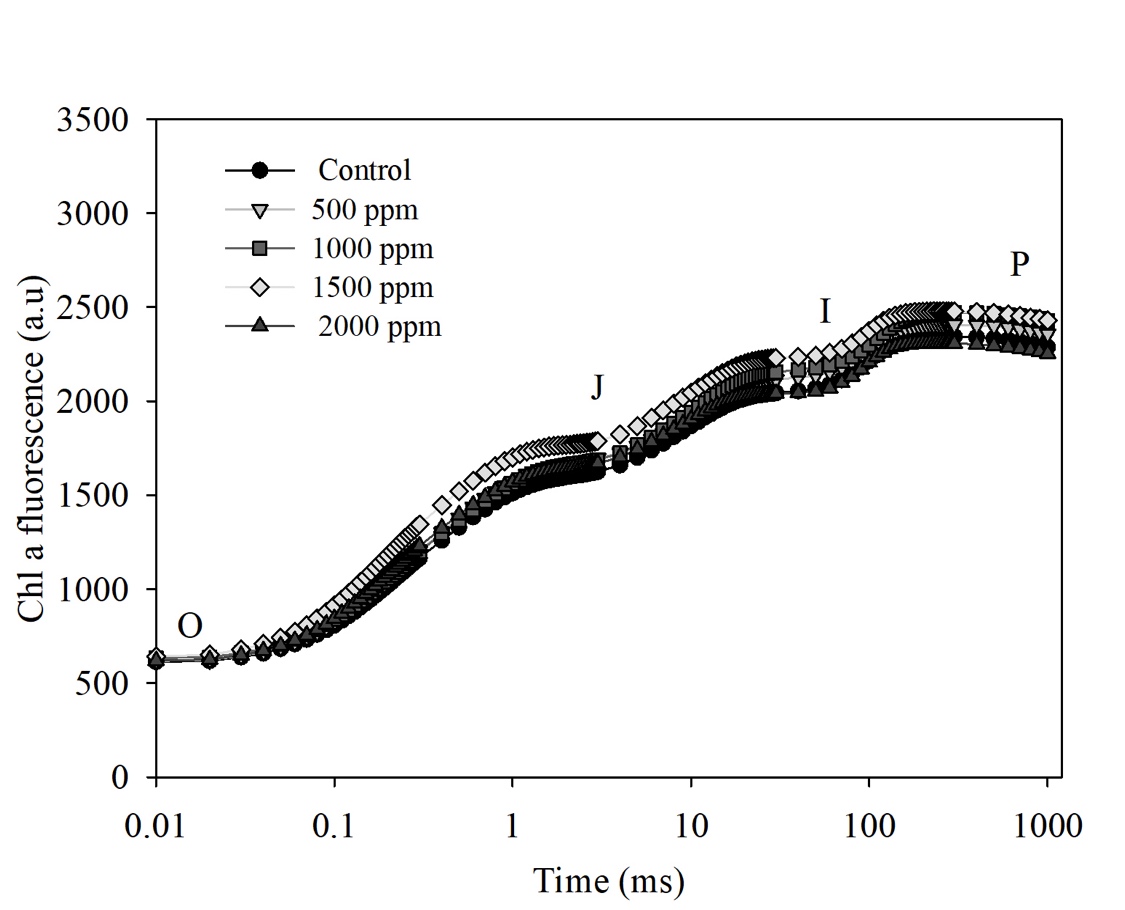
After receiving different concentrations of IBA, the plants remained photosynthetically active, considering that they presented the OJIP curves with a typical polyphasic increase (Figure 1). A higher initial fluorescence (Fo) was observed in plants that received concentrations of 1500 and 2000 mg L-1.
An increase was observed in the K band (ΔVOJ), with a positive amplitude in plants that received concentrations of 1500 and 2000 mg L-1, pointing to greater inactivity of the oxygen evolution complex (Figure 2). As for the L band (ΔVOk), an increase and a positive amplitude were found in plants that received doses of 1000, 1500, and 2000 mg L-1, showing lower connectivity of the PSII components (Figure 3).
The anatomical structures showed differences regarding the different IBA concentrations that the plants received (Table 1). As for leaf xylem length (LXL), an increase was observed at concentrations of 1000 and 1500 mg L-1, with no significant difference between them. The number of xylem vessels in the leaf was higher at the concentration of 1500 mg L-1. No significant difference was found in the other concentrations.
The xylem length (SXL) and the number of xylem vessels (NXVL) in the stem were higher at the concentration of 500 mg L-1, with no statistical difference between the other concentrations. However, the diameter of the stem xylem vessels (DXVS) was higher at the concentration of 2000 mg L-1 (Table 1).
Also, for the length of the root xylem (RXL), an increment in the concentration of 1000 mg L-1 was observed, followed by 1500 and 2000 mg L-1, with no difference between the latter. However, the number of xylem vessels (NXVR) and the diameter of xylem vessels in the root (DXVR) were increased at concentrations of 1000 and 1500 mg L-1. No difference was observed between them (Table 1).
As for the dry mass accumulation (Table 2), a higher dry mass was observed in the leaves of plants that received 1500 mg L-1, with no difference between the others. For stem mass, no significant difference was observed between concentrations. However, root dry mass was higher at concentrations of 1500 and 2000 mg L-1 (Table 2).
Figure 1. Polyphase curve of chlorophyll ‘a’ fluorescence emission in Piper nigrum plants under different IBA concentrations.
Table 1. Anatomical variables in Piper nigrum plants that received different IBA concentrations. Leaf xylem length (LXL), number of leaf xylem vessels (NXVL), diameter of leaf xylem vessels (DXVL), stem xylem length (SXL), number of stem xylem vessels (NXVS), diameter of stem xylem vessels (DXVS), root xylem length (RXL), number of xylem vessels in the root (NXVR), diameter of xylem vessels in the root (DXVR).
| Treatment | LXL | NXVL | DXVL | SXL | NXVS | DXVS | RXL | NXVR | DXVR |
|---|---|---|---|---|---|---|---|---|---|
| 0 | 95.13 b | 14.6 c | 15.53 a | 126.40 c | 10.60 b | 32.33 c | 97.86 c | 9.66 b | 35.46 b |
| 500 | 85.00 b | 16.86 c | 14.13 a | 188.53 a | 36.26 a | 35.53 b | 78.13 c | 9.80 b | 33.26 b |
| 1000 | 137.86 a | 31.13 b | 15.00 a | 116.00 c | 11.73 b | 31.73 c | 192.13 a | 12.13 a | 40.26 a |
| 1500 | 137.40 a | 34.00 a | 15.00 a | 127.46 c | 10.93 b | 32.80 c | 166.60 b | 11.98 a | 41.40 a |
| 2000 | 83.53 b | 16.53 c | 11.26 b | 147.13 b | 11.80 b | 39.26 a | 153.73 b | 9.40 b | 34.73 b |
Means followed by the same letter in the column are not different from each other by the test of Scott-Knott at 5% probability.
Table 2. Characterization of dry mass accumulation parameters in Piper nigrum plants that received different IBA concentrations. Leaves dry mass (LDM), stem dry mass (SDM), and root dry mass (RDM).
| Treatment | LDM | SDM | RDM |
|---|---|---|---|
| 0 | 2.77 b | 2.30 a | 0.55 b |
| 500 | 2.89 b | 2.29 a | 0.58 b |
| 1000 | 2.56 b | 2.10 a | 0.57 b |
| 1500 | 3.25 a | 2.55 a | 0.71 a |
| 2000 | 2.78 b | 2.13 a | 0.66 a |
Means followed by the same letter in the column are not different from each other by the test of Scott-Knott at 5% probability.
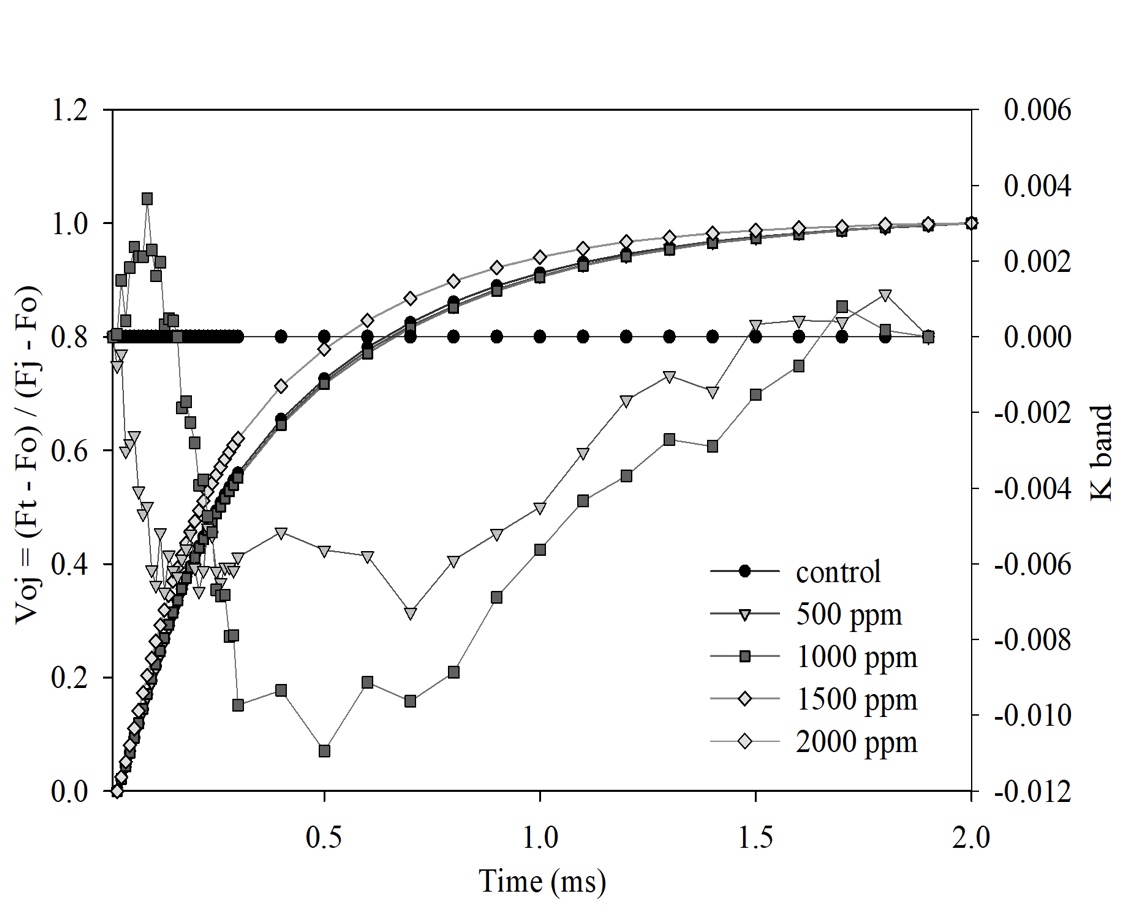
Figure 2. Normalization between phase O (obtained at 20 μs) and phase J (2 ms), as VOJ kinetics = (Ft-FO) / (FJ-FO); K-band variation (0.3 ms) or ΔVOJ established between 0 and 2 ms from the double normalization ΔVOJ = [VOJ (control) – VOJ (treatment)], in Piper nigrum plants that received different IBA concentrations.
Discussion
The increase in the initial fluorescence (Fo) in plants exposed to 1500 and 2000 mg L-1 indicates that part of the reaction centers had closed. As a result, the electron transport flux between QA to QB decreases, causing a reduction in the energy capture efficiency of the PSII (Paunov et al., 2018). The electron transport flux decreases because as PSII absorbs light and does not transport electrons, it cannot accept another until it has oxidized the first one to a subsequent electron carrier (QB), (Salvatori et al., 2014).
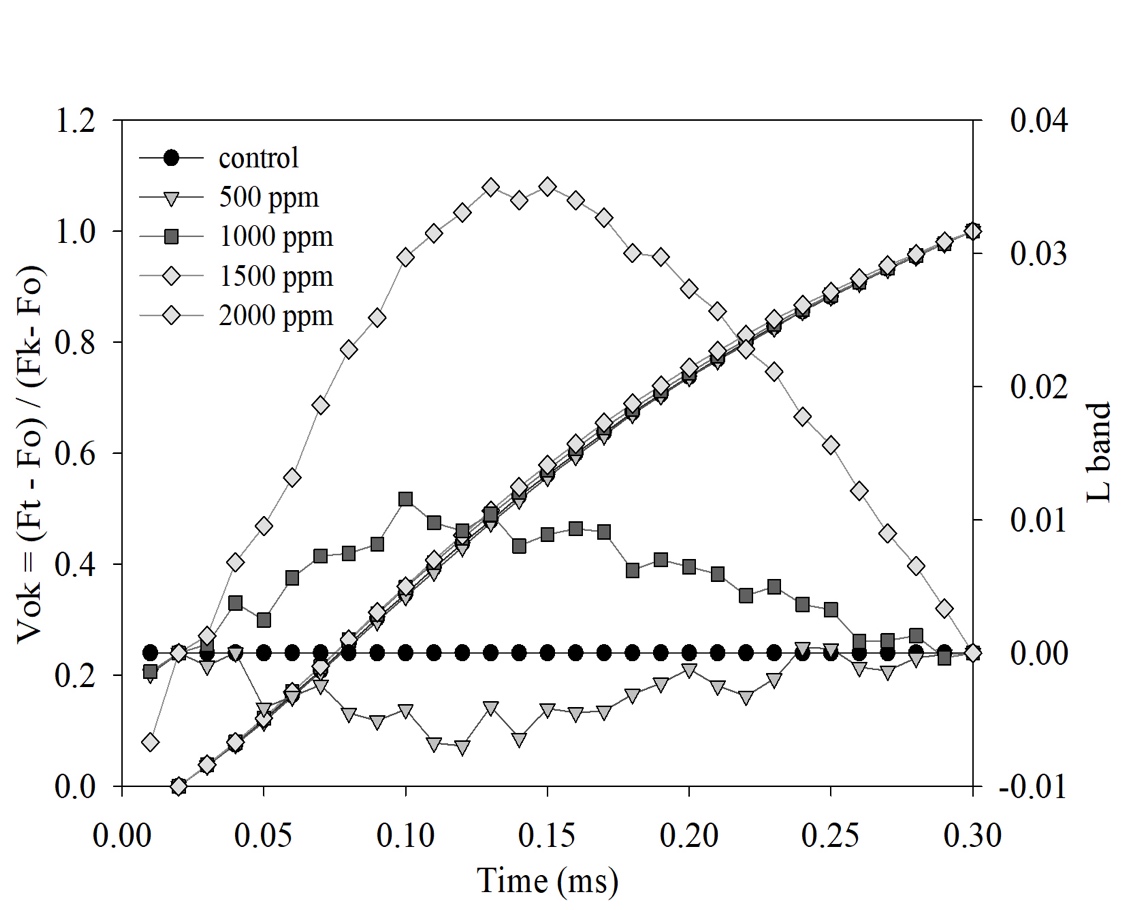
Figure 3. Normalization between O phase (20 μs or 20 ms) and K phase (300 μs or 0.3 ms) presented as VOK = (Ft-FO) / (FK-FO); Variation of the L band or ΔVOK established between 0 and 0.3 ms from the double normalization ΔVOK = [VOK (control) – VOK (treatment)], where VOK = (Ft – FO) / (FK – FO), in Piper nigrum plants subjected to different IBA concentrations.
The increase observed in the K band at concentrations of 1500 and 2000 mg L-1 shows a deficiency of the oxygen evolution complex (OEC) and coincides with the limitation of the donor side in the PSII (Gonçalves et al., 2010). This is because the transfer of electrons from the OEC to the donor side (Yz) is slower than the transfer of electrons from P680 to the QA (Tomek et al., 2001).
The increase observed in the L band at concentrations of 1000, 1500, and 2000 mg L-1 is caused by the fact that these AIB concentrations caused lower energy connectivity of the PSII components, resulting in less stability on the photosynthesis and losses in the use of excitation energy (Perboni et al., 2015). In addition, high values in the L band point to destabilization in the PSII units, and, as a consequence, less energy is exchanged between the independent PSII units (Zhang et al., 2015).
Auxin plays a central role in the formation of vascular tissue. When applied exogenously to undifferentiated tissues, it promotes the formation of vascular filaments, to the point that when auxin signaling is disturbed, vascular patterns are dramatically altered (Sharma and Zheng 2019). Channeling and accumulation of auxin are considered to be one of the first events of vascular differentiation, probably through its induction of the auxin response. Modulation of auxin levels in specific cells and tissues regulates the finality of vascular cells. For example, high levels of auxin increase the number of secondary xylem and phloem cells, while low levels of auxin reduce the number of xylem cells (Nanda and Melnyk 2017).
One factor that establishes the growth and production of a plant is its efficiency in transporting water through the xylem vessels, and the transport efficiency is linked to the size or quantity of cells in the tissue (Hsie et al., 2015).
The increase observed in xylem length (LXL), number of xylem vessels (NXVL), and diameter of xylem vessels in leaves (DXVL) at the concentrations of 1000 and 1500 mg L-1 is directly related to the increase of these same variables in the roots. This occurs so that the plant can maintain a constant flow, in addition to optimizing the efficiency of water use (Sack et al. 2015).
The functioning of the root xylem is very important as it is responsible for the absorption of water and mineral salts. However, the leaves need to have a very efficient hydraulic system, thus enabling a gain in gas exchange, as it allows the stomatal opening so that carbon assimilation takes place without the dryness of the mesophyll (Sack et al., 2015).
The exogenous application of auxin may cause hormonal changes in individuals, which may or may not be an advantage as its effect is linked to the stimulation of the growth and development of roots. Nevertheless, if the optimal value is exceeded, a toxic effect may occur (Silva et al., 2019).
The mass accumulation observed in the leaves of plants that were exposed to 1500 mg L-1 of IBA may be linked to the decline that these plants suffered in terms of photosynthesis and the stress caused by instability in electron transport. Furthermore, the accumulation of leaf mass at the concentration of 1500 mg L-1 is a reflection of the mass accumulation in the roots of plants that were exposed to the same IBA concentration. The growth and allocation of dry matter are controlled through investment in organs, seeking to minimize the effects of a limiting factor (Poorter et al., 2011). Dry mass allocation is a measure of plant performance, as it is a direct and final product of growth (Liu et al., 2016).
Material and Methods
Experiment conduction and seedling production
The experiment was conducted from September 2018 to March 2019 on the Experimental Farm of Linhares owned by Instituto Capixaba de Pesquisa, Assistência Técnica e Extensão Rural (Incaper), located at 19º25'00.1” S and 40º04'35.3” W, in the municipality of Linhares, northern Espírito Santo state.
Black pepper (Piper nigrum) cv. Kottanadan cuttings were used in the experiment due to their slow rooting process. Propagation material was collected from stock plants at approximately three years old. After collection, the cuttings were soaked in Carbomax® 500 SC fungicide solution for 15 minutes. Soon after, they were taken to the laboratory where their bases were soaked for 3 hours in indole-3-butyric acid (IBA) solution. The treatments consisted of the following application of different doses of IBA: 0; 500; 1000; 1500 and 2000 mg L-1.
After soaking in different IBA doses, the cuttings were planted in tubes with a volume of 280 cm³ filled with commercial substrate Bioplant®, with 3 g of Osmocote® (6M), irrigation through automatic micro-sprinkler for 90 days. The design used in the experiment was randomized blocks, with four replications, and five plants per plot, totaling 100 plants.
At the end of the experiment, analysis of chlorophyll “a” fluorescence, dry mass of the aerial part (DMAP), and root dry mass (RDM) in addition to the leaf, stem, and root anatomy was performed.
Chlorophyll ‘a’ fluorescence
Chlorophyll “a” fluorescence was evaluated using the Handy-PEA fluorometer (Hansatech, UK), according to the recommendations of Strasser et al. (2004). The leaves were dark adapted using leaf clips for 30 minutes, a period for complete oxidation of the photosystem. Afterward, a saturating flash of light of 3000 μmol m-2 s-1 of photons was emitted with a duration of one second. Using the OJIP transient fluorescence, the parameters established by the JIP Test were calculated. The interpretation and normalization of the parameters measured and calculated from this test followed by Strasser and Strasser (1995).
Leaf, stem, and root anatomy
For the anatomical evaluations, the plant material was collected at the end of the experiment. Fully expanded leaves were collected, the stem internode fragments were collected between the second and third node of the largest branch and the root fragments were collected 5 cm above the cap. The materials were fixed for 48 hours in 70% FAA. After this period, they were stored in 70% alcohol. Cross-sections were performed in the stem, root, and midrib of the leaves. The sections were clarified with sodium hypochlorite and stained with safrablue. After performing the sections, semi-permanent histological slides were mounted with glycerin gelatin. All sections were analyzed under a bright field microscope (Euromex). The images were captured with the aid of a micro-camera (CMEX 5) and the biometric measurements of the tissues were performed using ImageFocus 4 software from which the following variables were obtained for both leaf, stem, and root: xylem length, number of vessels, and xylem vessel diameter.
Dry biomass
At the end of the experiment, the plants were evaluated for the dry mass of the aerial part (DMAP) and root dry mass (RDM). The plants were dried in a forced air-circulation oven at 72°C until constant weight. After, the dry material was weighed on an analytical balance, and the values were expressed in grams (g).
Statistical analysis
Data were submitted for analysis of variance using the statistical program Sisvar, version 5.6, and the means were grouped using the Scott Knott test at 5% probability.
Conclusions
The exogenous IBA application promoted improvements in photosynthesis, conduction tissue, and dry mass accumulation. However, these improvements are only observed in mild concentrations. The concentrations of 1500 and 2000 mg L-1 caused damage to the photosynthetic apparatus as it affects electron transport. Thus, the use of 1000 mg L-1 of IBA is recommended as this concentration was beneficial for growth parameters, and anatomy and did not harm the photosynthetic apparatus.
Author Contributions
BCN, JJPM,SAF, PSR,TRF, and JC: experiment conduction, data analysis, and manuscript drafting. VSO, ERS and GPO: experimental design and manuscript review. CSD, JAMF, LOA and SD-A: project management and manuscript revision.
VSO and ERS: statistical analysis.
Conflict of Interest
The authors declare that there is no conflict of interest.
References
Ahmad N, Fazal H, Abbasi BH, Farooq S, Ali M, Khan MA (2012) Biological role of Piper nigrum L.(Black pepper): A review. Asian Pacific Journal of Tropical Biomedicine. 2: S1945-S1953. DOI: 10.1016/S2221-1691(12)60524-3
Albertino SMF (2011) Adubação, níveis crescentes de irradiância nas plantas matrizes e uso do AIB nas estacas para o enraizamento de cultivares de guaranazeiro (Paullinia cupana, var. sorbilis, (Mart.) Ducke). Embrapa Amazônia Ocidental-Tese/dissertação (ALICE).
Ambrozim CS, Furtado JG, Valani RS, Posse RP, Varnier E, Posse SCP, Dousseau S, Arantes LO, Oliveira EC (2017) Propagação de pimenta do reino em diferentes concentrações de ácido indolbutírico. Revista Ifes Ciência. 3: 17-28. DOI: 10.36524/ric.v3i2.322
FAO. Food and Agriculture of the United Nations. (2021) StatisticalDatabases. http://www.fao.org/faostat/en/
George KJ, Malik N, Kumar IV, Krishnamurthy KS (2017). Gene expression analysis in drought tolerant and susceptible black pepper (Piper nigrum L.) in response to water deficit stress. Acta physiol. plant. 39: 104. DOI: 10.1007/s11738-017-2398-5
Gonçalves JFC, Silva CE, Guimarães DG, Bernardes RS (2010) Análise dos Transientes da Fluorescência da Clorofila a de Plantas Jovens de Carapa guianensis e de Dipteryx odorata Submetidas a Dois Ambientes de Luz. Acta Amaz. 40: 89- 98. DOI: 10.1590/S0044-59672010000100012
Hsie BS, Mendes KR, Antunes WC, Endres L, Campos MLO, Souza FC, Santos ND, Singh B, Arruda ECP, Pompelli MF (2015) Jatropha curcas L. (Euphorbiaceae) modulates stomatal traits in response to leaf-to-air vapor pressure deficit. Biomass and Bioenergy. 81: 273-281. DOI: 10.1016/j.biombioe.2015.07.014
Liu Y, Dawson W, Prati D, Haeuser E, Feng Y, Kleunen MV (2016) Does greater specific leaf area plasticity help plants to maintain a high performance when shaded?. Annals of Botany. 118: 1329-1336. DOI: 10.1093/aob/mcw180
Lone AB, Unemoto LK, Yamamoto LY, Costa L, Schnitzer JA, Sato AJ, Ricce WS, Assis AM, Roberto SR. (2010) Enraizamento de estacas de azaleia (Rhododendron simsii Planch.) no outono em AIB e diferentes substratos. Ciência Rural. 40: 1720-1725. DOI: 10.1590/S0103-84782010000800008
Lucini L, Rouphael Y, Cardarelli M, Bonini P, Baffi C, Colla G (2018) A vegetal biopolymer-based biostimulant promoted root growth in melon while triggering brassinosteroids and stress-related compounds. Frontiers in plant science. 9: 472. DOI: 10.3389/fpls.2018.00472
Nanda AK, Melnyk CW (2017). The role of plant hormones during grafting. Journal of plant research. 131: 49-58. DOI: 10.1007/s10265-017-0994-5
Oliveira VS, Souza Rodrigues P, Buffon SB, Morais AL, Arantes SD, Tognere J, Vial PS, Schmildt O, Schmildt ER (2020) Efeito da aplicação de ácido-indol-3-butírico (AIB) no crescimento e qualidade de mudas de Piper nigrum L. cv. Kottanadan propagadas vegetativamente. Revista Ifes Ciência. 6: 139-148. DOI: 10.36524/ric.v6i2.393
Paunov M, Koleva L, Vassilev A, Vangronsveld J, Goltsev V (2018) Effects of different metals on photosynthesis: cadmium and zinc affect chlorophyll fluorescence in durum wheat. International journal of molecular sciences. 19: 787. DOI: 10.3390/ijms19030787
Perboni AT, Martinazzo EG, Silva DM, Bacarin MA (2014) Baixas temperaturas sobre a fluorescência da clorofila a em plantas de diferentes híbridos de canola. Ciência Rural. 45: 215-222. DOI: 10.1590/0103-8478cr20131427
Poorter H, Niklas KJ, Reich PB, Oleksyn J, Poot P, Mommer L (2012). Biomass allocation to leaves, stems and roots: meta‐analyses of interspecific variation and environmental control. New Phytologist. 193: 30-50. DOI: 10.1111/j.1469-8137.2011.03952.x
Sack L, Scoffoni C, Johnson DM, Buckley TN, Brodribb TJ (2015) The anatomical determinants of leaf hydraulic function. In Functional and ecological xylem anatomy. Springer, Cham.
Salvatori E, Fusaro L, Gottardini E, Pollastrini M, Goltsev V, Strasser RJ, Bussotti F (2014) Plant stress analysis: Application of prompt, delayed chlorophyll fluorescence and 820 nm modulated reflectance. Insights from independent experiments. Plant physiol. and biochem. 85: 105-113. DOI: 10.1016/j.plaphy.2014.11.002
Sharma A, Zheng B (2019) Molecular responses during plant grafting and its regulation by auxins, cytokinins, and gibberellins. Biomolecules. 9: 397. DOI: 10.3390/biom9090397
Silva CP, Lacerda EG, Sanches LFJ, Queiroz JO, Marchiotti RCB (2019). Enraizamento de estacas de Jabuticabeira tratadas com ácido indolbutírico (AIB) e ácido naftaleno acético (ANA). Rev Agr Acad. 2: 122-132. DOI: 10.32406/v2n32019/122-132/agrariacad
Strasser BJ, Strasser RJ (1995). Measuring fast fluorescence transients to address environmental questions: the JIP test, P. Mathis (Ed.), Photosynthesis: From Light to Biosphere, Vol. V. In Proceedings of the Xth International Photosynthesis Congress. Montpellier, France, Kluwer Academic Publishers, Dordrecht.
Strasser RJ, Tsimilli-Michael M, Srivastava A (2004). Analysis of the chlorophyll a fluorescence transient. In Chlorophyll a fluorescence (pp. 321-362). Springer, Dordrecht.
Tomek P, Lazár D, Ilík P, Naus J (2001). Research note: On the intermediate steps between the O and P steps in chlorophyll a fluorescence rise measured at different intensities of exciting light. Functional Plant Biology. 28: 1151-1160. DOI: 10.1071/PP01065
Zhang RH, Zhang XH, Camberato JJ, Xue JQ (2015). Photosynthetic performance of maize hybrids to drought stress. Russ. J. Plant Physiol. 62: 788-796. DOI: 10.1134/S1021443715060187