Australian Journal of Crop Science
Article | https://doi.org/10.21475/ajcs.26.20.08.pne134
Submitted: 18 September 2025 | Revised: 28 May 2026 | Accepted: 29 May 2026
Pages 619-626
Cowpea cultivar 'Manteiguinha' shows increased yield under combined treatment with bioinoculants, mineral fertilizers and organic amendment
Rayane do Nascimento Souza1, Deyvielen Maria Ramos Alvez2, Rodrigo Batista Pinto2, Marcelo Laranjeira Pimentel2, Mateus Alvez de Sousa1, Ludyanne da Silva Sousa1, Túlio Silva Lara3, Adão de Pires Almada1, Ulisses Sidnei da Conceição Silva¹, Eliandra Freitas Sia1, Rogerio Rangel Rodrigues4, Gabriel Brito Costa1, Iolanda Maria Soares Reis1*
1Institute of Biodiversity and Forests, Federal University of Western Pará, Santarém, PA, Brazil
2Department of Agricultural Production Sciences, Jaboticabal, SP, Brazil
3Institute of Water Science and Technology, Federal University of Western Pará, Santarém, PA, Brazil
4Federal Institute of Education, Science and Technology of Pará (IFPA, Santarém, PA, Brazil
*Corresponding author: iolanda.reis@ufopa.edu.br
Abstract: Cowpea (Vigna unguiculata) is an important crop for food security. However, its yield is limited by low technology adoption and high production costs, mainly due to fertilization requirements. In this study, a greenhouse experiment was conducted to examine yield-enhancing strategies for cowpea cultivar 'Manteiguinha'. Seeds were sown in pots containing Yellow Latosol. Six treatments were evaluated, as follows: control, mineral fertilizer, biofertilizer, inoculation with Bradyrhizobium sp., inoculation with Bradyrhizobium sp. + mineral fertilizer, and inoculation with Bradyrhizobium sp. + biofertilizer. Plants were evaluated for plant height, stem diameter, grain number per pod, pod length, pod weight per plant, hundred grain weight, shoot dry weight, and grain yield. The results show that inoculated plants have greater height, whereas biofertilizer-treated plants exhibited increased shoot dry weight and grain number per pod. Inoculation with Bradyrhizobium sp. + mineral fertilizer treatment resulted in increased yield compared to the control (p<0.05). Correlation analysis showed positive relationships between yield and shoot dry weight and between grain number per pod and hundred grain weight. Overall, these findings indicate that combined application of organic amendments and bioinoculants is a promising strategy to enhance the yield of cowpea 'Manteiguinha', contributing to the sustainability of cowpea cropping systems.
Keywords: Biological nitrogen fixation · Organic agriculture · Symbiosis · Vigna unguiculata (L.) Walp.
Introduction
Cowpea (Vigna unguiculata (L.) Walp.) is a crucial crop for food security, particularly among economically vulnerable populations, given its rich contents of proteins (23% to 32%) and carbohydrates (50% to 60%) (Jayathilake et al., 2018; Fasolin et al., 2019). Although Brazil is a major producer of cowpea (Ferreira et al., 2022), some regions of the country have consistently reported low yields, owing to limitations in technology adoption (Sousa et al., 2022). Cowpea production is primarily carried out by family farmers (Owade et al., 2020). Although the crop is also grown on a large scale under high-yield management practices (Freire Filho 2011), there are low-yield regions where the conditions of cropping systems play a decisive role in limiting the crop's potential (Mbuma et al., 2022).
Agricultural soils require substantial levels of nitrogen (N) (Gao et al., 2022). However, the high cost of N fertilization poses a challenge (Sinha et al., 2022), especially for producers with limited financial resources (Mizik et al., 2022; Bonilla-Cedrez et al., 2021). It should also be noted that excessive use of N fertilizers generates negative environmental impacts (Martínez-Dalmau et al., 2021), such as reduced soil microbial diversity (Wang et al., 2018; Dai et al., 2018). An alternative fertilization strategy is biological N fixation, a process carried out by soil bacteria. This approach aligns with sustainable agriculture and provides considerable annual savings in soybean cultivation (Freitas et al., 2022). However, biological N fixation remains underutilized in cowpea production.
Another alternative technique to enhance crop sustainability is biofertilization (Mahapatra et al., 2022). Biofertilizers, by-products of biogas production through anaerobic fermentation of organic residues, can be applied to soil and foliarly, complementing the action of mineral fertilizers (Kumar et al., 2022). Nevertheless, fertilization with N, phosphorus, and potassium (NPK) remains a widely used practice to enhance the growth and yield of crops (Rawal et al., 2022). NPK fertilizers combine three macronutrients with key roles in plant metabolism. However, it is essential to follow technical recommendations for mineral fertilization (Yin et al., 2019) to prevent problems with over-fertilization and the consequent impacts on plants and the environment (Van et al., 2022).
In view of these observations, this study aimed to assess the effects of mineral fertilization, biofertilization, and inoculation with Bradyrhizobium sp. on the agronomic characteristics of cowpea 'Manteiguinha'.
Results
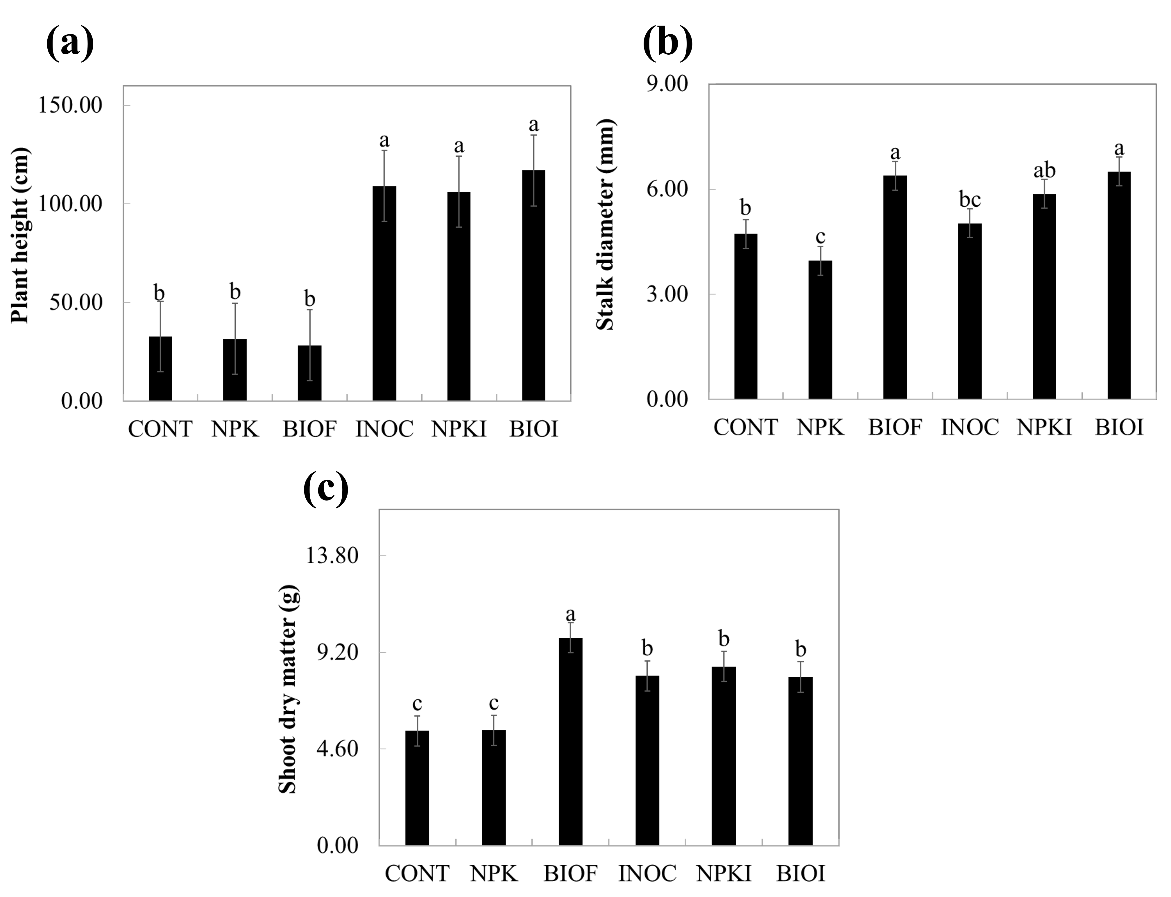
Cowpea 'Manteiguinha' plants grown under NPK or BIOF treatments did not differ in height from the control. On the other hand, INOC plants showed increased height compared with the control, as did NPKI and BIOFI plants (Fig. 1a).
The stem diameter of NPK-fertilized plants was smaller than that of the control. On the other hand, BIOF and BIOI treatments resulted in larger stem diameters compared with the control. It is noteworthy that treatments containing the inoculant, either alone (INOC) or combined with mineral fertilizer (NPKI), did not result in significant differences from plants grown without inoculant (Fig. 1b).
The shoot dry weight of BIOF plants was higher than that of the control and NPK plants. INOC, NPKI, and BIOI plants did not differ from each other, but differed from the control treatment by having higher shoot dry weight. The NPK treatment did not produce significant differences in shoot dry weight compared to the control (Fig. 2c).
Fig. 1 (a) Plant height, (b) stem diameter, and (c) shoot dry weight of cowpea 'Manteiguinha' subjected to different treatments. Treatments were as follows: control, mineral fertilizer (NPK), biofertilizer (BIOF), Bradyrhizobium sp. inoculation (INOC), Bradyrhizobium sp. inoculation + mineral fertilizer (NPKI), and Bradyrhizobium sp. inoculation + biofertilizer (BIOI). Different letters indicate significant differences between treatments by the t-test (LSD) at p < 0.05. Error bars represent the standard error of the mean.
Pod length was not influenced by treatments (Fig. 2a). BIOF plants showed a higher number of grains per pod than NPK and control groups, as did NPKI and BIOI treatments compared with the control. However, NPK and INOC groups did not exhibit a higher grain number per pod than the control (Fig. 2b).
Grain weight per plant was higher in INOC plants than in NPK and NPKI groups. INOC plants also differed from BIOI plants in this variable. The BIOF group did not differ in grain weight from the control (Fig. 2c). Thousand grain weight was higher in NPKI and INOC groups than in the control. BIOI plants differed from the control but not from INOC plants. BIOF and NPK groups did not differ from the control in thousand grain weight (Fig. 2d).
NPKI treatment improved the yield of cowpea 'Manteiguinha' compared with the control. However, the use of NPK alone did not promote a significant difference in yield in relation to the control. Similarly, INOC, BIOI, and BIOF plants exhibited higher yield than the control (Fig. 2e).
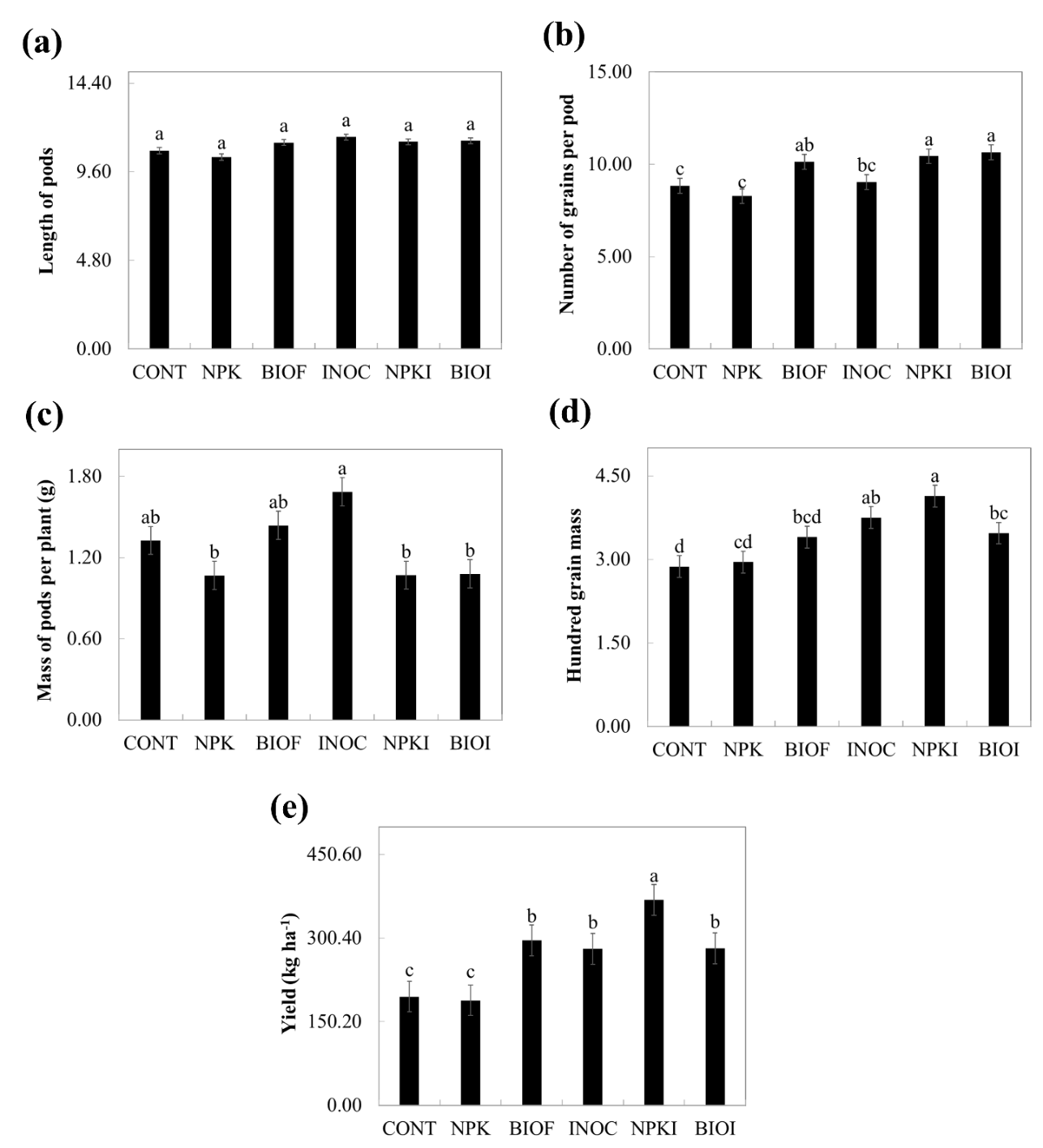
Fig. 2 (a) Pod length, (b) grains per pod, (c) grain weight per plant, (d) thousand grain weight, and (e) yield of cowpea 'Manteiguinha' subjected to different treatments. Treatments were as follows: control, mineral fertilizer (NPK), biofertilizer (BIOF), Bradyrhizobium sp. inoculation (INOC), Bradyrhizobium sp. inoculation + mineral fertilizer (NPKI), and Bradyrhizobium sp. inoculation + biofertilizer (BIOI). Different letters indicate significant differences between treatments by the t-test (LSD) at p < 0.05. Error bars represent the standard error of the mean.
Pearson's correlation analysis revealed positive relationships among variables (Fig. 3). Cowpea yield was positively correlated with stem diameter (r = 0.61, p < 0.001), dry shoot weight (r = 0.71, p < 0.001), grains per pod (r = 0.67, p < 0.001), and thousand grain weight (r = 0.83, p < 0.001). Furthermore, plant height was positively correlated with yield (r = 0.59, p < 0.001). Regarding the other variables, no strong or significant correlations were observed (p ≥ 0.05).
Discussion
Adequate plant growth has a direct impact on crop performance, influencing productivity and yield (Taiz et al., 2017). A lack of balanced fertilization can compromise the growth of cells and tissues responsible for stem elongation, resulting in smaller plants (Soure et al., 2019). Here, NPK and BIOF fertilization did not influence plant height, whereas INOC seed treatment enhanced height (Fig. 2a). The combined use of inoculant and BIOF (BIOI) led to an increase in stem diameter. The bacterium used as inoculant, Bradyrhizobium sp., can establish symbiosis with roots, forming nodules for N fixation. This association increases the availability of N to plants, ultimately resulting in enhanced growth (Zeffa et al., 2020), as evidenced by an increase in stem length and diameter.
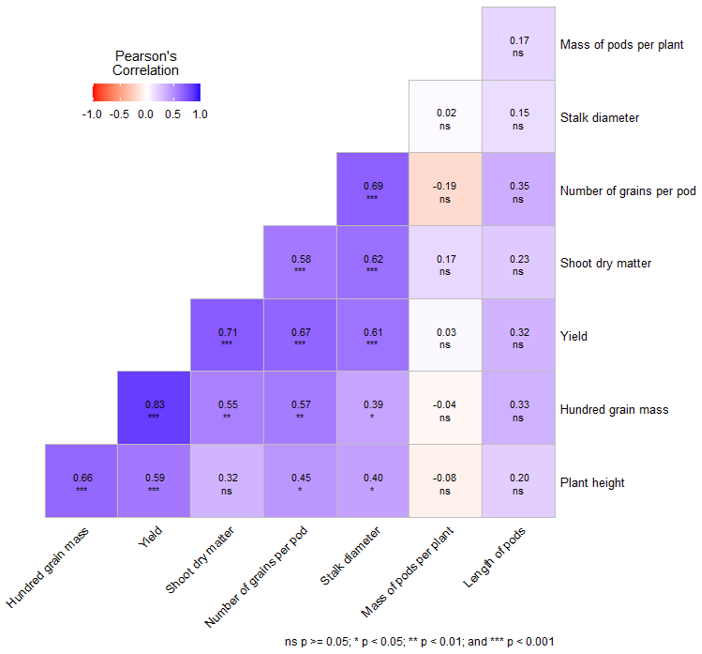
Fig. 3 Pearson correlation matrix for vegetative and productive variables of cowpea 'Manteiguinha'. Blue and red squares indicate positive and negative correlations, respectively. Lighter colors represent weaker correlations, whereas darker colors represent stronger correlations.
A plant suffering from a nutritional disorder may have a smaller diameter due to several factors, such as N deficiency. This type of deficiency reduces the rate of cell growth, resulting in a smaller stem diameter (Ciriello et al., 2014). Biofertilizers may be a source of N for plants (Ahmed et al., 2019), resulting in an increase in stem diameter (Alves et al., 2009). Similar findings were observed in common beans (Giomo et al., 2001).
Dry weight determination is fundamental in the evaluation of agricultural crop yield. This variable is used to estimate the total biomass, organic matter, crop yield, and efficiency of different cultivation systems (Poorte et al., 2019). Here, BIOF increased the dry weight of cowpea plants compared with the control, in agreement with the literature. Chagas Júnior et al., (2014), in studying the growth of inoculated cowpea, found that the N-fixing capacity of the tested rhizobia strains was important for plant biomass production and yield. Sousa et al., (2018) observed higher average height in cowpea treated with N fertilization, which did not occur in the current study.
Pod length was not influenced by treatments. This finding may be explained by heritability. This characteristic is independent of phenotypes, being mainly influenced by the genetic load (Martos-Fuentes et al., 2019). Number of grains per plant, by contrast, is highly correlated with environmental factors (Mofokeng et al., 2020). Here, plants treated with NPKI exhibited a higher number of grains than the control (Fig. 2b). The combined use of seed inoculation and NPK fertilizer probably enhanced nutrient use efficiency (Burbano-Figueroa et al., 2022), translating into a higher number of grains per plant.
Factors such as crop management techniques and growing season are determinants of the increase or decrease in pod weight (Freire-Filho et al., 2005). For example, organic cultivation may increase pod weight (Vidal et al., 2022). Treatments significantly influenced this variable, with BIOF and INOC affording a higher pod weight than the control (Fig. 2c). Biofertilizer provides nutrients that are absorbed efficiently and quickly, acting positively on plant metabolism (Mahapatra et al., 2022). Moreover, the beneficial interactions between microorganisms and plants can promote a healthy and favorable environment for crop growth and development (Shahwar et al., 2023).
A decrease in cowpea grain yield is caused by a reduction in either pod number or grain weight (Freire-Filho et al., 2005). Thousand grain weight is influenced by grain size or weight; in plants subjected to inoculation, there is an increase in N availability promoted by biological fixation. This nutrient can then be used by plants in biological processes (Gedamu et al., 2021). These effects were observed in the current study in plants treated with INOC and NPKI (Fig. 2d). Biological N fixation can reduce the crop's dependence on synthetic N fertilizers. Inadequate fertilization can have negative environmental impacts (Brito et al., 2011).
Similar findings for yield were reported by Chagas et al., (2010) in studying the agronomic efficiency of plants inoculated with rhizobia. The authors found that yield increased with combined application of fertilization and inoculation. Here, NPKI plants had a higher number of grains per pod and higher thousand grain weight, leading to an increase in yield, which did not occur in the NPK treatment.
Correlation analysis demonstrated the relationships between variables (Fig. 3). An increase in stem diameter led to an increase in grains per pod and, consequently, grain yield. This association is related to the high levels of NPK and soil bases (Ca and Mg) provided by the biofertilizer (Table 2). These findings are in agreement with those obtained by Thu et al., (2023), who observed improved yield in common bean, attributed to an increase in nutrient intake via organic fertilization. Parameters such as dry weight accumulation, grain yield, and crop productivity are strategic factors for decision making with regard to fertilization and soil management (Magalhães et al., 2019).
Material and Methods
Study site and plant material
The experiment was conducted in a greenhouse under 50% shade at the Federal University of Western Pará (UFOPA), Santarém, Pará State, Brazil, to reduce excessive solar radiation and temperature fluctuations typical of the region and to ensure uniform plant development across treatments. Seeds of the heirloom cowpea cultivar 'Manteiguinha' were used in this study.
The cowpea cultivar ‘Manteiguinha’ was selected because it is a traditional, locally cultivated landrace widely used by smallholder farmers in the western Pará region, Brazil. This cultivar is valued for its grain quality and adaptability to low-input production systems but is characterized by limited agronomic information regarding its response to fertilization strategies and biological nitrogen fixation. Therefore, ‘Manteiguinha’ represents an appropriate model to evaluate the potential of bioinoculants, organic amendments, and mineral fertilization to improve productivity under sustainable and low-cost management conditions.
Prior to sowing, seeds were disinfected by immersion in 96% alcohol for 1 min and 1% sodium hypochlorite for 3 min , followed by successive washing with autoclaved distilled water.
Seeds were planted in 5 L polyethylene pots filled with 3.5 kg of substrate. The substrate was collected from the 0–0.20 m layer of a Yellow Latosol at the UFOPA experimental farm, located at km 37 of the Santarém Curuá–Una Highway (PA370), Santarém, Pará, Brazil. Subsequently, the soil was declumped and sieved through a 2 mm mesh sieve. The air-dried fine earth fraction was used for texture and fertility analyses (Table 1). The soil added to pots was sieved through a 5 mm mesh sieve.
Table 1. Physicochemical characteristics of the soil used for cowpea production.
| pH | P | K | Ca + Mg | Ca | Mg | Al | H | CEC | Sand | Silt | Clay | |
| Water | CaCl2 | mg dm3 | .....................cmolc dm−3..................... | .....................g kg−1..................... | ||||||||
| 5.4 | 4.7 | 3.3 | 28.8 | 2.8 | 2.0 | 0.7 | 0.3 | 5.0 | 8.1 | 156.0 | 175.0 | 669.0 |
CEC, cation-exchange capacity
Experimental design and treatments
The experiment followed a completely randomized design with six treatments and six replications, totaling 36 pots. Treatments consisted of an untreated control (no fertilization or inoculation); mineral fertilization (NPK), with soil application of urea, single superphosphate, and potassium chloride; biofertilization (BIOF), with weekly soil applications of liquid biofertilizer; Bradyrhizobium sp. inoculation (INOC), performed by seed inoculation; mineral fertilization combined with Bradyrhizobium sp. inoculation (NPKI); and biofertilization combined with Bradyrhizobium sp. inoculation (BIOI).
The soil added to the pot was corrected by liming. NPK and NPKI pots were fertilized with urea as a source of N, single superphosphate as a source of phosphorus, and potassium chloride as a source of potassium. Fertilizer rates were defined according to the Fertilization and Liming Manual for Pará State (Cravo et al., 2007).
For seed inoculation, a 10% sugar solution was prepared by mixing 30 g of sugar and 300 mL of water. Then, the solution was added with 1 g of Bradyrhizobium sp. BR3262 (SEMIA 6464) per 250 seeds (Araujo; Gualter, 2017). Three seeds were planted manually in each pot, and seedlings were thinned to one per pot.
Liquid biofertilizer was obtained from a domestic composter. The chemical characteristics of the biofertilizer are described in Table 2.
Biofertilization consisted of weekly applications of 10 mL of biofertilizer diluted in 100 mL of water. The biofertilizer was applied directly to the soil. Field capacity was maintained at the desired level throughout the experimental period by watering the pots daily. Weeding was performed manually, as needed.
Table 2. Chemical characteristics of the biofertilizer produced by a domestic composter in Santarém, Pará, Brazil.
| pH | P | N | K | Ca + Mg | Ca | Mg | Al | Na | TOC | OM | ||
| Water | CaCl2 | mg dm−3 | ....................cmolc dm−3.................... | .......g kg−1....... | ||||||||
| 9.33 | 8.96 | 387.67 | 70 | 1289.00 | 3.3 | 2.4 | 0.9 | 0 | 3 | 16.82 | 28.99 | |
TOC, total organic carbon; OM, organic matter.
Assessments and data collection
Agronomic variables were measured 65 days after sowing, when the first pods were maturing, according to the stages described by Freire Filho et al., (2008). Plant height, stem diameter, and pod length were measured using a digital caliper. Grain number per pod was determined by manual counting. Pod weight per plant and hundred grain weight were determined using a precision analytical balance.
Plant shoots were collected and washed in 1% neutral detergent in distilled water, followed by a second washing with 3% hydrochloric acid in distilled water, and a third washing in autoclaved distilled water. Then, the plant material was dried to constant weight in a forced circulation oven at about 65 °C. The shoot dry weight was measured using a precision analytical balance. After grain variables were determined, it was possible to calculate the grain yield, expressed in kg ha−1.
Statistical analysis
The data were analyzed for outliers (Dixon's Q-test), normality (Shapiro–Wilk test), and homogeneity of variances (Levene's test). As the assumptions were met, the data were subjected to analysis of variance (ANOVA), followed by comparison of means using Tukey's test at the 5% significance level (p < 0.05). All statistical analyses were performed using R software version 4.1.0 (R Team, 2022).
Conclusions
Treatment of cowpea 'Manteiguinha' with biofertilizer or mineral fertilizer combined with inoculant showed promise, resulting in a greater number of grains per pod, increased grain weight per plant, and enhanced yield compared to the control. Fertilization with NPK only did not lead to significant differences from the control. Therefore, the application of organic amendments combined with inoculants is a promising approach to improving crop quality and yield, thereby contributing to sustainability and economic viability in agriculture. This research highlights several opportunities for future investigations to address existing knowledge gaps in the cultivation of cowpea, particularly the understudied 'Manteiguinha' cultivar.
Author contributions
Rayane Souza, Deyvielen Alvez and Iolanda Reis conceived the idea. Rayane Souza, Deyvielen Alvez, Rodrigo Pinto, Marcelo Pimentel, Mateus Sousa, Ludyanne Sousa, Túlio Lara, Eliandra Sia, Ulisses Silva, Rogério Rangel Gabriel Costa, Adão Almada and Iolanda Reis performed the experiments. Rayane Souza and Iolanda Reis contributed to the original draft preparation and acquired funding for the study. All authors participated in data analysis, writing review, and editing. All authors have read and approved the final version of the manuscript for publication.
Conflict of interest: The authors of this research state that they have no conflicting interests with regard to the publication of this work.
Funding
We thank FINEP Call No. 01/2022 (Grant No. 2685/22) for the scholarship support and publication fee funding, and the Pro-Rectorate of Research, Graduate Studies and Technological Innovation of the Federal University of Western Pará for funding the translation of this paper.
References
Ahmed A, El-Agyzy FH, & Shaban, A (2019) Influence of nitrogen sources and bio-fertilizer on soil nutrients, yield and quality of cowpea under saline soil conditions. Asian Soil Research Journal, 1:1-14.
Alves SV, Alves SSV, Cavalcanti MLF, Demartelaere ACF, & Teófilo TMS (2009) Desempenho produtivo do feijoeiro em função da aplicação de biofertilizante. Revista Verde de Agroecologia e Desenvolvimento Sustentável. 4: 19.
Bonilla-Cedrez C, Chamberlin J, & Hijmans RJ (2021) Fertilizer and grain prices constrain food production in sub-Saharan Africa. Nature Food. 2:766-772.
Brito MDMP, Muraoka T, & Silva ECD (2011) Contribuition of nitrogen from biological nitrogen fixation, nitrogen fertilizer and soil nitrogen on the growth of the common bean and cowpea. Bragantia. 70:206-215.
Burbano-Figueroa O, Pérez-Pazos JV, & Moreno-Moran M (2022) Assessing NPK use efficiency of commercial inoculants in cassava (Manihot esculenta Cratz): an application of data envelopment analysis. Journal of Crop Science and Biotechnology. 25:253-267.
Chagas Junior AF, Oliveira AG, Santos GR, Reis AFB, Chagas LFB (2014) Promoção de crescimento em feijão-caupi inoculado com rizóbio e tricoderma spp. no cerrado. Revista Caatinga, Mossoró. 27:190-199.
Chagas Junior AF, Rahmeier W, Fidelis RR, Santos GRD, & Chagas LFB (2010) Eficiência agronômica de estirpes de rizóbio inoculadas em feijão-caupi no Cerrado, Gurupi-TO. Revista Ciência Agronômica. 41:709-714.
Ciriello V, Guerrini IA, & Backes C (2014) Doses de nitrogênio no crescimento inicial e nutrição de plantas de guanandi. Cerne. 20:653-660.
Dai Z, Su W, Chen H, Barberán A, Zhao H, Yu M, ... & Xu J (2018) Long‐term nitrogen fertilization decreases bacterial diversity and favors the growth of Actinobacteria and Proteobacteria in agro‐ecosystems across the globe. Global change biology. 24:3452-3461.
de Araújo CL, & Gualter RMR (2017) Caracterização morfofisiológica de bactérias nativas de solos do Cerrado isoladas de nódulos de feijão-caupi. Biotemas. 30:25-35.
de Freitas VF, Cerezini P, Hungria M, & Nogueira MA (2022) Strategies to deal with drought-stress in biological nitrogen fixation in soybean. Applied Soil Ecology. 172:104352.
de Sousa MA, Avelino VS, & Reis IMS (2020) Growth of cowpea submitted to mineral fertilization and different doses of biofertilizer. Scientia Agraria Paranaensis. 19: 321-328.
de Sousa WN, Brito NF, Santos FC, Barros IB, de Sousa JTR, de Freitas Sia E, & Reis IMS (2018) Resposta do feijão-caupi à inoculação de Bradyrhizobium japonicum, adubação nitrogenada e nitrogênio do solo. Revista Agroecossistemas. 10:298-308.
Fasolin LH, Pereira RN, Pinheiro AC, Martins JT, Andrade CCP, Ramos OL, & Vicente AA (2019) Emergent food proteins–Towards sustainability, health and innovation. Food Research International. 125:108586.
Ferreira WM, Lima GR, Macedo DC, Júnior MF, & Pimentel C (2022) Cowpea: A low-cost quality protein source for food safety in marginal areas for agriculture. Saudi Journal of Biological Sciences. 29:103431.
Freire Filho FR (2005) Feijão-caupi: avanços tecnológicos. Embrapa Informação Tecnológica; Teresina, PI: Embrapa Meio-Norte.
Freire Filho FR, Cravo MDS, Vilarinho AA, Cavalcante EDS, Fernandes JB, Sagrilo E, ... & Sampaio L S (2008) BRS Novaera: cultivar de feijão-caupi de porte semi-ereto.
Freire Filho RF, Ribeiro VQ, Rocha MDM, Silva KJD, Nogueira MDR, & Rodrigues EV (2011) Feijão-caupi no Brasil: Produção, melhoramento genético e desafios. Empresa Brasileira de Pesquisa Agropecuária (EMBRAPA Meio Norte), Teresina.
Gama JRFN, Carvalho EJM, Rodrigues TE, & Valente MA (2007) Solos do estado do Pará. Recomendações de adubação e calagem para o estado do Pará. Belém, Embrapa Amazônia Oriental. 19-29.
Gao Y, Fang Z, Van Zwieten L, Bolan N, Dong D, Quin BF, ... & Chen W (2022) A critical review of biochar-based nitrogen fertilizers and their effects on crop production and the environment. Biochar. 4:36.
Gedamu SA, Tsegaye EA, & Beyene TF (2021) Effect of rhizobial inoculants on yield and yield components of faba bean (Vicia fabae L.) on vertisol of Wereillu District, South Wollo, Ethiopia. CABI Agriculture and Bioscience. 2:1-10.
Giomo GS, Razera LF, & Nakagawa J (2001) Espaçamentos para produção de sementes de guandu em semeadura tardia. Bragantia. 60:121-126.
Jayathilake C, Visvanathan R, Deen A, Bangamuwage R, Jayawardana BC, Nammi S, & Liyanage R (2018) Cowpea: an overview on its nutritional facts and health benefits. Journal of the Science of Food and Agriculture. 98:4793-4806.
Kumar S, Sindhu SS, & Kumar R (2022) Biofertilizers: An ecofriendly technology for nutrient recycling and environmental sustainability. Current Research in Microbial Sciences. 3:100094.
Magalhães ID, Lyra GB, Souza JLD, Ferraz RLDS, & Cavalcante CA (2019) Growth, production and yield of common bean under water replacement levels. Revista Brasileira de Engenharia Agrícola e Ambiental. 23:754-760.
Mahapatra DM, Satapathy KC, & Panda B (2022) Biofertilizers and nanofertilizers for sustainable agriculture: Phycoprospects and challenges. Science of the total environment. 803:149990.
Martínez-Dalmau J, Berbel J, & Ordóñez-Fernández R (2021) Nitrogen fertilization. A review of the risks associated with the inefficiency of its use and policy responses. Sustainability. 13:5625.
Martos-Fuentes M, Fernández JA, Ochoa J, Carvalho M, Carnide V, Rosa E, ... & Egea-Gilabert C (2017) Genotype by environment interactions in cowpea (Vigna unguiculata L. Walp.) grown in the Iberian Peninsula. Crop and Pasture Science. 68:924-931.
Mbuma NW, Gerrano AS, Lebaka N, & Labuschagne M (2022) Interrelationship between grain yield components and nutritional quality traits in cowpea genotypes. South African Journal of Botany. 150:34-43.
Mizik T (2023) How can precision farming work on a small scale? A systematic literature review. Precision agriculture 24:384-406.
Mofokeng MA, Mashilo J, Rantso P, & Shimelis H (2020) Genetic variation and genetic advance in cowpea based on yield and yield-related traits. Acta Agriculturae Scandinavica, Section B—Soil & Plant Science. 70:381-391.
Owade JO, Abong’ G, Okoth M, & Mwang’ombe AW (2020) A review of the contribution of cowpea leaves to food and nutrition security in East Africa. Food Science & Nutrition. 8:36-47.
Poorter H, Fiorani F, Pieruschka R, Wojciechowski T, van der Putten WH, Kleyer M, ... & Postma J (2016) Pampered inside, pestered outside? Differences and similarities between plants growing in controlled conditions and in the field. New Phytologist. 212:838-855.
Rawal N, Pande KR, Shrestha R, & Vista SP (2022) Nutrient use efficiency (NUE) of wheat (Triticum aestivum L.) as affected by NPK fertilization. Plos one. 17:e0262771.
Shahwar D, Mushtaq Z, Mushtaq H, Alqarawi AA, Park Y, Alshahrani TS, & Faizan S (2023) Role of microbial inoculants as bio fertilizers for improving crop productivity: A review. Heliyon. 9:e16134.
Sinha E, Calvin KV, Kyle PG, Hejazi MI, Waldhoff ST, Huang M, ... & Zhang X (2022) Implication of imposing fertilizer limitations on energy, agriculture, and land systems. Journal of environmental management. 305:114391.
Souri MK, & Hatamian M (2019) Aminochelates in plant nutrition: a review. Journal of plant nutrition. 42:67-78.
Sousa DJP, Nogueira GAS, Teixeira KBS, Monteiro GGTN, Brito AEA, Nascimento VR, ... & Okumura RS (2022) Mitigation of the effects of salt stress in cowpea bean through the exogenous aplication of brassinosteroid. Brazilian Journal of Biology. 82:e260818.
Taiz L, Zeiger E, Møller I M, & Murphy A (2017) Fisiologia e desenvolvimento vegetal. Artmed Editora.
Team RC (2020) RA language and environment for statistical computing, R Foundation for Statistical. Computing.
Thu TA, Hien TH, & Minh VQ (2023) Improving bush bean (Phaseolus vulgaris L.) yield and quality by increasing soil nutrients with organic fertilizer. Legume Research-An International Journal. 46:482-488.
Van Oort F, Paradelo R, Baize D, Chenu C, Delarue G, Guérin A, & Proix N (2022) Can long-term fertilization accelerate pedogenesis? Depicting soil processes boosted by annual NPK-inputs since 1928 on bare loess Luvisol (INRAE-Versailles). Geoderma. 416:115808.
Vidal VL, Assunção A, Coelho M, Sales RN, & Peixoto N (2022) Bush snap bean genotypes under conventional and organic cultivation. Revista de Agricultura Neotropical. 9:e6827-e6827.
Wang C, Liu D, & Bai E (2018) Decreasing soil microbial diversity is associated with decreasing microbial biomass under nitrogen addition. Soil Biology and Biochemistry. 120:126-133.
Yin Y, Ying H, Zheng H, Zhang Q, Xue Y, & Cui Z (2019). Estimation of NPK requirements for rice production in diverse Chinese environments under optimal fertilization rates. Agricultural and Forest Meteorology. 279:107756.
Zeffa DM, Fantin LH, Koltun A, de Oliveira AL, Nunes MP, Canteri MG, & Gonçalves LS (2020) Effects of plant growth-promoting rhizobacteria on co-inoculation with Bradyrhizobium in soybean crop: a meta-analysis of studies from 1987 to 2018. PeerJ. 8:e7905.